Pathways for global food security in a warming climate
From Afghanistan to Zimbabwe, climate shocks are exposing weak links in food systems – not just in harvests, but in access, nutrition and the ability to recover. A new Food Security Index covering 162 countries tracks who is most at risk, why, and what we can do about it.


From night markets to global supply chains, climate change is making food systems more vulnerable to the climate-driven volatility, as shown by IIED’s Food Security Index (Photo: Ritu Bharadwaj, IIED)
The consequences of climate change constitute a clear and present danger for human flourishing: they include trillions of dollars-worth of economic losses since the 1970s, concentrated in developing countries; disease spreading as disasters contaminate dwindling water supplies; and an increasingly volatile agricultural environment for farmers as the weather swings from one extreme to another.
In fact, climate change has made farms significantly less efficient than they were 60 years ago, even though they now cover more of the world’s surface than forests.
This graph shows how the disaster intensity trend, while increasing universally, has increased unevenly across different country groups, with Fragile and Conflict Affected States, Small Island Developing States and least developed countries most exposed to disasters. Hover over country groups or click on the legend to make comparisons
The Intergovernmental Panel on Climate Change (IPCC) science tells us the impacts on health, and on food and water security, are already showing. Yet the World Health Organization (WHO) has calculated that hundreds of thousands of lives could be saved every year if the worst consequences of climate change are avoided.
IIED has designed a new Food Security Index to fill gaps in the strategic toolbox available to governments and international policy experts to protect their food systems. Systems designed for assessing food security risks are key for strategic decisions about investment, incentives and taxes, but can’t provide a consistent, structural view that can be linked to forward-looking climate scenarios. At the same time, the countries where climate risks to food systems are highest are not covered comprehensively by existing composite indices.
We’ve brought together data from a range of publicly available indicators that enable the comparison of food security levels across 162 countries, with data for the four pillars of food security for each country.
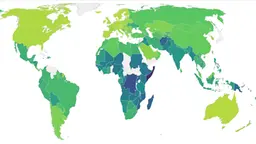
This choropleth map shows the Food Security Index score of 162 countries; the darker the colour the more insecure. Check the box, top left, for country labels and hover over countries to see exact scores, income category and region. Countries without data are grey
The four pillars of food security
Food security is comprised of four ‘pillars’, used by the UN's Food and Agriculture Organization and others. Considering each pillar is important for analysis to be truly useful because climate-driven shocks rarely affect just one aspect of a country’s food landscape, and their effects will differ by geography. These pillars are:
Unpacking all four pillars is important because climate shocks rarely affect food security through only one channel. They tend to hit several aspects of food security across these pillars at once, and the dominant constraint can differ between countries.
Ritu Bharadwaj, IIED principal researcher leading this work
Methodology
IIED’s Food Security Index includes data from more than two dozen indicators and indices produced by organisations including INFORM, the World Bank, the UN Development Programme and UN Food and Agriculture Organization, WHO and UNICEF.
Availability, access, utilisation and sustainability each have their own sub-index, which have been averaged with equal weight to produce a final score. This lets users compare countries’ food security directly.
However, the indicators within each pillar’s sub-index are weighted using a different method (a geometric mean) that prevents strong performance in one from masking weaknesses in others.
A regression analysis was then used to examine the association between food security outcomes, economic development and climate risk under the IPCC’s warming scenarios of 1.5°C, 2°C and 4°C.
This scatter chart shows the correlation between the climate change risk index and the overall Food Security Index for different country groups.
This helps explain why, in the warming scenarios, risk concentrates in the same places, which coincides with countries where climate exposure is high and institutional and economic buffers are low. In other words, higher warming does not spread food insecurity evenly. It deepens it first and most sharply in the countries already on the lower end of the climate risk and food security curve.
This scatter chart shows the correlation between the Food security Index and greenhouse gas emissions by country grouping.
It shows the countries with higher emissions cluster at higher food security levels, while many of the lowest Food Security Index scoring countries cluster at low emissions. This does not imply emissions cause higher food security; it shows the countries projected to face the largest climate-related deterioration in food security are those that have contributed least to the problem.
Main findings
The Food Security Index shows that sustainability is where the risk to a nation’s food security, resulting from climate change, appears first – even in the rich world.
The United States of America, whose overall food security score is 8.74 out of 10, provides an illustrative example. It scores extremely high for availability (9.49) but only 7.25 for sustainability, behind other G7 countries like the United Kingdom (8.43) and Germany (8.25), which have comparable overall scores.
In a world that is 2°C hotter than the pre-industrial average, US food sustainability falls by 0.52 points to 6.73, compared to a decline of 0.34 for the UK and 0.40 for Germany. This reduction is markedly greater than the fall in the USA’s aggregate score in a 2°C warming scenario (-0.44).
Overall, however, our results show a deep divide in food security between wealthy nations and poorer ones. Developed countries are relatively morefood secure, with an average score of 8.86 out of 10, while the least developed countries (LDCs) scored only 5.13 and war-torn nations just 4.29.
It’s when factoring in the predicted effects of climate change that this divide becomes a chasm and its inherent unfairness is magnified.
The LDCs have contributed very little to historic greenhouse gas emissions but are much more vulnerable to climate change than, say, the EU27. And the Food Security Index shows that as climate risk rises, food security tends to fall. Countries starting from a more fragile position have less capacity to absorb shocks before their food systems slip into crises.
Under a 2°C warming scenario food security scores are predicted to fall by a massive 11.99% in the LDCs, compared to only 3.07% in developed countries – the nations whose historic emissions have done most to cause climate change.
In the catastrophic scenario of 4°C of warming, the economic dominance and stability of the wealthiest countries limits deterioration of their food security to 6.14%, whereas LDCs could see their scores drop by 23.98% from current levels – despite having done least to cause climate change in the first place.
This choropleth map shows the Food Security Index score of 162 countries (the darker the colour the more insecure) under a 1.5°C global warming scenario. Toggle the baseline, 2°C or 4°C options to see how the country scores change under different scenarios and hover over countries to see exact scores, income category, region and the change compared to the baseline. Countries without data are grey
All that said, pure economic power doesn’t provide comprehensive protection and the rich world won’t be entirely insulated from supply chain disruption caused by climate change.
Although each US$1,000 of GDP per capita translates to a 0.2-point increase in the food security score, that boost is least visible in the sustainability pillar. This reinforces the conclusion that sustainability is the most fragile of the four pillars.
Reaction
“Climate change is rapidly becoming one of the most powerful drivers of hunger and food insecurity across the world, particularly in countries where poverty, fragility, and limited fiscal space already constrain resilience,” said Renato Domith Godinho, director of the Global Alliance Against Hunger and Poverty Support Mechanism.
“This report provides important new evidence on food security outcomes… exploring how climate impacts are likely to deepen existing inequalities in food systems, with the most severe consequences seen in the most vulnerable countries.
“Its findings align with the landmark Belem Declaration on Hunger, Poverty, and Human-Centered Climate Action.”
Recommendations
Among the first signs of food insecurity are a loss of purchasing power and poorer diets. To protect life and health, it's important that governments be able to respond at short notice when these warning signs begin to appear. IIED research shows investing in social protection schemes designed to pay out before or as soon as possible after disaster strikes can save countries billions, compared to scrambling together emergency responses afterwards.
For example, Ethiopia’s Productive Safety Net Programme helps households maintain living standards during drought, while in Bangladesh cash transfers tied to predicted flooding protects access to food, despite post-disaster price rises.
Linking early warning to early action requires governments to survey who is at risk and where, before agreeing on precisely what circumstances will trigger action, and by which of their agencies.
In some cases social protection schemes can also be used to create infrastructure that will lessen the impact of later climate shocks. India’s MGNREGS, an employment guarantee system, helps people maintain their income during crisis while directing them to work on water harvesting, soil conservation and other projects that will increase their resilience, and the future availability of food.

People queue in front of a government ration centre in India to get foodgrain. Such initiatives are a vital safety net for households facing food insecurity (Photo: Ritu Bharadwaj, IIED)
It’s not hard to see how a similar approach could be taken to secure access to food as well, such as by investing in roads that can stand up to the reality of a hotter world.
All this support costs money, but climate-related pressure on food security is greatest on countries that often have little room for manoeuvre in fiscal terms. This means that secure, predictable finance will be important, so nations can avoid taking out new loans reactively and storing up debt interest repayment problems for later.
Country case studies
Explore what the Food Security Index looks like for specific countries and what solutions might work for them:
- Food Security Index: 2.51
- Availability: 2.81 | Access: 2.78 | Utilisation: 1.72 | Sustainability: 2.85
- Ranking: 161st (out of 162)
- Population: 112.8m
The Democratic Republic of Congo is towards the very bottom of the index, where conflict and displacement turn climate and economic shocks into persistent crisis. A defining feature is how weakness is not confined to production: the sharpest constraint is the utilisation pillar (nutrition/health/water, sanitation and hygiene (WASH) outcomes), illustrating how food security deteriorates fastest when services and delivery systems are disrupted.
Country solution package
Prioritise anticipatory, shock-responsive support that reaches displaced and conflict-affected people. Protect utilisation early by bundling cash/food help with nutrition, primary healthcare and climate-resilient WASH. Strengthen last-mile delivery systems (registries, logistics, accountability) that keep working despite disruption. Use pre-arranged, trigger-based finance so action starts before crises peak.
- Food Security Index: 5.94
- Availability: 5.57 | Access: 5.73 | Utilisation: 6.44 | Sustainability: 5.98
- Ranking: 114th (out of 162)
- Population: 18.9m
One of the most food-secure countries among the least developed countries, Senegal shows how stronger basic systems can lift a nation’s food security closer to the global average. Its profile highlights the importance of protecting utilisation and sustainability as climate risk rises. By keeping nutrition, health and WASH services functioning – alongside stable markets and safety nets – Senegal can prevent climate change-induced weather shocks from cascading into rapid deterioration in food security outcomes.
Country solution package
Lock in resilience gains by linking early warning to early action, with clear triggers and protocols for delivery of early-action activities. Expand shock-responsive social protection (updated registries, rapid payments, transparent eligibility and grievance systems) to protect access to food when prices rise. Bundle support with nutrition and climate-resilient WASH continuity to prevent early utilisation decline. Secure layered, pre-arranged finance to fund early action, not just response.
- Food Security Index: 9.17
- Availability: 8.66 | Access: 9.43 | Utilisation: 9.74 | Sustainability: 8.90
- Ranking: 2nd (out of 162)
- Population: 6m
Denmark is at the top end of the index, illustrating what strong, well-funded systems deliver: high access, excellent utilisation (nutrition/health/WASH outcomes) and robust stability. Such high scores rely on systems continuing to function under stress – and climate risk will test sustainability through heat, supply-chain disruption and price transmission.
Country solution package
Protect Denmark’s high performance by stress-testing food supply chains and logistics, strengthening early warning and contingency planning for extreme weather, and safeguarding utilisation through heat-health, nutrition and WASH continuity measures. Maintain affordability buffers in case of weather or energy shocks. Pair domestic resilience with international action: emissions cuts and predictable finance that enables early action in the most exposed countries.
- Food Security Index: 8.74
- Availability: 9.49 | Access: 8.86 | Utilisation: 9.53 | Sustainability: 7.25
- Ranking: 19th (out of 162)
- Population: 347.2m
Although the US is among the highest performing countries, showing how strong infrastructure, markets and services support very high availability and utilisation, its relatively lower sustainability score highlights how climate risk can still erode stability through extreme weather, supply-chain disruption and price shocks.
Country solution package
Stress-test and climate-proof food supply chains, storage and logistics; strengthen early warning and contingency planning for heat, drought and floods; and protect accessibility through affordability buffers during weather or energy shocks. Safeguard utilisation via heat-health, nutrition and WASH continuity. Pair domestic resilience with predictable finance that enables early action in the most exposed countries the US relies on.
- Food Security Index: 6.72
- Availability: 7.84 | Access: 7.51 | Utilisation: 7.88 | Sustainability: 4.35
- Ranking: 89th (out of 162)
- Population: 212.8m
Brazil sits near the global average for food security overall, with comparatively strong availability and utilisation, but a much weaker sustainability score, showing how food insecurity under climate risk is often driven by instability and repeated shocks: if a system has thinner buffers and lower stability, it’s easier for extreme weather or market disruption to undo improvements – pushing households back into less diverse diets and worse nutrition outcomes.
Country solution package
Prioritise sustainability: link early warning to early action with clear triggers and protocols, and invest in resilience measures that reduce volatility across production, supply chains and livelihoods. Expand shock-responsive social protection to protect access to food when prices spike. Bundle support with nutrition and WASH continuity to prevent early utilisation decline. Use pre-arranged finance to fund early action.
- Food Security Index: 6.64
- Availability: 5.38 | Access: 7.14 | Utilisation: 6.79 | Sustainability: 7.40
- Ranking: 92nd (out of 162)
- Population: 0.5m
Cabo Verde is a relative success story: despite structural limits on domestic food production (lower availability), it achieves strong access and sustainability scores, showing how well-functioning services, markets and stability buffers can protect food security in an import-dependent island context. Its resilience depends on keeping food supply chains and affordability stable during global shocks.
Country solution package
Consolidate gains by stress-testing imported food supply chains (diversified sourcing, strategic stocks, port/logistics contingency plans) and linking early warning to early action for price and supply disruption. Keep accessibility strong with shock-responsive safety nets that scale quickly when costs rise. Protect utilisation through nutrition and WASH continuity. Use pre-arranged finance to act early.
To that end, and in the same way some governments deploy early-warning systems for their citizens, international climate funds need to create mechanisms that release money to governments based on pre-agreed thresholds or indicators, like the paths of cyclones or water shortages.
One key change in international disaster planning and response must be to consider nutrition, water and sanitation, and primary healthcare together with food security. According to our analysis, utilisation, which is closely linked to health, is extremely sensitive to climate risk.
Tracking and tackling food security problems ought to be done at the level of each of the four pillars, to improve targeting and value for money.
With thanks to IIED's Jon Sharman and consultant Nick Turner for their contributions to the presentation of the index online.