New study shows early investment in social protection beats aid payments after the disaster
Advance cash and resilience investments to prepare for disasters, return up to US$5 for every $1 spent, while aid payments after the disaster loses money.
Countries in Africa and Asia could prevent billions of dollars in damages linked to climate change by investing much smaller sums before disaster strikes, according to new analysis by IIED.
Researchers examined the potential cost of severe climate shocks, which are normally expected to hit once in 20 years. But these are becoming more frequent because of climate change. When they hit, losses could include livestock death, loss of employment, damage to infrastructure and medical costs, among other factors.
In total, the eight countries surveyed are expected to face US$21.4 billion in losses based on analysis of past 62 years data, equivalent to the entire annual GDP of Senegal. India alone could face over $11 billion in losses, followed by Pakistan ($6.5 billion) and Bangladesh ($2.3 billion).
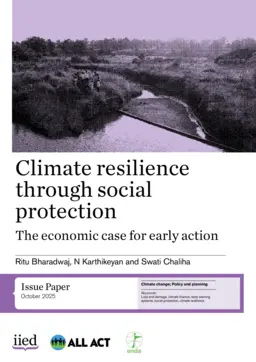
The analysis also calculated how effective existing social protection schemes or post-disaster humanitarian responses would be at mitigating these losses. On average, existing social safety nets offset just 2% of losses, while humanitarian aid might cut them to 59%.
However, early investments in resilience – making homes, infrastructure and government systems resistant to climate impacts – could reduce losses to just 27% of the expected total. Anticipatory direct benefit transfers – such as cash or food provided before a disaster hits – could also reduce losses significantly, down to 42%.
In terms of the costs and benefits of these different strategies, every $1 of early investment yields $5.17 in development gains and avoided losses. Anticipatory transfers more than double the return ($2.06 per $1). However, humanitarian response ($0.83) and existing social protection ($0.23) fall well below the break-even point.
The study also shows the ‘cost of cover’ gap. To offset $21.4 billion in expected losses, existing social protection would require $93 billion, humanitarian response $25.8 billion, anticipatory transfers $10.4 billion, and early resilience investments just $4.1 billion.
“This evidence shows governments can protect people and economies at a fraction of the cost of waiting until disaster strikes,” said Ritu Bharadwaj, lead author of the study. “The choice is simple. Invest early and save lives and money, or pay far more later when recovery is harder and families are already trapped in crisis.”
“Countries are already using this analysis to prepare proposals for the new Fund for Responding to Loss and Damage, so the evidence is shaping real investment decisions. And in an era of shrinking development aid, every dollar counts.
"This study shows that if we spend those limited resources wisely on early action, we can save lives, protect economies and avoid pouring money into inefficient systems that cost more than the disasters themselves.” said Bharadwaj, IIED's director of climate resilience, finance and loss and damage.
Notes to editors
- Read the full paper, including data breakdowns for each of the countries analysed: Bangladesh, Ethiopia, Ghana, India, Malawi, Pakistan, Senegal and Uganda
- Watch a recording of the online event featuring an expert panel
For more information or to request an interview, contact Jon Sharman:
+44 7407 727 886, or [email protected]