Debt repayments eclipse climate finance for low-income nations
Financial burden feeds cycle of vulnerability to climate change impacts.

The world’s poorest and most climate-vulnerable countries continue to spend billions more to repay debts than they receive in funding to fight climate change, IIED analysis has found.
It comes as the International Monetary Fund and World Bank prepare to hold their annual meetings in Washington DC from 13 to 18 October.
The link between high debt burdens and worsening climate impacts is a vicious cycle for low-income countries.
Paying for disaster recovery takes away from basic services such as education and healthcare, meaning governments have to borrow more, and so their debts pile up. High interest rates based on perceived risk mean this debt is expensive.
Climate-driven disasters are becoming more frequent and less predictable, but low-income nations have historically lacked the resources to invest in ways of reducing their impacts.
Key points
- In 2023, the most recent year for which data was available, 59 least developed countries (LDCs) and Small Island Developing States (SIDS) paid US$37 billion to service their debts and received only $32 billion in climate finance
- Climate finance to LDCs fell from $22.1 billion in 2022 to $20.8 billion in 2023. Funding to SIDS has increased from $7.8 billion to $12.3 billion
- Climate finance has risen overall from $28 billion in 2022 and $20 billion in 2021
- While 2023’s debt repayments were lower than in 2022 ($59 billion), they remained higher than in 2021 ($33 billion) and 2020 ($27 billion)
- Seven of these countries are already in debt distress; 17 more are at high risk of default and another 20 at moderate risk
- Eighteen countries’ debt service payments equate to 3% or more of their total GDP
- Of the $32 billion in climate finance, $22 billion was earmarked to help countries adapt to climate change and $10 billion for cutting greenhouse gas emissions
Sejal Patel, an IIED senior researcher, said: “It’s grimly ironic that the countries most vulnerable to the climate crisis have done the least to cause it.
“Their crushing debt burdens make it very difficult to deal with increasingly damaging and unpredictable extremes of weather.
“Wealthy creditor nations have spent years discussing the idea of reforming the global financial system to make it fairer, but nothing really seems to be happening.
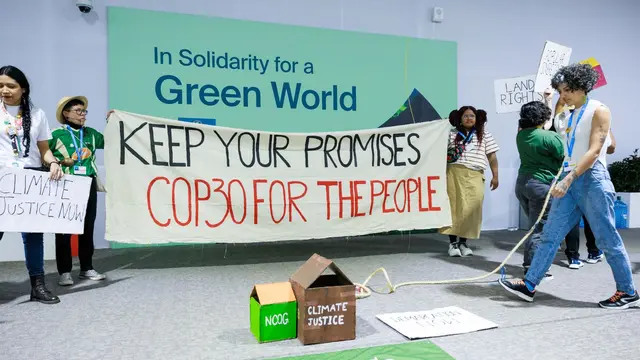
“At the same time, as we saw at COP29, the rich world is loath to agree to provide the amounts of climate finance the least developed countries and others need.”
IIED is calling for an overhaul of the global financial system to make it fairer for lower-income countries.
Swift action to tackle the sovereign debt crisis should be one of the main elements of this reform. Tools available include debt-for-climate-and-nature swaps and the use of parametric insurance to cover repayments in the wake of natural disasters.
Funders should make greater use of low-interest loans, also called concessional loans, as set out in Barbados’s Bridgetown Initiative.
In some cases, debt cancellation may be an appropriate option. Countries’ situations should be considered on a case-by-case basis.
Notes to editors
- See the full data table. Data sourced from the OECD and World Bank
- These 2023 figures cover 59 LDCs and SIDS as opposed to those from 2022 which covered 58, because data for Suriname became available this year. Figures from 2021 represent 59 countries including Bhutan, which has since graduated out of the LDC cohort
- See 'Breaking down siloes: reforming financing and trade for climate adaptation in LDCs'
- The Debt Sustainability Support Service, co-developed by IIED and Small Island Developing States, was adopted in the Financing For Development outcome document in Seville earlier this year
For more information or to request an interview, contact Jon Sharman:
+44 7407 727 886, or [email protected]