GET SET to be heard: why farmer advocacy starts with good governance
Stephen Mwangi explains why forest and farm producer organisations hold the key to meeting global restoration and climate commitments, and why strengthening their internal governance is the first step to winning the policy changes they need to thrive.


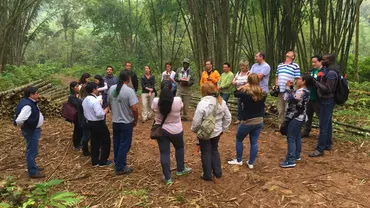
Members of the Kokoo Pa Farmers Association and the FFF team visit a cocoa farm shaded by trees in Ghana’s Ashanti region in June 2023 (Photo: Stephen Mwangi, IIED)
Forest and farm producer organisations can accelerate restoration and climate action, but only if they can influence the policies that hold them back. Strengthening their internal governance, consultation and representation processes is where that influence starts.
Picture a cocoa farmer in the Ashanti Region, Ghana, with a valuable timber tree growing among her cocoa. It shades her crop, acts as a nutrient pump, shelters birds and stores carbon. But under the law, the tree is not hers to own or sell, so she gains little from protecting it. The sensible choice is to let it go. Multiply her choice across millions of farms, and you see why targets aiming to restore ecosystems keep slipping.
No amount of tree planting fixes that. Policy does. And farmers win policy change when they speak together through organisations that decision-makers trust.
That is why I believe strengthening the internal governance of producer organisations is one of the best investments we can make in restoration.
Stewards without a say
Global restoration initiatives such as the UN Decade on Ecosystem Restoration, the Bonn Challenge and the UN 2030 Agenda for Sustainable Development targets for SDG 13 and SDG 15 all fall due within four years, and the world is off track.
The world's 1.5 billion forest and farm producers are among nature's most important stewards, yet small-scale farmers receive just 1.7% of climate finance, and insecure land and tree rights deter them from investing.
Their potential is gaining recognition. At World Forest Week in Rome this month, the Food and Agriculture Organization of the United Nations (FAO) launched a technical brief presenting producer organisations as a practical, cost-effective route to rural resilience, a message echoed at the Forest and Farm Facility Global Conference in Santa Cruz, Bolivia, in September 2026. The challenge now is how to ensure producer organisations are heard.
When farmers organise, policymakers listen
Reaching 1.5 billion producers one by one is impossible; reaching them through their organisations is not. This is the founding insight of the Forest and Farm Facility (FFF), a partnership between the FAO, IIED, the International Union for Conservation of Nature (IUCN) and AgriCord, that works to strengthen forest and farm producer organisations (FFPOs). Its 2025 annual report documents how FFPOs are increasingly shaping policy.
In Ghana, the Ghana Federation of Forest and Farm Producers (GhaFFaP) used FFF-supported policy dialogues to press for change on tree tenure, and the Forestry Commission is now trialling tree registration so farmers can secure rights to their trees.
In Kenya, the Farm Forestry Smallholder Producers Association of Kenya (FF-SPAK), representing over 50,000 farming families, helped lead the drafting of the country's first National Agroforestry Strategy (2025-2035) (PDF) with FFF support.
Behind each win is an organisation that policymakers were willing to listen to.

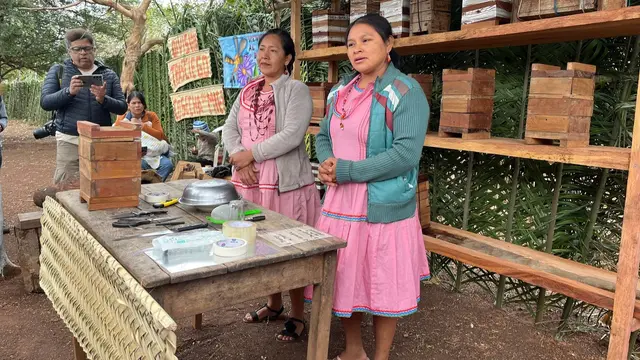
Forest and farm producers and the AFR100/FAO team visit a coffee farm integrated with trees in Elgeiyo Marakwet County, Kenya, in October 2025 (Photo: Stephen Mwangi, IIED)
Credibility starts at home
An FFPO speaks credibly only if it is accountable to its members: leaders chosen fairly, women and young people heard in inclusive consultation processes, views then represented fairly in decision making processes, and money well managed to allow that to happen.
These same qualities let FFPOs run viable businesses, enforce collective rules for land and trees and share benefits fairly. Weak governance undermines all of this, and advocacy fastest of all: a divided or opaque organisation is easy to ignore, and hard to fund.
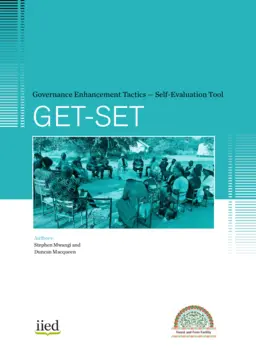
When FFF surveyed 41 FFPOs in six countries, internal governance emerged as a key knowledge gap. The FFF team at IIED responded by developing the Governance Enhancement Tactics – Self-Evaluation Tool (GET-SET). It guides leaders and staff through honest self-reflection on their structures, systems and practices, drawing on tactics of leading FFPOs, so that they move from naming problems to fixing them.
From the training room to the policy table
The GET-SET tool has found demand beyond FFF and has been deployed in programmes such as the FAO-led GEF-7 Drylands Sustainable Landscapes Impact Program and the AFR100 Support Programme. Under the AFR100 Support Programme, its logic is built into the design: well-governed farmer organisations shape better policy and deliver better restoration and business, so governance comes first. Training is the opening step of a support package that moves on to advocacy and national restoration policy dialogues.
Recently, I used the GET-SET tool to train more than 40 trainers of trainers from the AFR100 programme's six countries: DR Congo, Kenya, Madagascar, Malawi, Togo and Tanzania.
Alongside core governance topics, participants examined how governance choices shape an organisation's power to influence policy, exploring how members' priorities become a clear mandate, who speaks for the organisation, how field evidence is gathered and how alliances with other FFPOs are built.
Impacts from such work on governance can be seen in the advocacy activities of very well-governed FFPOs – showcased in a recent learning event on policy advocacy run by the FFF. The trainers will now cascade the approach to FFPOs in their own restoration landscapes.

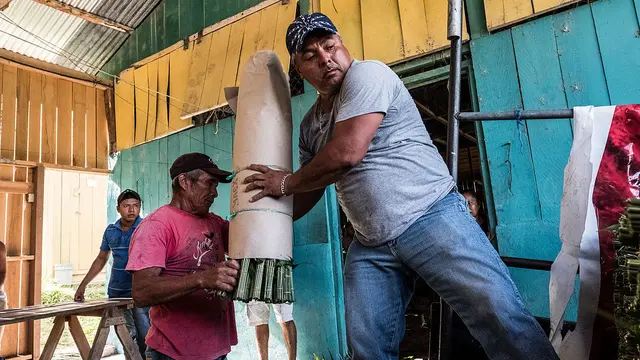
Members of the Lake Ol’Bolossat Community Conservation Group take part in internal governance training in Nyandarua County, Kenya, in December 2024 (Photo: Stephen Mwangi, IIED)
Closing the circle
Back to that cocoa farmer. Whether her tree survives depends less on how many seedlings are planted than on whether her organisation can win her the right to own it. That takes a strong, accountable voice.
Funders and governments racing to meet 2030 commitments should back FFPO governance as a low-cost, high-return investment. FFPOs should see it as how they earn their seat at the policy table and keep it.
Learn more
Explore how FFPOs are driving change in the Forest and Farm Facility impact stories, and look out for our research report on a policy advocacy module for FFPOs later this year.