Bees, nuts and medicinal plants bring many benefits in Bolivia’s Chiquitano dry forest
In Eastern Bolivia’s Chiquitano dry forest, Indigenous producers are demonstrating how productive forests bring business, food security and cultural benefits.


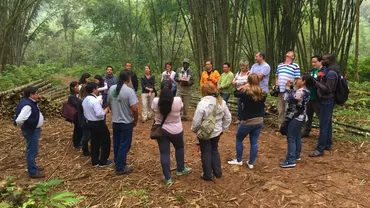
Members of the San Lorenzo de Lomerío Indigenous community demonstrate how they transfer native bee colonies from fallen logs to specially designed hives in Santa Rita de Monteverde (Photo: Alice Gerow, IIED)
Rain is not expected in Bolivia’s Chiquitano dry forest in September. Yet on day one of the Forest and Farm Facility (FFF) delegation visit, a downpour battered the tarpaulins where the group had gathered for a tour of the forest projects. In a region where water is scarce, our hosts welcomed the rain as a benediction.
The Chiquitano dry forest is a rare transition zone, linking the Amazon rainforest to the north and the Gran Chaco lowland to the south. At over 20 million hectares, it is the world’s largest tropical dry forest. For two days, it was also the setting for the FFF’s global conference, gathering 150 participants from 25 countries, representing forest and farm producer organisations (FFPOs), government agencies and technical support partners.
Since 2012, the FFF has invested US$84 million in around 1,000 FFPOs. In Bolivia alone, it has supported 50 Indigenous and peasant organisations across forest-positive value chains including wild almond, copaibo (medicinal tree), cusi (palm) and apiculture in the Chiquitania.
Building a beekeeping enterprise around inclusion, traditional knowledge and innovation
Near the historic town of Concepción, we met beekeepers from Santa Rita de Monteverde and San Lorenzo de Lomerío. Since 2022, with FFF funding and technical support from the Departmental Association of Beekeepers of Santa Cruz (Adapicruz), these Indigenous communities have developed apiculture into a women-led enterprise that strengthens both ecological and cultural resilience.
The partnership began with efforts to reinstate beekeeping following forest fires. Beekeepers first worked with the western honeybee, while adapting production to increasing drought. In the second year, women began managing señoritas (tetragonisca angustula), native stingless bees. After fires and land clearing, they locate surviving colonies in logs and transfer them to hives made by local woodworkers, designed to meet the bees’ nesting structure and temperature requirements, and protect them from predators.
Initially the women worked independently, but in the third year, they organised and joined a producer organisation previously reserved for men. The enterprise began by selling honey and propolis before bringing in young people to develop value-added products. As one member explained, “We had a good product, but we needed a good business.”
Native bees forage on local trees, including cuchi and tajibo. Recognising their significance, the beekeeper groups partnered with universities and laboratories to investigate the healing properties of these plants. They also advocated for the plants’ protection under Concepción’s law for non-timber forest products (NTPFs), which protects NTFPs and supports Indigenous communities’ use of them, particularly women entrepreneurs.
Working with the municipality of Concepción, they established a laboratory and were trained by a university faculty in product development. The result is two product lines:
- Monkoxi, an artisanal cosmetics range drawing on biocultural knowledge passed down from grandmothers combining propolis and honey with local plants such as tobacco, camphor and hibiscus, and
- ApiDermic, a pharmaceutical line developed with laboratories, including a propolis-inspired biopolymer for treating burns.
Monkoxi products are sold mainly in local markets, while ApiDermic remains a prototype, with commercialisation constrained by licensing requirements. Adapicruz is developing a commercial entity to address this bottleneck.

An economist and beekeeper presents an artisanal cosmetics line blending beekeeping products and local plants (Photo: Alice Gerow, IIED)
Bridging production and conservation while ensuring cultural continuity
Along with entrepreneurship came cultural transmission from community elders to younger beekeepers: of the bésiro language, and of oral traditions around the Jichi, spirits that inhabit the landscape.
The Chiquitano beekeeping model illustrates what productive forests can make possible: livelihoods that depend on a healthy forest can also support food security, biodiversity, climate action and cultural continuity. As Ignacia Supepi, a local Indigenous leader, put it:
We do not have your professional titles, but we are professionals in looking after our territories, their fauna and flora. We can have productive activities without destroying forests, without depleting our resources, without erasing our cultural identity
– Ignacia Supepi, local Indigenous leader
This perspective is particularly important in the Chiquitania, where the forest sits between pressures for agricultural expansion and Amazonian conservation ideals. As Paola Aguirre Melgar, vice-governor of the department of Santa Cruz, said, the Chiquitano dry forest “is not a postcard, but a functioning, productive unit.”

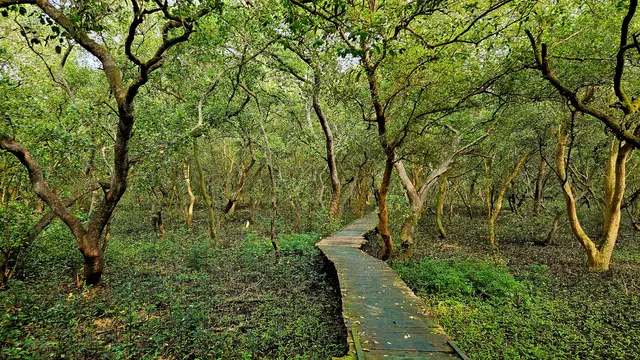
The Chiquitano dry forest near Rio Blanco in the department of Santa Cruz, Bolivia, in September 2026 (Photo: Alice Gerow, IIED)
Recognising and enabling FFPOs as partners
The conference highlighted a mismatch between the value forest-dwelling producers generate and the fragmented recognition they get in return. Smallholders are evaluated separately against government sector targets, development programme indicators, financial returns and market value, while fronting the cost of delivering economic, social and environmental outcomes.
While the FFF has channelled finance directly to these FFPOs, this is the exception rather than the norm. What’s more, these producers face significant barriers to resource rights, infrastructure, favourable regulation, financial services and market access. As Thales Mendonça from global organic producer group INOFO, commented: “Markets ask farmers to be more structured, competitive, scalable – when there is not even a road to the farm”.
In response, the FFF conference’s closing Chiquitania Declaration called for a shift in perspective. Instead of viewing FFPOs as beneficiaries, they should be recognised as partners in designing, implementing and evaluating the policies and investments that shape their territories.
This applies to scale: rather than imposing a global blueprint, the focus should be on creating the conditions and institutions that allow local producer-led solutions to grow. Gustavo Cabrera, of the family farming confederation COPROFAM, said: “These are complex, interconnected systems, with multiple temporalities. Simplification would be destruction.”
Looking ahead in the face of funding uncertainty
Based on this premise, the FFF team presented a proposal to extend the programme to 2031, to reach 25 countries and an additional 1,000 FFPOs. Producer organisations would be core partners, with a transition away from FFF support as they reach commercial and institutional maturity.
Despite the partnership’s results, the Northern governments that invested in it were absent from the conference. There was, however, evidence of Southern government support.
The head of Brazil’s Agrarian Development and Family Agriculture ministry along with government representatives from Bolivia, Kenya, Vietnam, Zambia – to mention only those present at the conference – all showed support of the Brazilian government’s new plan to accelerate solutions under the COP30 action agenda TERRA – Together for the Expansion of Resilient and Restorative Agroecology and Agroforestry. Within TERRA, the FFF has been designated as the implementation mechanism of the Global Productive Forests Initiative, which seeks to drive a global transformation in agroforestry led by producer organisations.
In this dry season for donor investment, the challenge now is to ensure FFPO partners are not left waiting for another benediction.