What will count as progress in the first global review? We need a gender-just evidence system
Are the Convention on Biological Diversity evidence systems capable of making gendered realities visible, and does the evidence they produce travel far enough through the system to change decisions or adjust implementation strategies?



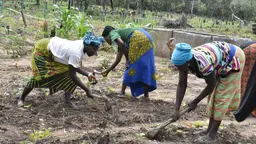
A group of women farmers work in a field in India (Photo: EqualStock, via Unsplash)
At this month's UN biodiversity summit, CBD COP17, Parties will undertake the first global review of progress in implementing the Kunming-Montreal Global Biodiversity Framework (KMGBF).
The review sits at the end of the planning, monitoring, reporting and review (PMRR) evidence chain, which moves from planning through national biodiversity strategies and action plans (NBSAPs), to monitoring, national reporting and the global report. Its purpose is not only to assess progress, but to help identify and respond to implementation challenges.
But what can the global review see, and what can it miss? If gendered realities, knowledge, contributions and inequalities remain invisible along this chain, or if some actors and forms of knowledge are not recognised as legitimate evidence producers, interpreters and users, our picture of collective progress will inevitably be incomplete.
From gender-biodiversity data to gender-just biodiversity evidence systems
Gender justice dimensions remain weakly integrated across biodiversity evidence systems. What is measured often tells us little about gender inequalities, data are not consistently disaggregated and relevant evidence may not be collected or recognised. These gaps continue as evidence is analysed, reported and used to inform decisions.
The mid-term review of the Gender Plan of Action at SBI-6 (PDF) reinforced calls for more sex-disaggregated data. But better data alone are not enough. A whole-of-society approach to implementation also requires a whole-of-society approach to evidence, recognising women, Indigenous Peoples and youth as evidence producers and users.
A gender-just evidence system, therefore, asks what becomes visible and what remains invisible; whose knowledge and evidence counts; and whether evidence reveals inequalities and leads to changes in implementation. The dimensions of justice (recognition, procedural, distributive and reparative) help us examine these questions throughout the evidence cycle.
Recognition: why women and why women’s knowledge?
Biodiversity loss and action do not enter gender-neutral societies; they interact with existing distributions of rights, resources, labour and power. Women, in all their diversity, are therefore rights-holders impacted by biodiversity loss and gender-blind action, while, at the same time, they are also holders and producers of knowledge essential to understanding biodiversity change.
Along the PMRR evidence chain, recognition means moving beyond 'counting women' to looking at whether their knowledge, forms of paid and unpaid labour, contributions to biodiversity action and differentiated experiences of environmental change are recognised as relevant evidence of progress and made visible in the global review.
Procedural justice: who gets to produce, analyse and use the evidence?
Being counted is not the same as having a say over what counts. Procedural justice shifts the focus from women as data subjects to women as evidence actors. It asks who defines the questions, methods and indicators, whose knowledge is considered credible, and who interprets the evidence as it moves through PMRR.
Women’s and community-based organisations are already producing evidence, but producing evidence does not necessarily mean having authority over how it is recognised, interpreted or used. This brings questions of data governance to the fore.
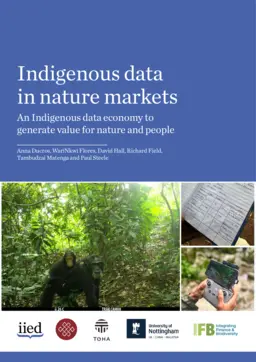
Indigenous data sovereignty, grounded in distinct collective rights, goes further by asking who generates and controls data, who determines its use and who benefits from the value it generates. Recent research showed that Indigenous data sovereignty is both a question of governance and a tool to generate value and reduce risk in nature finance mechanisms.
Distributive justice: who benefits, who bears the costs and who holds the rights?
Progress on biodiversity can look positive in aggregate while its benefits, costs and responsibilities are distributed unequally. A distributive justice lens asks whether PMRR makes these differences visible: who gains access to land, resources, finance and opportunities. Intersectional sex-disaggregated quantitative and qualitative data are essential for this.
A restoration programme, for example, may report hectares restored and women participating, while missing whether women gained tenure or finance, gained decision-making authority or absorbed additional unpaid labour.
Reparative justice: can biodiversity evidence help acknowledge past and continuing harms?
A reparative justice lens asks whether PMRR enables past and continuing harms arising from biodiversity loss and action to be visible, including patterns of exclusion or rights violations over time. But making harm visible is not enough.
Evidence should inform corrective action and adjustments to implementation and, where appropriate, contribute to restoring rights and other forms of remedy or redress.
This means asking not only whether harms are documented, but whether evidence helps prevent their continuation or recurrence.
From evidence to action
Evidence is only valuable if it informs action. The first global review is an opportunity to ask not only what progress has been made, but what our evidence systems allow us to recognise as progress in the first place.
A gender-just evidence system requires more than adding indicators or collecting more sex-disaggregated data. Evidence can be produced but not recognised, collected but lost through aggregation, or reported without influencing decisions. Gender justice needs to travel through the entire evidence cycle. Making inequalities visible matters only if that evidence travels through the system and informs how implementation responds.
As Parties take stock of collective progress at COP17, the question is therefore not only what we are counting, but what we can see, whose evidence counts, and what we will do differently because of it.
More in this series
Insight: Women’s tenure rights for gender-responsive coherence across the Rio Conventions, Karen Wong Pérez, Omaira Bolaños (October 2026)
Insight: Is culture the missing ingredient in the biodiversity economy?, Dilys Roe, Krystyna Swiderska (September 2026)
Insight: More money for nature? Ensuring finance supports local action is as important, Anna Ducros, Nicola Sorsby (September 2026)
Insight: Achieving 30x30: the vital role of Indigenous and traditional territories, rights and governance, Barbara Lassen, Krystyna Swiderska (August 2026)
Insight: Why nature finance and gender data are central to achieving the world’s biodiversity goals, Nicola Sorsby, Karen Wong Pérez (August 2026)
Insight: Getting back on track: turning global biodiversity promises into fair and locally-led action by 2030, Nicola Sorsby, Barbara Lassen (July 2026)