Where to find IIED and partners at COP17: event listing
The 17th meeting of the Conference of the Parties to the Convention on Biological Diversity (COP17) will be held from 19-30 October 2026 in Yerevan, Armenia. IIED researchers and partners will be attending various events, to ensure local priorities help shape decision making.
Yerevan, Armenia

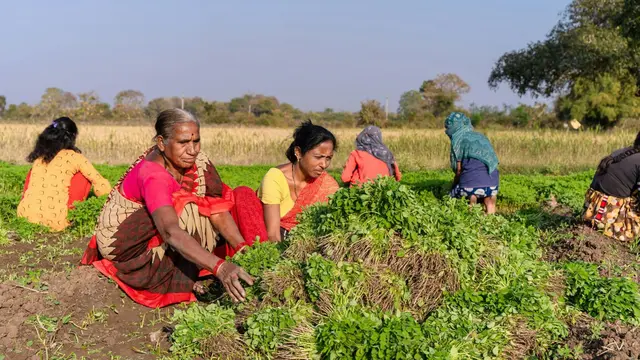
Women farmers plant onions in Tamil Nadu, India. IIED is seeking to ensure international funding reaches Indigenous Peoples and local communities directly (Photo: IWMI/Hamish John Appleby, via Flickr, CC BY-NC 2.0)
The 17th UN biodiversity conference (COP17) will take place in Yerevan, Armenia between 19-30 October 2026, marking a shift from agreeing biodiversity ambition to demonstrating delivery.
 This year in Yerevan, parties will conduct the first global review of collective progress in implementing the Kunming-Montreal Global Biodiversity Framework (GBF), making this an important test of whether global commitments are translating into implementation.
The Convention on Biological Diversity (CBD) Subsidiary Body on Implementation (SBI) met in Rome in February, which was followed by the meeting of the Subsidiary Body on Scientific, Technical and Technological Advice (SBSTTA) in Nairobi from 27 July to 1 August. Along with the 7th meeting of the SBI in Nairobi from 4-12 August, these were key milestones on the road COP17.
IIED and partners have engaged at key moments on the road to COP17, including the SBI and SBSTTA meetings, to help turn the global biodiversity framework into action, backed by evidence and solutions grounded in local experience.
At COP17, we will push for gender-just, Indigenous People and local communities-led action, with finance and decision-making power shifted to the people most impacted by biodiversity loss.
Our engagement will focus on five critical themes:
- Shift the power to local communities: COP17 must make 30x30 about the quality of governance, not just the quantity of land and sea protected – with Indigenous Peoples, local communities and women recognised as rights-holders, decision-makers and biodiversity stewards
- Get money to where it’s needed most: reforming biodiversity finance systems so that funding reaches Indigenous Peoples and local communities directly, transparently and on their own terms
- Challenge unfair economics: COP17 must tackle the economic incentives driving biodiversity loss, including harmful subsidies, and ensure nature finance supports people, rights and ecosystems rather than treating nature only as something to be priced and traded
- Realise the value of nature: the cultural, social and environmental value of nature must be recognised – supporting sustainable use, traditional knowledge and nature-based livelihoods that benefit communities while protecting biodiversity
- Put gender justice at the heart of GBF implementation: COP17 must put women’s rights, knowledge and leadership at the centre of GBF implementation — strengthening land and resource rights, recognising women-led and community-generated evidence, and ensuring women can shape decisions that affect biodiversity and livelihoods
Explore how IIED was involved in the lead-up to CBD COP17:
- Events at the Subsidiary Body on Scientific, Technical and Technological Advice (SBSTTA)
- Events at the 6th Meeting of the CBD SBI
CBD COP17 events
All event times are for GMT+4.
Week 1
Monday 19 October
Building gender-responsive biodiversity data systems – addressing the gender data gap and women's participation for effective implementation and monitoring of the KM-GBF
Time: 1.15pm
Location: Lastiver – Youth Group meeting room
Hosted by: UN CBD Women's Caucus, WEDO, UNEP-WCMC, ILC, IIED, UN Women, W4B
Speakers: TBC
The Kunming-Montreal Global Biodiversity Framework (KM-GBF) recognises the importance of inclusive participation and robust data, yet significant gaps remain in both gender-responsive biodiversity data and women’s participation in biodiversity monitoring and data governance. Indigenous, pastoralist and local community women in particular hold valuable knowledge and monitoring practices that remain underrepresented in official systems.
This side event will explore these interconnected gaps, showcase promising approaches to strengthen gender-responsive biodiversity data, and highlight how women-led and community-based monitoring can support more inclusive implementation of the GBF. It will also launch a handbook on gender and biodiversity data and develop practical recommendations for strengthening gender-biodiversity monitoring.
Related reading: New report: recognition of women-led biodiversity data vital to advance gender justice | Advancing gender justice in biodiversity data and policy through women-led data collection and evidence generation
Tuesday 20 October
From principles to practice: scaling inclusive nature action through the global biodiversity framework
Side event
Time: 1pm
Location: Dutch Pavilion
Hosted by: UK Government, IIED, UCL, CBD Women's Caucus, gender focal points
Speakers: TBC
The inclusive nature action principles are a collaboratively developed framework that promote gender-responsive, locally-led, rights-based approaches to halting and reversing biodiversity loss. The principles have been developed by a diverse multistakeholder group of governments, civil society actors, Indigenous Peoples and local communities, multilateral agencies and research institutes.
This event will showcase diverse actors putting these principles into practice, by securing equity and rights in the delivery of the global biodiversity framework. There will also be an interactive panel question-and-answer session focused on the tangible changes and interventions needs to move from principles to practice at scale. Attendees will be encouraged to submit questions in advance to facilitate a productive and insightful conversation.
Related reading: Emerging principles for supporting locally-led biodiversity action
Wednesday 21 October
The other 30X30 target – harnessing transformative, locally-led action to reach our global restoration goal
Time: 6.15pm
Location: Tatev – Subnational Group Meeting Room – Block 2, 3rd Floor
Hosted by: IIED, CCI, F&F, WCPA Restoration Working Group, more TBC
Speakers: Dilys Roe, IIED; Rob Small, Fauna & Flora; REDAA grantees; ELSP grantees; more TBC
The 30x30 target is widely associated with protecting 30% of the world’s land and oceans, but Target 2 of the global biodiversity framework sets a parallel ambition to restore at least 30% of degraded ecosystems by 2030. However, restoration can cause harm when it overlooks local ecosystems, livelihoods and rights – for example, through poorly designed tree-planting initiatives or approaches that reproduce historical injustices.
This side event will showcase examples of locally-led, rights-based restoration that deliver benefits for people, nature and climate. Drawing on experiences from the IIED-supported project 'Research and action for locally led nature restoration' (REDAA) and ELSP programmes and the IPBES Transformative Change Assessment, it will explore what is needed to deliver Target 2 in ways that are socially just, ecologically effective and respectful of the rights and knowledge of Indigenous Peoples and local communities.
Thursday 22 October
From assessment to action: putting equitable governance into practice under Target 3
Time: 6.15pm
Location: Sisian – Eastern European States meeting room
Hosted by: IIED, Kenya Wildlife, RECOFTC, Madagascar National Parks, Madagasikara Voakaji, Honeyguide, Conservación Amazónica
Speakers: TBC
This side event will present practical experiences from conservation organisations in assessing and improving equitable governance at protected and conserved areas (PCAs) across five countries. Target 3 commits CBD Parties to ensure PCAs are equitably governed by 2030. Yet many countries, conservation organisations and PCA managers still face the practical challenge of how to move from this global commitment to meaningful changes in how governance is assessed, improved and reported.
This event focuses on that implementation gap, sharing lessons on how the site-level assessment of governance and equity (SAGE) tool can inform local action, system-level learning and national reporting.
Week 2
Monday 26 October
Environmentally harmful subsidies reform amid geopolitical tensions and rising fuel prices
Time: 6.15pm
Location: Jermuk – African States meeting room
Hosted by: IIED, UNEP FI, IISD, Business for Nature, PEW, UNDP, Mozambique government
Speakers: TBC
Environmentally harmful subsidies continue to contribute to biodiversity loss, carbon emissions and unsustainable resource use across sectors including fisheries, agriculture and fossil fuels. As governments face rising economic and political pressures, this side event will explore how international commitments, including Target 18 of the global biodiversity framework and the WTO Agreement on Fisheries Subsidies, can provide momentum for reform.
Bringing together different research and experiences, the event will examine how countries can reform harmful subsidies while protecting livelihoods, supporting energy security and strengthening sustainable businesses. It will also explore how business support and positive incentives can help make sustainable practices more competitive while delivering fairer outcomes for small-scale producers.
Wednesday 28 October
TERRA and the global biodiversity framework: agroecology and agroforestry as pathways to close the implementation gap
Time: 1.15pm
Location: Vayk – Side-event Room 3
Hosted by: CGIAR, FAO, Ministry for Agrarian Development of Brazil, IUCN, IIED
Speakers: TBC
This side event presents TERRA – the COP30 action agenda's plan to accelerate solutions for agroecology and agroforestry – as a concrete, country-driven pathway for delivering the agriculture-related targets of the Kunming-Montreal Global Biodiversity Framework.
Founded at the invitation of the COP30 Presidency by six institutional partners – Brazil's Ministry of Agrarian Development and Family Farming (MDA), the Forest and Farm Facility (FFF), NOW Partners Foundation, IFAD, the Agroecology Coalition, and the Alliance Bioversity-CIAT (CGIAR) – TERRA converts dispersed agroecology and agroforestry initiatives into coordinated territorial transitions, deployed through five levers of acceleration: producer organisations, capacity building, blended finance, seeds and technology, and value addition and market access.
The event will bring together speakers directly engaged in agroecological and agroforestry transitions on the ground – including farmer organisation representatives and practitioners from TERRA's territorial work – to share first-hand experience on what drives uptake at scale, and what remains needed to close the implementation gap.
Further reading
Transforming nature finance for people, nature and climate: IIED’s nature finance strategy, 2025-2030, (2025) IIED project flyer
Challenging coloniality and racial injustice in finance for nature, Nicola Sorsby, Natalie Lartey, Krystyna Swiderska, Mohsen Gul, Michael Lomotey (2026) IIED working paper
Insight: Nature finance: some progress at COP30 with more needed in 2026, Nicola Sorsby, Ebony Holland (December 2025)
Project: Connecting social protection with fisheries management and conservation
Project: Incentives for coastal conservation and fisheries management
Incentives for coastal stewardship in Tanzania, Kate West, Emma Etchells, Kokubanza Timanywa, Peadar Brehony (2025)
Blue social protection handbook: protecting people, fish and food, Annabelle Bladon, Gunilla Greig, Yuko Okamura, Gianluigi Nico (2025), World Bank report
Infograhic: Leveraging social protection and labor market interventions for sustainable fisheries (PDF), World Bank
Insight: Compromises, challenges and more unfinished business at COP16’s reconvened biodiversity talks, Karen Wong Pérez, Anna Ducros (March 2025)
News: Historic platform for Indigenous Peoples, but finance failure at COP16 (November 2024)
Events at the Subsidiary Body on Scientific, Technical and Technological Advice (SBSTTA)
Monday 27 July
Advancing gender responsive biodiversity data systems for effective implementation and monitoring of the Kunming-Montreal Global Biodiversity Framework
Side event
Hosted by: CBD Women’s Caucus, with support from IIED, Guatemala, UNEP-WCMC, IUCN-CEESP, WEDO, GEDA
Speakers: Amelia Arreguín Prado, Shruti Ajit (CBD Women’s Caucus); Marina Lopez (Guatemala gender focal point); Karen Wong Perez (IIED)
The implementation of the Kunming-Montreal Global Biodiversity Framework (KMGBF) requires robust, inclusive and actionable biodiversity data systems capable of informing policy, monitoring progress, and supporting accountability. However, major gaps remain in the availability, accessibility and use of gender-responsive biodiversity data across national and global monitoring processes.
Women, Indigenous Peoples and local communities, youth, and grassroots organisations are key knowledge holders and biodiversity stewards, yet their contributions often remain invisible within biodiversity monitoring frameworks and national reporting systems. Strengthening gender-responsive biodiversity data systems is therefore essential for achieving equitable and effective implementation of the KMGBF.
This side event provided a platform for governments, women’s organisations, researchers, Indigenous Peoples and local communities representatives, and technical experts to exchange experiences and identify pathways to strengthen gender-responsive biodiversity data governance and implementation.
Related reading: New report: recognition of women-led biodiversity data vital to advance gender justice | Advancing gender justice in biodiversity data and policy through women-led data collection and evidence generation
Wednesday 29 July
Delivering 30x30 through equity and rights: how do we fulfil the ambitions of Target 3?
Side event
Hosted by: CBD Women’s Caucus, ICCA Consortium, IIED, IUCN WCPA/CEESP, Greenpreace Internations, SwedBio
Speakers: Albert Chan (ICCA Consortium); Danie Mabengo (ANAPAC); Jennifer Corpuz (IIFB); Jessica Campese (ICCA Consortium); Meenal Tatpati (CBD Women's Caucus); Katie Reytar (WRI); Nichanan Tanthanawit (Greenpeace International)
In Target 3 of the Kunming-Montreal Global Biodiversity Framework (KMGBF), parties committed to conserve at least 30% of land and sea areas by 2030, while ensuring equitable governance and recognising the rights of Indigenous Peoples and local communities, including to their lands, territories, and traditional knowledge. However, the implementation of the governance, equity and rights aspects of Target 3 at national level and on the ground remains uneven.
Indigenous Peoples and local communities face barriers such as a lack of recognition of their territories and governance institutions in national policies, insufficient mechanisms for equity in shared governance arrangements, weak integration of rights-based approaches in NBSAPs, gaps in safeguards and insufficient access to financial resources, among others.
This event explored how upcoming CBD decisions and guidance can support parties to enhance respect and recognition of Indigenous Peoples' and local communities' rights and meet Target 3 through a human rights-based approach.
Co-creating wildlife use and trade indicators: join the IN-WILD stakeholder working group and network
Side event
Hosted by: IUCN, IUCN SULI, UNEP-WCMC, CPW
Speakers: Norbert Barlocher (IUCN), Neil Burgess (UNEP-WCMC), Molly Brown (IUCN), Dilys Roe (IIED & IUCN)
This side-event introduced IN-WILD, a GEF-8 funded project revolutionising indicators for wildlife use and trade monitoring through social media big data to help deliver KMGBF Target 5. This project is also part of the 2026-2028 workplan of the Collaborative Partnership on Sustainable Wildlife Management (CPW).
The event presented preliminary findings from IN-WILD’s situation and gap analysis of wildlife use and trade indicators and explore – through a panel discussion with MEA Secretariats and CBD Parties, what indicators are currently being used to monitor progress to national sustainable use targets and how innovative data sources and aligned methodologies can strengthen national reporting, NBSAP implementation and technical processes under the CBD, alongside improved coordination with CITES and CMS.
A further focus was to highlight opportunities for participants to engage with the wider IN-WILD Stakeholder Working Group on wildlife use and trade indicators, and the wider project stakeholder network.
Events at the 6th Meeting of the CBD SBI
Tuesday 17 February
Are women-led organisations the missing partners for global biodiversity framework implementation and global review?
Press conference
Hosted by: CBD Women’s Caucus, IIED
Speakers: Amelia Arreguin Prado, Shruti Ajit (CBD Women's Caucus), Ceire Booth (UNEP), Venge Nyirongo (UN Women), Marina Lopez (Guatemala gender focal point), Karen Wong Perez (IIED)
As parties took critical decisions to shape how the global biodiversity framework is implemented at SBI-6, questions of who produces biodiversity data, how it is used, and whose knowledge counts were central to ensuring implementation is inclusive, effective and accountable. This includes whether commitments to gender equality are being translated into concrete actions, adequate resources and results.
This press conference launched a new report highlighting the ways in which women-led and community-based organisations are generating vital, gender-responsive biodiversity data through their everyday engagement with ecosystems and governance processes – only for formal decision-making spaces to fail to use this data when setting policies.
Related reading: Advancing gender justice in biodiversity data and policy | Advancing gender justice in biodiversity data and policy through women-led data collection and evidence generation
Contact
Oliver Arnold-Richards ([email protected]), strategic campaigns manager, IIED's Communications Group