IIED at London Climate Action Week 2026
London Climate Action Week 2026 will bring together world-leading climate professionals and communities from across London and the globe to find practical solutions to climate change.


London financial district, where LCAW 2026 will be held (Photo: Frans Ruiter on Unsplash)
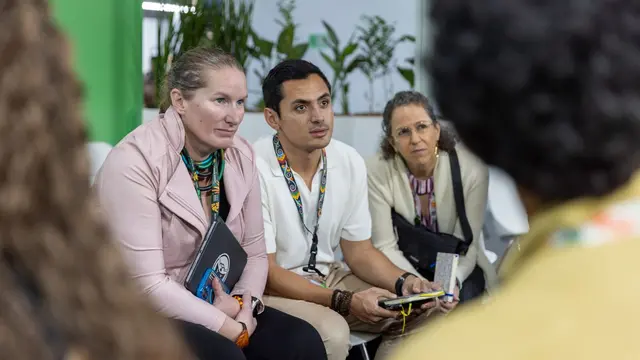
At a time when multilateralism is under pressure, London Climate Action Week 2026 is a vital moment for cooperation in a fractured world. IIED will use the week to convene partners across government, finance, civil society, research and business to explore how climate action can be fairer, more locally led and more effective.
Across our engagements, we will focus on:
- Getting finance to where it is needed most: mobilising for climate resilience, locally led adaptation, sustainable livelihoods and green development, particularly for communities most affected by climate and nature crises.
- Reforming financial architecture and incentives: exploring how public finance, private investment and subsidies can be reshaped to support people, nature and long-term resilience.
- Advancing locally-led, rights-based climate and nature action: supporting local leadership, land rights and recognition of Indigenous Peoples’ and local communities’ knowledge in global processes.
- Supporting just transitions and inclusive green development: advocating for transitions in energy, land use, supply chains and mineral-rich countries that deliver benefits for local communities, while protecting human rights and ecosystems.
- Advancing gender equality and women’s climate leadership: advocating for finance and decision-making processes that reflect the priorities, rights and leadership of women most affected by climate and nature crises.
Together, these conversations will help connect local realities with global decision-making, ensuring climate ambition is grounded in equity, rights and practical solutions.
Key events
Monday, 22 June
Funding climate action at scale: lessons from effective global philanthropy
Hybrid event
Hosted by: GAGGA, Alliance, with support from IIED
Speakers included: Sonia Medina (CIFF); Juliana Tinoco (Socio-Environmental Funds of the Global South (Alianza Fondos del Sur/The Global South House); Elika Roohi (Alliance)
Gender-just, locally-led solutions are not a ‘nice to have’, they are the most effective response we have to the climate crisis. Evidence from a decade of funding by the Global Alliance for Green and Gender Action (GAGGA) and three decades of covering philanthropy by Alliance magazine shows that local interventions that centre communities ultimately lead to resilience and long-term sustainability.
This panel discussion explored effective models from across global philanthropy that are making a difference in the climate space and included a workshop prompting participants to challenge assumptions and bring new ideas into their own work.
Further reading: Principles for locally led adaptation
Are we here? Are we heard? Launch of women in global climate and environmental leadership
Hybrid event
Hosted by: IIED, GWL Voices, EmpoderaClima, Plataforma CIPÓ, Project Dandelion, SHE Changes Climate
Speakers included: Mary Robinson (Project Dandelion, first woman president of Ireland, former UN High Commissioner on Human Rights, GWL Voices member), Rachel Kyte (UK Special Envoy on Climate, GWL Voices member), Bianca Pitt (SHE Changes Climate), Maiara Folly (Plataforma CIPÓ), Karen Wong Pérez (IIED), Renata Koch (EmpoderaClima)
Despite their central role in community resilience, adaptation and environmental stewardship, women remain markedly underrepresented in the highest levels of climate decision-making. GWL Voices’ new spotlight report on women in global climate and environmental leadership presents new figures spanning over 30 years of data on leadership and participation at seven key multilateral climate and environmental institutions, including the three Rio Conventions. By also examining first-hand testimonies of women climate leaders and institutional policies across these institutions, the new report offers a unique analysis that can help stimulate global debates around gender equality and climate change.
The high-level launch of the report at LCAW 2026 was followed by a panel discussion with women climate leaders across generations, think-tanks, research institutes, civil society and others, providing a timely and much-needed quantitative and qualitative overview of how power is experienced and exercised by women in multilateral climate and environmental governance – with a view towards building a gender-equal multilateral system that tackles the climate and environmental crises effectively and fairly.
Tuesday, 23 June
Pathways for resourcing community-led climate solutions
In-person event
Hosted by: The Global South House
With support from: Shift The Power, RFCA, WINGS, F20, Global Witness, IIED
There is growing recognition that Indigenous Peoples, women, youth, grassroots groups, environmental defenders and locally-rooted institutions are already delivering climate solutions. Yet despite their central role, these actors remain significantly marginalised and undercapitalised within global finance systems.
In the context of accelerating climate impacts, widening inequalities, pressures from extractive frontiers, and shrinking civic space, the outcomes of COP30 create a pivotal opportunity to strengthen more decentralised, inclusive and place-based financial systems. Scaling locally oriented financial mechanisms, particularly global South-led funds, is essential to making global climate finance more legitimate, effective and grounded in the realities and priorities of frontline communities. Global South-led funds are at the forefront of this shift.
This event, convened by the Global South House, brought together representatives from governments, multilateral funds, philanthropy, financial institutions, Indigenous Peoples' organisations, community-led funds and civil society to examine how current financial architectures shape the flow of resources, and what it will take to redesign them in ways that support a more just and territorially grounded climate transition.
Further reading: Financing social and environmental justice in the global South | The Global South House at COP30: lessons, barriers and the path forward
Who controls the energy transition? Power, land and climate finance at the frontier
Online event
Hosted by: IIED, International Land Coalition, Land Rights Now
Speakers included: Nathaniah Jacobs (IIED); Jeremy Bourgoin (ILC); Joan Carling (Indigenous Peoples Rights International); Lauren Nel (Natural Justice)
The global energy transition is often framed in terms of finance, technology and targets, but at its core, it is a profound transformation of land use and control. While land issues are increasingly present in forums like London Climate Action Week, they are typically subsumed within broader agendas such as climate finance, nature, adaptation or food systems.
This webinar made the case that land rights and land governance are not peripheral but central to addressing the climate crisis and its impacts. As investment in renewable energy and transition minerals accelerates, the ‘transition’ is already reshaping territories worldwide, often where Indigenous Peoples and local communities live. Yet governance systems are not keeping pace.
The result is a growing risk of more conflict, delays and inequality. Simply put: the energy transition is happening on land, and right now, we are not governing it fast enough to ensure rights protection, social equity and sustainability. Climate finance is flowing but without land governance, delivery will fail or harm communities.
This webinar brought together academia, civil society and grassroots rightsholders to explore what it takes to deliver a just transition in practice. It highlighted how securing the land rights of Indigenous Peoples and local communities is essential across three dimensions of justice: distribution (fair sharing of benefits and burdens), procedure (inclusive and transparent decision-making) and recognition (respect for rights, identities and knowledge systems).
Wednesday, 24 June
Building convergence to scale high integrity nature credit markets
In-person event
Hosted by: IIED, Delegation of the European Union to the UK, International Advisory Panel on Biodiversity Credits, Biodiversity Credit Alliance, Green Finance Institute, UNEP Finance Initiative, Terassos
Nature credit markets are evolving rapidly, with growing interest from governments, investors, businesses and conservation leaders seeking credible mechanisms to finance biodiversity protection and restoration at scale.
This high-level event brought together financial institutions, policymakers, market developers, conservation organisations and practitioners to explore how greater convergence across policy, market architecture and high-integrity project supply can accelerate the growth of high integrity nature credit markets.
Through three interactive panel discussions and audience engagement, the event examined:
- The business case for investing in biodiversity and nature credits
- The role of high-integrity supply in stimulating market demand
- Emerging policy frameworks and market architecture needed for market activation
- Lessons from Latin America, East Africa and other global South initiatives, and
- The connection between nature credits, sustainable supply chains and resilient business operations.
Africa's readiness and leadership for critical minerals value addition
Online event
Hosted by: IIED, Southern Africa Resource Watch
Speakers included: Mkhululi Nkosilamandla Ncube (African Union African Minerals Development Centre); Claude Kabemba (Southern Africa Resource Watch); Chantelle Moyo (Southern Transitions); Lindlyn Moma and Lorenzo Cotula (IIED
Africa has significant reserves of the minerals powering the global shift to clean energy. Yet communities often bear social and environmental costs while manufacturing jobs and industrial gains are located elsewhere. Constraints affecting infrastructure, energy, finance and technology have reduced opportunities for Africa to secure a greater role in value addition. But these longstanding patterns are now under challenge.
Governments are pushing beneficiation requirements. Communities are organising and workers and civil society are demanding fairer terms. Regional institutions are exploring collective bargaining strategies, while trade, investment and industrial policies are being used to optimise value addition and ensure more just energy transition outcomes.
This event examined the effective action needed to tackle constraints and seize opportunities for mineral-rich countries in Africa to develop critical minerals in line with sustainable development pathways.
Consultation on locally led adaptation sector guides
Private event
Hosted by: IIED, Mercy Corps
With support from: Climate Resilience Alliance
IIED and partners are developing sectoral guidance for national governments on locally led adaptation across three sectors: food, water and infrastructure, and human settlements.
This event allowed key actors to meet and share their inputs that will help shape the development of these guides.
Friday, 26 June
Just transition in agrifood systems: advancing decent livelihoods, women's empowerment and climate resilience
Online event
Hosted by: ODI Global, FAO
Speakers included: Jim Skea (IPCC); Mairi Dupar (ODI Global); Aditya Bahadur (Red Cross Climate Centre); Eddy Frank Vasquez (Alliance of Small Island States); Elizabeth Nsimadala (president of East Africa Farmers Federation); Hans-Peter Lankes (ODI Global); Harjeet Singh (Farmer, founder of Satat Sampada Climate Foundation, special advisor to the Fossil Fuel Treaty Initiative); Kaveh Zahedi (FAO); Maryam Rezaei (ODI Global); Jazmin Burgess (C40 Cities); Dr Matthew L Bishop (University of Sheffield); Rachel Waterhouse (FCDO); Ruchi Tripathi (Global Alliance for the Future of Food); Simon Addison (FAO); Milagre Nuvunga (MICAIA Foundation); Anthony Whitbread (International Livestock Research Institute); Jeneen Hadj-Hammou (IIED)
Agrifood systems sit at the heart of the climate and development challenge. Yet they remain largely absent from global just transition frameworks. This omission is especially significant for rural communities, informal workers, women and small-scale producers, who are among the most exposed to climate and economic shocks while often excluded from social protections, finance and decision-making processes.
This public dialogue, co-convened by ODI Global and The Food and Agriculture Organization of the United Nations (FAO), elevated agrifood systems within global just transition debates. It explored how just transition frameworks can more effectively address the interconnected challenges of agrifood systems, ensuring inclusive outcomes for rural livelihoods, sustainable food production, and climate resilience.
Contact
Oliver Arnold-Richards ([email protected]), strategic campaigns manager, IIED's Communications Group