IIED at the 70th Commission on the Status of Women (CSW70)
Throughout CSW70, IIED and partners hosted and participated in a range of key events. This page provides more details.

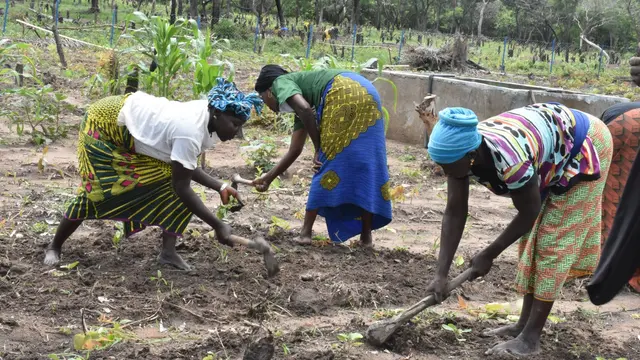
A group of women farmers from India talk in a field (Photo: amol sonar, via Unsplash)
The Commission on the Status of Women is the principal global intergovernmental body exclusively dedicated to the promotion of gender equality, the rights and the empowerment of women. It plays a crucial role in advocating for the rights of women and girls, documenting their lived experiences worldwide, and establishing global standards for gender equality and empowerment.
The 70th session of the commission (CSW70) took place at United Nations Headquarters in New York from 9-19 March. This year, discussions focused on ensuring and strengthening access to justice for all women and girls, including by promoting inclusive and equitable legal systems, eliminating discriminatory laws, policies and practices, and addressing structural barriers.
Throughout the two weeks, IIED and partners led on and participated in a range of online events, building on IIED's work to advance gender justice in biodiversity data and policy, as well as our work with partners to strengthen community-led gender data for climate and heat resilience.
Events
Wednesday 11 March
Rethinking power and women’s leadership
NGO parallel event
Hosted by: Rights and Resources Institute, IIED
Speakers: Namnyak Sinandei, Pastoral Women’s Council; Lucy Njoki Macharia, community land rights defender, Kenya; Sara Omi, Coordinadora de Mujeres Líderes Territoriales; Yungdrung Jhama Lama, Yak Herding Community; Omaira Bolanos, Rights and Resources Initiative; Hindou Oumarou Ibrahim, Association for Indigenous Women and Peoples of Chad
The full and meaningful participation of Indigenous, pastoralist, Afro-descendant and local community women in decisions about land and resources, at local, national and international levels, is essential to strengthening the resilience and adaptive capacity of communities, women and girls. Recognising these women as agents of transformative change is also critical to addressing the biodiversity and climate change crises and to protecting and advancing their human and land tenure rights.
This event opened a dialogue on the transformative leadership of Indigenous and pastoralist women, examining persistent barriers and innovative pathways for meaningful participation in public life and in their communities.
It presented an example from the Women in the Global South Alliance for Tenure and Climate of their guiding principles, which challenge and seek to transform discriminatory power relationships within their own collective and in their relations with external actors, and proposed more equitable, relational forms of governance and decision-making.
Related reading: Series of five case studies on gender-just societies
Thursday 12 March
Envisioning community-led feminist gender and heat data systems for urban climate justice
NGO parallel event
Hosted by: IIED
Speakers: Venge Nyirongo, UN Women; Michelle Koyaro, SDI Kenya; Nancy Njoki, Muungano wa Wanavijiji (Kenyan federation); Mussa Raido, CCI; Teurai Nyamangara, Dialogue on Shelter; Bessy Kathambi, Nairobi University Environmental Governance and Management, Biodiversity Conservation, SDG Implementation; Karen Wong-Perez, Marcelle Mardon and Wayne Shand, IIED
Vulnerable populations living in informal settlements, in cities of the global South, are often at the forefront of experiences of climate hazards. Women and girls living in informal settlements are disproportionately affected despite the significant contributions they make to households and communities, playing productive, reproductive and community roles.
This event brought to the fore collaborative work from IIED and grassroots movement Slum Dwellers International. It highlighted and shared co-produced gender-responsive climate resilience data collection efforts currently underway in three cities in Zimbabwe, Kenya and Tanzania.
Through a climate risk lens, and in particular extreme heat, the event showcased how non-state actors are advancing the generation of knowledge and evidence at the gender-environment-climate nexus. It highlighted how key partnerships can support inclusive data integration into decision-making frameworks while contributing to grassroots data ownership and sovereignty, key moves towards more gender and socially-just climate action.
Related reading: Rising heat levels mean increased risks for women in informal settlements | Closing the gender data gap to enhance climate adaptation in urban Zimbabwe | Overheating cities: lessons from informal settlements in Dar es Salaam | Better cities are possible: transforming informal settlements on a warming planet
Tuesday 17 March
From land rights to a gender-just economy: lessons from Indigenous women
NGO parallel event
Hosted by: IIED, Rights and Resources Institute, International Land Coalition
Speakers: Doris Munyingi, GROOTS Kenya; Ketty Marcelo Lopez, National Organisation of Amazonian and Andean Indigenous Women of Peru; Espérance Nyota, Union for the Emancipation of Indigenous Women (UEFA); Caroline Kayanja, Uganda Community Based Association for Women and Children's Welfare; Omaira Bolanos, Rights and Resources Institute; Philippine Sutz and Karen Wong Perez, IIED
This online event as part of CSW70 presented case studies from Indigenous, pastoralist and Afro-descendant women.
Across sub-Saharan Africa and Latin America, climate change, extractive industries, conservation policies and economic pressures are rapidly reshaping land and natural resource governance.
In many pastoralist and Indigenous territories, these intersecting crises are intensifying inequalities - particularly for women, who often depend on land for their livelihoods yet face structural barriers to ownership, control and decision-making.
This event brought together grassroots leaders and civil society organisations from Kenya, Uganda, the Democratic Republic of Congo and Peru to share lessons from a series of in-depth case studies developed collaboratively by IIED and local partners, with support from RRI and ILC.
Gender justice: why is progress so slow?
Following last year’s CSW69, senior IIED researcher Karen Wong Pérez spoke about global progress towards gender justice, and why the journey towards gender-just environmental action isn’t moving quickly enough, on an episode of IIED's podcast, Make Change Happen.
In addition to reflecting on what she found in New York, she explores the connections between environmental and climate justice, and makes clear the difference between seeking gender equality and the broader ambition of gender justice.
Stay informed
You can sign up for updates on IIED's work to support gender-inclusive climate-environment action, and explore our Gender Environment Hub.
You can also sign up to IIED's mailing list for updates and invitations to events throughout the year, including webinars, critical themes and debriefs.
Contact
Matt Wright ([email protected]), web planning and content manager, Communications Group