IIED at the 69th Commission on the Status of Women (CSW69)
Throughout the upcoming CSW69, IIED and partners hosted and participated in a range of key events. This page provides more details.

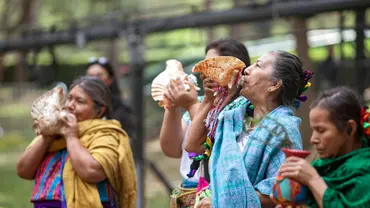
Indigenous Women of the Americas protesting for climate justice (Photo: Peg Hunter, via Flickr, CC BY-NC 2.0)
The Commission on the Status of Women is the principal global intergovernmental body exclusively dedicated to the promotion of gender equality, the rights and the empowerment of women. It plays a crucial role in advocating for the rights of women and girls, documenting their lived experiences worldwide, and establishing global standards for gender equality and empowerment.
The 69th session of the Commission on the Status of Women (CSW69) took place at United Nations Headquarters in New York from 10 to 21 March. the 2025 event coincided with the 30th anniversary of the Beijing Declaration and Platform for Action, providing an opportunity to reflect on progress and address ongoing challenges in achieving gender equality.
CSW69 aimed to review the implementation of the Beijing Declaration and Platform for Action and the outcomes of the 23rd special session of the General Assembly, addressing the challenges that still remain in enforcing gender-responsive policies that reflect the lived realities of women and girls globally.
Throughout the two weeks, IIED and partners led on and participated in a range of online and in-person events, building on IIED's work to highlight current gaps in gender-blind, one-size-fits-all policies that fail to serve women, gender-diverse, and marginalised groups.
There is a web of interconnected problems that are stopping effective decision-making and policies. IIED is actively working with partners to support the visibility of marginalised experiences and advance data-informed decisions through analysing existing gender data knowledge and partnering with and supporting local actors in their efforts in advocating for data sovereignty and owning and managing their own data.
Key events
Advancing data for synergies between gender, climate and environment
NGO parallel event
Hosted by: IIED, CBD Women’s Caucus, UNFCCC, UN Women, Women’s Environment and Development Organization (WEDO), Gender and Environment Data Alliance (GEDA)
Speakers: Rachel Kagoiya, GROOTS Kenya; Zoneziwoh Mbondgulo, Women for Change; Sadia Satti, Sustainable Development Policy Institute; Ketty Marcelo, Organización Nacional de Mujeres Indígenas Andinas y Amazónicas del Perú (ONAMIAP); Tahnee Prior, Women of the Arctic; Jessamyn Encarnacion, UN Women; Amelia Arreguín Prado, CBD Women's Caucus; Khiddir Iddris, GEDA; Karen Wong Pérez, IIED
This NGO CSW69 parallel event focused on the data challenges hindering the implementation of the Beijing Declaration and Platform for Action, specifically exploring opportunities for synergy between gender, climate and environment.
Significant progress has been made in closing the data gap at the gender-environment-climate nexus, but power imbalances still remain. By recognising the contributions of non-state actors in the collection and generation of valuable data and evidence, and integrating this with information from state actors, we can support better informed decision-making.
This event brought together state and non-state actors to showcase best practice for addressing the data gap and call on CSW member states to recognise gender data and evidence collected by non-state actors, including community-led or grassroot actors, and integrate this into decision making at all levels of government and society.
Event coverage
Key messages from this parallel event were shared at the side event on 21 March (see event coverage below).
You can watch a recording of this event below or on IIED's YouTube channel, where individual links to the start of each speaker's contribution are also provided. The recording is available in English, Spanish and French.
Friday, 21 March
Fulfilling the true vision of Beijing (and Rio): a whole-of-society approach to gender and environment data
Side event
Venue: UN Headquarters, Conference Room E, GA Building, New York
Hosted by: IIED, Permanent Missions of Chile, Canada, Colombia, Ireland (TBC) and Mexico to the UN, CBD Women’s Caucus, UNFCCC, UN Women, Women’s Environment and Development Organization (WEDO), Gender and Environment Data Alliance (GEDA)
Speakers: Natalie Cleveland, Data2X; First Secretary Andrés Alejandro Borlone Diaz, Permanent Mission of Chile to the UN; Ambassador Fergal Mythen, Permanent Mission of Ireland to the UN; Karen Wong Pérez, IIED; Rosalind Helfand, UN Women; Immaculata Casimero, Wapichan Wiizi Women’s Movement; Jessamyn Encarnacion, UN Women/Women Count Programme; Alice Morris, Working Group for Women and Land Ownership (WGWLO) in India/International Land Coalition; Fleur Newman, UNFCCC; Ambassador Juan José Quintana, Permanent Mission of Colombia to the UN
The impacts of intertwined crises, such as climate change and biodiversity loss, vary widely among women and girls and reveal deep inequalities that affect them differently. Recognising and addressing this is essential for effective policymaking and moving towards gender justice.
This official side event explained why a ‘whole-of-society approach’ to data is vital for better informed decision-making. This approach requires collaboration between state actors, private sector and civil society in order to contribute complementary data across different times and scales, enriching decision-making processes.
Recognising the contributions of non-state actors, including community-led or grassroot actors, in collecting, owning and analysing data is crucial in enabling conditions for gender-responsive implementation of the Rio Conventions.
This event featured perspectives from member states, UN agencies, and organisations that are part of the Gender and Environment Data Alliance (GEDA) and the CBD Women's Caucus.
Event coverage
You can watch individual videos of all the speakers at this event in this YouTube playlist, while the video featuring IIED senior researcher Karen Wong Pérez is also featured below.
Key messages
In her contribution, Wong Pérez set out some core challenges: measuring progress without inclusive data, driving change amid silenced voices and siloed solutions, and using gender data to pursue a more holistic vision of gender justice in a complex world.
No progress can be achieved without a shift towards a whole-of-society approach to data, an inclusive and participatory strategy that ensures data is collected, shared and used equitably, engaging all sectors of society.
This approach prioritises the voices of those historically excluded from data systems, such as Indigenous peoples, women, youth and local communities, ensuring their knowledge, needs and perspectives shape data governance and decision making.
Karen said: “This approach is not just aspirational, it is essential for effective policy and transformative action.”
Wong Pérez identified five key messages that had emerged from discussions at the parallel event on 11 March that partners felt were essential for this whole-of-society approach:
- Rethinking how we approach data: what we count as valid data is shaped by how we think and structure knowledge. We must question traditional methodologies and embrace new, inclusive approaches
- Women's lived experiences must shape data systems: women navigate different roles, challenges and ways of knowing that have often been rendered invisible. As Katie Marcelo, from Peru, said: “Indigenous women must move from invisibility to visibility in official statistics”
- Decolonising data collection: communities must have a say in how their realities are measured, communicated and used. We must diversify the formats and platforms through which data is collected and shared so it is accessible at all levels
- Making the best use of data: the key challenge is not just collecting data, but using it. We must ensure gender and environment data actually inform policy action and accountability, and
- The need for institutional transformation and investment: as Rachel Kadukagoya, from Roots Kenya, said: “It costs money to make women count.” Data is power and data gaps are power gaps. Without gender environment data, we cannot see the full picture or build inclusive, sustainable solutions.
Gender justice: why is progress so slow?
Three weeks after CSW60, senior IIED researcher Karen Wong-Pérez also spoke about global progress towards gender justice, and why the journey towards gender-just environmental action isn’t moving quickly enough, on an episode of IIED's podcast, Make Change Happen.
In addition to reflecting on what she found in New York, she explores the connections between environmental and climate justice, and makes clear the difference between seeking gender equality and the broader ambition of gender justice.
Stay informed
You can sign up for updates on IIED's work to support gender-inclusive climate-environment action, and explore our Gender Environment Hub.
You can also sign up to IIED's mailing list for updates and invitations to events throughout the year, including webinars, critical themes and debriefs.
Contact
Matt Wright ([email protected]), web planning and content manager, Communications Group