Agroforestry entrepreneurship by smallholder farmers – regreening Nepal
Duncan Macqueen looks at how diverse and flexible models of agroforestry enterprise are driving forest landscape restoration in Nepal.


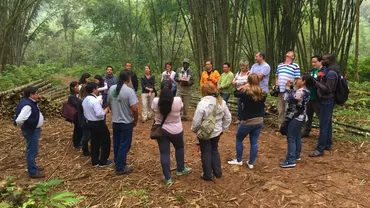
Members of the Setidevi dairy cooperative are feeding tree fodder to dairy livestock to increase milk yields, farmer income and tree cover across the middle-hills of Nepal (Photo: Duncan Macqueen, IIED)
Nepal is one of those unusual countries where forest cover is increasing: expanding from 26% in 1992 to 45% in 2016. The increase is being driven largely by local participation in tree-growing or forest-managing producer organisations, such as community forest user groups (CFUGs).
For decades, securing community forest tenure across 23,000 CFUGs has underpinned their growing confidence in planting trees. Forests soak up carbon, so growing areas of community forest provides rare, good news for climate action.
Nepal is also months away from graduating from least developed country status to middle income country status as its per capita income grows. How on earth is Nepal achieving this dual feat?
Innovations are emerging as organised groups of producers try and generate income from agroforestry: farming combinations of animals, crops and trees in the same area. Under stable land-use policies, planting or managing trees can make economic sense in many different types of agroforestry systems.
Forest user groups under the Federation of Community Forest Users Groups Nepal (FECOFUN) and the Association of Family Forest Owners Nepal (AFFON) are finding that mixing horticultural crops into forest-management plans can boost income generation. Smallholder farm groups under the National Farmers Group Federation (NFGF) or the Himalayan Grassroots Women’s Natural Resource Management Association (HIMAWANTI) are finding that tree planting within agroecological approaches can boost returns to farming.
Livestock groups, such as the Central Dairy Cooperative Association Limited Nepal (CDCAN) or the Federation of Central Livestock Fishery Cooperative (FELIFICON) are finding that tree fodders increase the yield of milk or meat. Innovations in agroforestry are underpinning increases in both tree cover and rural income.
Well-organised smallholder farmer groups are driving useful change
For more than a decade, the Forest and Farm Facility (FFF) has been providing direct financial support to groups of forest, farm and livestock smallholders in Nepal such as FECOFUN, AFFON, NFGF, HIMAWANTI, CDCAN and FELIFICON. These groups have used their strength in numbers to drive major policy impacts.
For example, advocacy by FECOFUN and AFFON reshaped the Forest Act and Forest Regulations in 2024 to allow CFUGs to include agroforestry and ecotourism enterprises, which has accelerated market-oriented tree planting. Additionally, the forest regulations now allow family foresters to grow and sell timber within agroforestry enterprises on private smallholdings.
Both changes to the forest act motivate groups to invest in agroforestry – to the benefit of tree cover and income generation.
Parallel FFF-supported work by NFGF has mainstreamed agroecological approaches, including agroforestry, into Nepal’s municipal agricultural policies, and these have in turn shaped a new agroecological approach within the draft agriculture bill that is currently before parliament.
FFF support to CDCAN has also achieved major policy victories, such as its successful advocacy for a 9% price increase to the government-defined price of milk, which has incentivised dairy production. But CDCAN’s work really stands out in their promotion of innovative tree fodder systems.
Farmers are milking agroforestry systems for all they are worth
As part of an FFF impact assessment visit, I had the privilege of visiting the Setidevi cooperative, which has been supported by CDCAN under an FFF grant to promote models of climate-smart agroforestry fodder production systems.
The Setidevi cooperative has 1,065 members who bring an average of 7,000 litres of milk a day to seven collection centres. What is immediately striking, for a livestock production system, is just how many trees there are in the landscape.

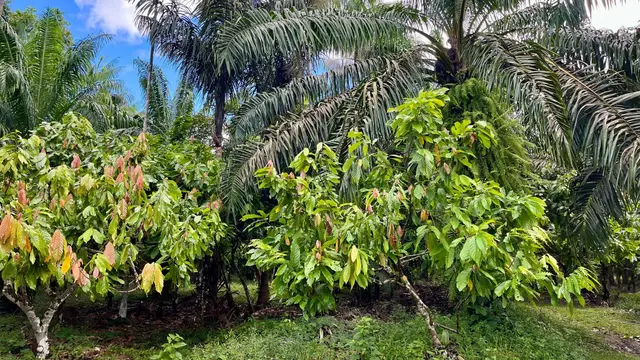
Fodder-oriented agroforestry production system of the Setidevi dairy cooperative in the middle-hills of Nepal (Photo: Duncan Macqueen, IIED)
The fodder-oriented agroforestry production system involves a combination of at least five varieties of napier grass (napier, super napier, red napier, and C4 and C5 napier).
The grasses are cut and mixed with leaves from at least nine tree fodder species, such as Leucaena leucocephala, Ficus semicordata, Ficus sarmentosa, Ziziphus mauritiana, Bauhinia purpurea, Bauhinia variegata, Morus nigra, Artocarpus lacucha and Prunus cerasoides. Stems of the widely planted sweetcorn are also chopped, mixed and dried into nutritious silage.
Farmers cut napier grass every 15 days and tree fodders twice a year, but stagger which trees are cut to ensure a regular supply of fodder. Farmers also mix fruit and spice trees into the system – such as persimmon, cardamom, citrus, plum, banana, almond and pear – building climate resilience by advancing agrobiodiversity.
The Setidevi cooperative has also established within its local CFUG some 30ha of fodder species. Every 2-3 months, they open this CFUG area for 20-22 days, to allow farmers who have a shortfall on their own land to collect fodder from the forest.
Self-mobilised finance is driving climate action
Another key innovation is the Setidevi savings and credit fund. The fund has built up a total capital of US$1,094,890. Members can take out small loans for dairy-related activities, such as buying cattle, building cowsheds and establishing tree-based fodder systems.
If saving in the scheme, they earn 10% interest on their savings; and if taking out a loan, they are charged interest at 12-14%. It is self-mobilised finance systems like these – and not multilateral climate funds or commercial banks – that actually reach farmers and provide the funding they need for climate and nature action, such as establishing these dairy-oriented agroforestry production systems.
As the FFF comes towards the end of its second phase, it is documenting the very large number of positive impacts that come from getting finance directly into the hands of local farmer groups – and the many varied and productive agroforestry systems that they use to increase tree cover and generate income together.
Going forward, FFF hopes to draw into its management regional and global farmer organisations to further enhance its role as a leading mechanism of getting climate and nature money where it matters: to the farmers themselves.
As part of this effort, FFF co-launched TERRA (Together for the Expansion of Resilient and Restorative Agroforestry and Agroecology), a global initiative for scaling restorative agroecology and agroforestry. This includes ensuring greater support and finance for family farmers, Indigenous Peoples and local communities.