Five steps to accelerate finance for climate resilience
The final months of 2026 mark a crossroads for climate finance as the global climate finance system shifts from pledges to implementation. Investors increasingly recognise the value of supporting climate resilience but need an enabling environment. Drawing on conversations at the 2026 London Climate Resilience Finance Summit, we set out five priorities for unlocking finance for climate resilience.



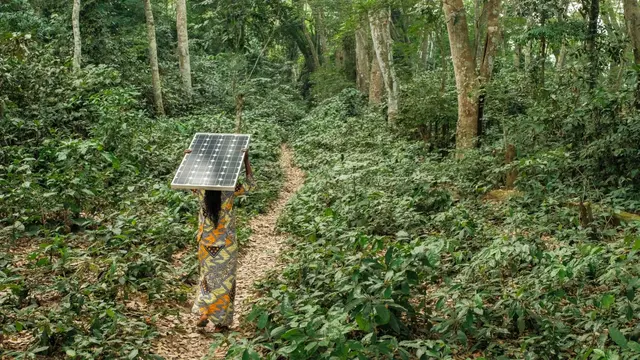
Farmers prepare fields in Turkana, Kenya, using bunds to capture floodwater for irrigation – an example of building resilience to increasingly unpredictable rainfall (Photo: Loes van der Pluijm, via Wikimedia Commons, CC BY-SA 4.0)
Resilience is moving from the margins to the mainstream, driven as much by necessity as ambition. A supercharged El Nino, deadly floods in Nepal and a summer of drought, extreme heat and wildfires across four continents have made the stakes high.
The 2026 summit, convened by IIED and partners, brought together more than 800 senior ministers, bankers, insurers, reinsurers, brokers, investors, business leaders and civil society to identify blockers to resilience investment and how to remove them. IIED researchers joined the summit discussions to learn more about where the system remains stuck.
Blocks we identified:
Resilience-centred investments remain small, dispersed and expensive to initiate. Project preparation, the work of turning early ideas into a pipeline of bankable, investable projects with credible costs, risks and returns, is chronically underfunded. Smaller firms cannot access suitable products or affordable local-currency finance. Despite increasingly informative risk analytics, few borrowers see credit prices fall when they invest in resilience.
Incentives reward the wrong things. Institutions default to minimising near-term risk. Resilience, a longer-horizon and distributed benefit, gets displaced. Countries facing the greatest climate risks pay the highest capital costs. Too little value is placed on coordination between actors who must create a resilient enabling environment.
Bankability is a necessary test, but not a full measure of public value. Finance that reaches only large, established borrowers excludes the smaller suppliers, informal enterprises and frontline communities on whom systemic resilience ultimately depends, and who offer a critical de-risking function.

As Juliana Tinoco of the Global South House philanthropic platform argues, frontline communities are already investing their own labour, knowledge and land in adaptation: recognising that role and channelling capital through trusted territorial funds is itself a form of systemic risk reduction.
These are the handbrakes on resilience finance: capital that cannot find a pipeline, pipeline that cannot find affordable capital, and a risk-and-return frame that reads investment in resilience as cost rather than value.
The vision is equally clear: a financial system that understands climate resilience as necessity, pricing that rewards risk reduction, prudential and disclosure rules that recognise resilience gains, patient and local-currency capital and coordination so no single institution has to move alone.
Five actions to make finance resilience ready
Each actor has a role, and the summit discussions clarified what their priorities should be:
1. Banks and investors: embed resilience in core screening
Instead of hunting for isolated 'resilience projects', investors should routinely test every asset for physical risk and resilience value, using tools such as the IIGCC Climate Resilience Investment Framework and the UNEP FI Adaptation and Resilience Impact Measurement Toolkit.
They should develop patient, local-currency and aggregation vehicles that connect small investments to institutional capital, and test whether avoided disruption and stronger adaptive capacity can move credit spreads and pricing. If resilience truly reduces risk and secures returns, why does finance rarely become more affordable?
IIED's work on redefining credit ratings and unlocking US$1.3 trillion in resilience finance through better risk assessment digs into these mechanics in more depth.
2. Insurers, reinsurers and brokers: do more than retreat on price
In 2025 insurance giant Swiss Re estimated the global natural catastrophe protection gap – the difference between insured and total economic losses – at $424 billion.
To prevent premiums rising further or cover being withdrawn from exposed places, primary insurers, reinsurers, brokers and bondholders must work together on risk pools, engage on public backstops and premium structures that reward measurable risk reduction and release finance early, as the Insurance Development Forum and V20 Sustainable Insurance Facility already show is possible.
Together with governments, they should decide what remains commercially insurable, decide where public backing is essential and reimagine the role of insurers in reducing risk before crises and supporting building back.

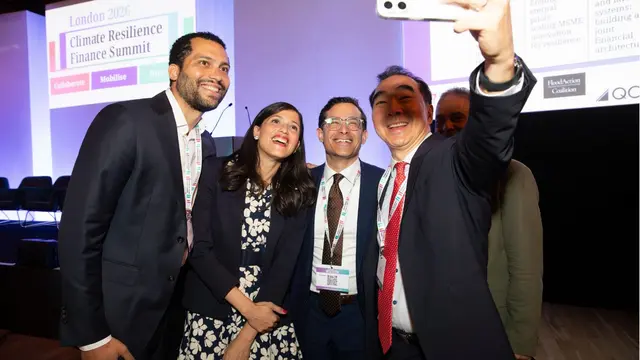
Attendees at the 2026 London Climate Resilience Summit listen to speeches in the opening plenary session (Photo: Benjamin Mole/IIED, Via Flickr, CC BY-NC-ND 4.0)
3. Regulators: set market conditions that make resilience investable
Regulation has moved swiftly in the last year, but there are still major differences in regulations across jurisdictions that offer an opportunity for learning and setting standards.
The Bank of England's supervisory statement SS4/25, in force from December 2025, raises expectations for banks and insurers to manage climate-related risks. But prudential rules, disclosure and solvency treatment, including the European Insurance and Occupational Pensions Authority's work on adaptation (PDF), still under-reward risk reduction.
Regulators must move from measuring downside to recognising resilience gains in capital treatment, stress tests and disclosure, so that insurers and lenders can build resilience rather than retreat from risk.
4. Governments: build resilience into economic decisions
Finance ministries and central banks should treat resilience as macro-fiscal risk management, not an environmental add-on. The Coalition of Finance Ministers for Climate Action (CFMCA) and the Network for Greening the Financial System could take this forward.
The LSE's macroeconomic case for investing in climate adaptation, developed with CFMCA, finds median benefit-cost ratios of around 4:1, rising to 5:1 in lower-income countries. These returns should be built into budgets, procurement, infrastructure decisions and debt sustainability analysis, as the Bridgetown Initiative and V20 have long argued.
This must be set against the fiscal squeeze many Majority World governments now face, where debt repayments continue to eclipse climate finance and aid budgets are being cut.
The share of pre-arranged crisis finance must be lifted tenfold by 2034. This must be part of a wider shift to allocating finance to reduce risk and target anticipatory finance, taking advantage of better, longer-range early warnings.
5. Businesses: share responsibility for supply-chain resilience
Buyers cannot map climate risks facing suppliers and then pass the cost of adapting on to them. This is a recipe for a wider system failure.
Real commitment should be visible in purchasing terms, budgets and board decisions, and the design of supply chain instruments and financing approaches.
The question is not only whether a business is protected, but whether its decisions strengthen the resilience of those around it, including the labour and communities on which they rely.
Making the next few months count
Every proposed solution should answer three questions: who pays, who benefits and who decides? But it must also answer a fourth – and this was the clearest message from the summit: what is the incentive to act now? Investors and financiers of resilience need a visible, near-term upside.
Achieving change will depend on continuing to convene the whole ecosystem, because each actor’s move is contingent on the others: banks need regulators to move, insurers need governments, governments need pipeline, pipeline needs capital, and all of them need frontline voices in the room.
Each call to act can be tested in the coming months. From Climate Action Weeks in New York and Bangkok, to the International Monetary Fund and World Bank Annual Meetings to COP31 in Turkey, the next few months offer many moments to transform these ideas into practical commitments.