Spurring finance for climate resilience
Global investment in climate resilience is far short of what is needed. As climate impacts increase, this funding gap is becoming a significant risk. Yet investing in resilience is also a major business opportunity. IIED convenes the London Climate Resilience Finance Summit to advance a long-term vision for how we can invest money now to avoid future losses.


Audience members listen to the opening plenary speeches of the London Climate Resilience Finance Summit 2026 (Photo: Benjamin Mole/IIED)
2026 has seen severe heatwaves in Europe and South Asia, causing heat-related deaths, infrastructure damage, livelihood loss and economic disruption. In Canada, unusual heat triggered wildfires that burnt millions of hectares. At the beginning of the year, flooding in southern Africa destroyed crops, homes and livelihoods.
As communities and businesses worldwide face the destructive impacts of climate change, finance for climate resilience is increasingly being recognised as a crucial component of reducing risk.
But despite the urgency, resilience investment remains relatively small. Banks and investment companies struggle to find a steady pipeline of investable resilience projects, and allocating funding to resilience measures is too often categorised as a cost and not as an investment in a more secure future.
The challenges are especially severe for least developed countries, Small Island Developing States and other vulnerable countries which are experiencing growing climate impacts while facing debt that leaves them unable to build the resilience they need.
Yet investing in resilience is a major economic opportunity: it supports productivity, security and economic stability.

The London Climate Resilience Finance Summit is designed to transform that recognition into investment. The summit convenes investors, governments, financial institutions and communities to discuss how to mobilise finance for a climate-resilient future and explore practical pathways for integrating resilience into every investment decision and business process.
Five shifts to scale resilience finance
Based on our research and summit discussions, IIED has identified five steps to accelerate resilience finance:
1. Banks and investors should routinely test every asset for physical risk and resilience value
2. Insurers, reinsurers and brokers must collaborate on risk pools, reward risk reduction action and release finance quickly when crises hit
3. Regulators need to create frameworks that encourage efforts to reduce risk and set market conditions that make resilience investable
4. Governments should treat resilience as a core part of protecting public finances and long-term debt sustainability, not an environmental add-on. International public finance has a critical role to play – particularly to support the most vulnerable and to help unlock private investment at scale, and
5. Businesses should commit to sharing responsibility for supply-chain resilience.
Reframing resilience as an investable asset
IIED is aiming to change how decision makers think about climate risk, showing how resilience can be reframed from a perceived cost into an investable asset.
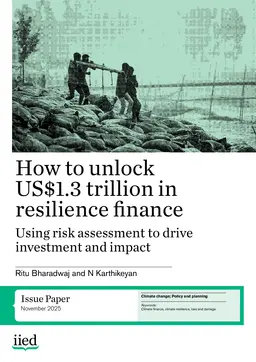
A recent IIED paper showed how the insurance sector can support this shift: the sector’s risk analytics and engineering expertise can quantify avoided losses, identify resilience-building opportunities and demonstrate financial returns, potentially turning resilience into a mainstream, finance-ready asset that is investable at scale.
Looking ahead
Evidence shows investing in protecting households, communities, businesses and infrastructure delivers long-lasting benefits. The coming year is a critical moment to remove barriers to resilience investment and grow the finance needed to protect communities and economies from growing climate threats.