Accelerating energy access in DRC through inclusive, cross-sectoral planning
IIED, STEER Centre and the 11th Hour Project are partnering with the Mwangaza Network in the Democratic Republic of Congo to promote energy access through awareness raising and training on inclusive planning of energy services aligned with local needs and priorities, using the Energy Delivery Models (EDM) approach.

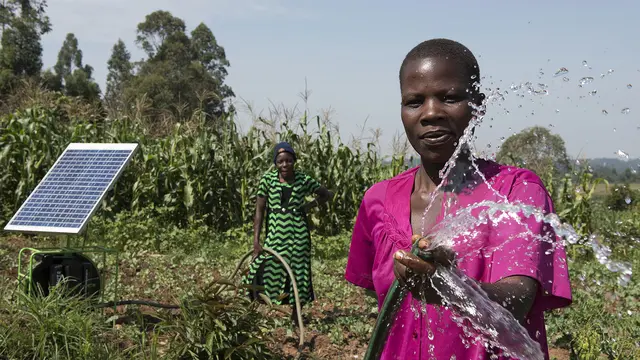
A woman carries a solar pannel near Yangambi, DRC. Rural communities are disproportionally affected by the limited access to energy in DRC (Photo: Landscape Alliance, via Flickr, CC BY-NC-ND 2.0)
Democratic Republic of the Congo (DRC) has abundant renewable energy potential. Yet only 22% of the population has access to electricity and only 5% have clean cooking. Where people are connected, the electricity supply is often unreliable.
Limited access to energy constrains households, communities and livelihoods, restricting economic opportunities and delivery of essential services such as healthcare, education, water and sanitation. These impacts disproportionally affect low-income households, rural communities and other marginalised groups, reinforcing existing social and economic inequalities.
Access to energy is constitutional right in the DRC and the country has ambitious targets for achieving Sustainable Development Goal (SDG) 7 on modern energy for all by 2030. Yet progress remains limited due to the absence of a national energy policy framework integrated across development sectors, and lack of effective sub-national energy planning.
Since July 2024, IIED and Loughborough University’s Centre for Sustainable Transitions: Energy, Environment and Resilience (STEER), have been working with civil society organisations in the Mwangaza Network. The aim is to strengthen their capacity to engage with government and other stakeholders on the added value of more inclusive and cross-sectoral planning approaches to accelerate progress on DRC’s SDG 7 targets and wider development goals.
What are the project partners doing?
The collaboration began with a learning exchange in Naivasha, Kenya. Mwangaza Network and DRC government representatives explored Kenya’s new integrated national energy planning framework and gained insights from Kenyan government officials and civil society organisations involved in sub-national energy planning.
Following this, in 2025, 45 Mwangaza representatives took part in online training sessions on the EDM approach and its use in county energy planning in Kenya. Participants learned how the six-step approach is used to identify the priority development needs of end users, the energy and non-energy barriers to meeting them, and to develop inclusive and sustainable solutions.
Further workshops in Dar es Salaam and Nairobi supported Mwangaza to analyse relevant national and sub-national policies, including DRC’s mission 300 compact, and develop influencing strategies.
During 2026, the Mwangaza Network has been carrying out engagements with key stakeholders on energy planning and investment at national level and across seven provinces. A high-level roundtable is planned for autumn 2026 in collaboration with the DRC Ministry of Energy.
In 2027, the partners will undertake a targeted programme of capacity building for women working in Mwangaza, to build their expertise on energy access and the gendered nature of energy poverty.
An EDM demonstration project is also being planned at sub-national level in Lualaba province. The project will provide a practical example of inclusive, cross-sectoral planning and implementation, and aim to deliver concrete development impacts for local communities. Through 'learning by doing' it will build capacity of the host organisation and other Mwangaza members and collaboration with other partners such an ANSER (the rural electrification agency) to generate learning and future opportunities.
Additional resources
Accelerating local development through inclusive energy planning: lessons from Meru county, Kenya, Enzo Leone, Sarah Wykes, Emmanuel Cyoy, Yvonne Ogao (2026), IIED briefing
Tools and approaches to support needs-based demand assessment and investment in County Energy Planning in Kenya, Ben Garside, Daniel Mwendwa, Adrian Onsare, Sarah Wykes (2023), UKPACT working paper
Modelling needs-based county energy demand: a case study using Meru County CEP solutions, Daniel Mwendwa, Adrian Onsare, Sarah Wykes (2023), UKPACT working paper
Vertical collaboration for county energy planning in Kenya, Emmanuel Ngeywo, Sarah Wykes (2022), UKPACT working paper
Data needs for county energy planning in Kenya, Emmanuel Ngeywo, Ben Garside, Adrian Onsare, Sarah Wykes (2022), UKPACT narrative report
EDM for community and local development (2022), Energy Delivery Models
Energy services for local development: integrated and inclusive planning for county governments in Kenya, Ben Garside, Nipunika Perera (2021), IIED working paper
Planning pro-poor energy services for maximum impact: the Energy Delivery Model Toolkit (Indonesia), Ben Garside, Sarah Wykes (2017), working paper
Water, crisis and conflict in MENA: how can water service providers improve their resilience?, Loan Diep, Tim Hayward, Anna Walnycki, Marwan Husseiki, Linus Karlsson (2017), IIED working paper
Long read: Five fundamentals to keep Lebanon's water flowing, by Anna Walnycki (December 2017)