Women producers’ dialogue series: digital technologies
This dialogue discussed how forest and farm producer organisations can harness digital technologies to provide tools and services that advance the cause of women producers, entrepreneurs and leaders.

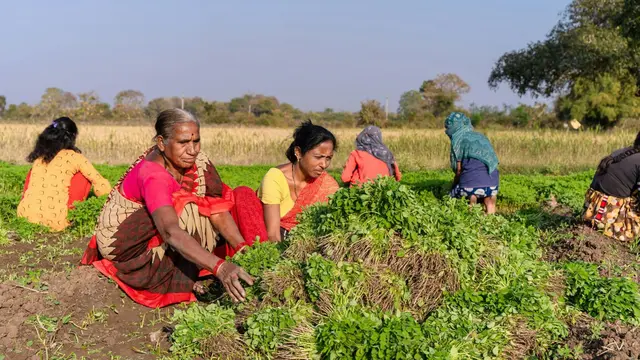
Women leading the way in digital financial inclusion (Photo: copyright SEWA)
As one of the implementing partners of the Forest and Farm Facility (FFF), IIED is hosting an online dialogue series for women-led or majority women forest and farm producer organisations (FFPOs).
The aim of the dialogues is to create a space for women producers, entrepreneurs and leaders to connect with each other, share and exchange experiences and ideas, and support and inspire one another around women’s empowerment in their own contexts.
This second dialogue explored how digital technologies can become useful tools in advancing the cause of women producers, entrepreneurs and leaders in rural areas of the global South.
More than 30 women representatives of majority women or women-led FFPOs actively participated in the dialogue.
Speakers
- Kata Wagner (moderator), researcher, IIED
- Varsha Mehta, independent researcher, India
- Nguyen_Huu Nhuan, Vietnam National University of Agriculture (VNUA)
- Ana Osuna Orozco, Rainforest Foundation UK
Event coverage
With the intent to inspire participants to reflect on the usefulness of a range of digital tools in their own contexts, the speakers introduced seven innovative digital technologies used either by women producers and entrepreneurs themselves or by support organisations in their efforts to advance women’s equity.
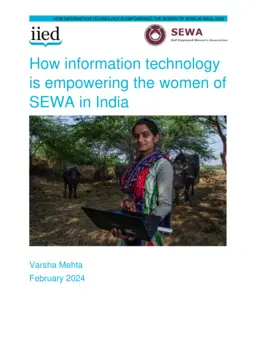
The initiatives presented included four digital technology tools developed by the Self-Employed Women’s Association (SEWA) in India, including the:
- SEWA mobile membership management system
- RUDI Sandesha Vyavhar mobile business application for logistics management and marketing of SEWA-owned RUDI branded products
- SEWA mBachat mobile savings application, and
- SEWA Bazaar, the digital social enterprise used to sell SEWA members’ products imbuing SEWA values and ethics.
There was a digital traceability system using QR codes and a mobile production diary application to support the Tu Nhien Cooperative (Viet Nam) members’ safe vegetable production and to boost their products’ market value, plus digital tools developed by the Rainforest Foundation UK to aid communities and women claim their land rights (MappingForRights and Haki Ardhi).
After the presentations, participants discussed in smaller groups challenges and solutions based on their individual experiences around digital information and communication tools, and how these can realistically be put to use to close the gender gap.
Dialogue participants collectively identified a range of potential applications of digital tools that have the promise of advancing women producers and catalysing change. These included:
- Agricultural e-commerce platforms can, for example, boost women's economic initiatives by raising awareness of and enabling access to non-local markets, by enabling collective marketing and formal contract negotiations, and by increasing incomes through a broader customer base, access to information on market trends and customer preferences.
- Digital financial services can further inclusion and financial independence for women by helping to overcome geographical distances to financial service providers. Access to financial services can in turn aid in formalising budding businesses and help build credit histories necessary for larger loans. Digital accounting tools further offer the opportunity to improve the financial management of local credit mechanism.
- Digital capacity building tools can support skill development for women who are often forced to cut their formal education short, for example by connecting women through mobile phones to mentorship services or by enhancing access to extension and advisory services to women via mobile phones. This in turn increases agricultural productivity and women’s confidence, as well as gender equity within households and communities.
- Vital decision-making processes linked to agricultural and forest production may be significantly improved through access to timely weather forecasts and disaster warning systems.
- Online networking and collaboration between women who might be geographically too distant to meet in person - being often more bound to their households compared with men due to the traditional distribution of roles and responsibilities - enhances collective action and organisation of women. A united voice may in turn bring about greater visibility and recognition of women’s contributions in their communities.
- Established women organisations’ may amplify their messages and inform a wider public about their activities and services for their women members through digital media. Increasing their outreach in this way allows organisations to grow their membership and increase their influence on decision making processes that touch on their members’ interests.
- Digital tools allow in general for greater flexibility and time savings that allow for easier accommodation of the triple responsibility of women in productive, reproductive and community roles.
- Mastering ICT tools can boost confidence and social standing of women within their households and communities.
While the discussions during the dialogue focused on gender-specific benefits of digital tools and services, a number of potential useful applications for men and women producers and their organisations were also identified. These included how:
- Using digital tools as repository of membership and other information enables FFPOs to increase their efficiency in responding to calls for proposals for which such information is required, increasing their members’ opportunities for external support.
- Digital technologies may also help producers minimise production costs through, for example, lowering post-harvest losses through digital monitoring of appropriate storage conditions in warehouses.
- The development of digital maps of FFPO-managed landscapes can render relevant information of relevance for community management and development available for planning and decision-making processes.
Dialogue participants also observed some common challenges they experienced in the development of digital tools and services in their respective organisations and collectively devised suggestions on how to overcome these.
These included how learning to use digital tools can be a challenge for rural women producers when there is a lack of continuous capacity building and support. Digital tools that are based on less complex technologies can therefore often be more valuable and enhance accessibility (such as using mobile phones that are not smartphones).
The presented case studies highlighted that women may acquire new skills in multiple, sometimes informal ways including through their more technologically-savvy children and through collective learning in groups in which women can motivate each other. Any approach to further the uptake of digital tools among women forest and farm producers should therefore be inclusive, encourage knowledge exchange and integrate the youth.
Engaging young people in digitisation strategies may also be useful in encouraging their involvement in the organisational structures of producer organisations and to motivate against rural outmigration.
Digitalisation processes also vary with their contexts. Rural areas in the global South in particular present unique challenges, with rural women facing additional challenges compared to their male peers, in the form of limited access to infrastructure, low literacy rates and socioeconomic inequalities.
The development of digital tools and services should therefore be carried out in respect of the specific territorial context using participatory and adaptive approaches that emphasise community and collective development.
New digital tools and services may also carry risks for their users. For example, online product traceability systems store a wealth of information on individual producers and sensitive data may be exposed if appropriate security measures are not implemented.
It is therefore vital to design digital tools adapted to their intended users’ needs and capacities and to offer tailored training programmes as well as ongoing support to mitigate any risks they may carry.
Watch the dialogue recording
Watch a recording of the second dialogue in English below or on IIED's YouTube channel. The recording is also available in French and Spanish.
Additional resources
How ICT is empowering women entrepreneurs in Vietnam: a case study of Tu Nhien Cooperative (2024), Nguyen Huu Nhuan, report
How information technology is empowering the women of SEWA in India (2024), Varsha Mehta, report
Contact
Kata Wagner ([email protected]), researcher (forests and prosperity), IIED's Natural Resources research group