Training women to influence high-stakes international climate talks
IIED and partners are training a new generation of women climate negotiators from the least developed countries, helping ensure the knowledge and priorities of women from their countries, shape outcomes of the UN climate talks.

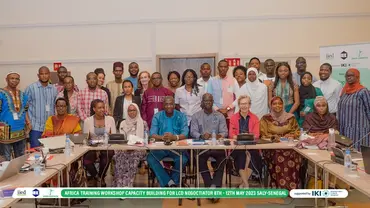
Young negotiators take part in a mock UNFCCC simulation exercise during the Africa Regional Training Workshop in La Somone, Senegal (Photo: copyright Ibra Seck, ENDA Energie)
IIED alongside partners ENDA Energie (ENDA), Prakriti Resources Centre (PRC) and Legal Response International (LRI) are continuing the crucial work to equip climate negotiators from the least developed countries (LDCs) with knowledge, skills and confidence to negotiate for ambitious action to tackle climate change.
With limited financial resources, the LDCs – despite being the countries most vulnerable to the impacts of climate change – struggle to make their voices heard at these global summits. Many attend their first negotiating sessions with little exposure to the complex process. It’s often a case of learning on the job.
Women remain underrepresented. And it’s about more than uneven numbers: data shows even when women are part of their country delegations, speaking time and decision-making positions are monopolised by men. Women typically take on administrative roles.
So being a woman, and from the LDCs, the barriers are twofold.
Trained by LDC experts
Through our programme, nearly 100 women from the LDCs have been trained − well over half of all the early-career negotiators who have taken part.
This meaningful experience has strengthened my commitment to advancing climate action and advocating for the interests of the world's most vulnerable countries
− Hamda Abdallah Amin, Djibouti
Our immersive three-day regional training workshops bring together delegates from Francophone Africa, Anglophone Africa and Asia and the Pacific to build their knowledge of key negotiation issues and develop practical skills.
The workshops are co-designed and delivered by experienced LDC negotiators ensuring the training is regionally grounded and geared towards the LDCs’ priorities.
Delegates participate in realistic UNFCCC mock negotiation sessions, receive guidance and presentations from seasoned LDC negotiators and legal experts, and build supportive peer networks.
Negotiation capacity, technical understanding and process is fundamental for those of us representing our countries. It shapes how effectively we engage across agenda items and influence outcomes
− Ayan Harare, Somalia
And impact extends far beyond the workshops. With new skills and knowledge, trainees take on new responsibilities and grow into leadership roles within the LDC delegation and at national level. Foundations are laid for new generations of women climate negotiators to step forward − equipped, connected and ready to lead.
Further reading
Article: Targeting support to women
Insight: Understanding the gender imbalance at the international climate negotiations, Fernanda Alcobé and Elaine Harty (June 2023)