Items tagged:
Urban crises
-
Multiple housing and climate-related vulnerabilities of informal workers in Indore, India
While informal workers in Indore, India contend with multi-faceted vulnerabilities, recent research shows a gradual transition towards resilience. Guest bloggers Siddharth Agarwal and Kanupriya Kothiwal discuss the findings.
-
The case for sewers
On World Toilet Day 2021 we take a look at the surprisingly controversial role of sewers in countering poor-quality sanitation in cities in the global South
-
Can we reduce urban poverty and inequality and achieve net zero cities?
This year, World Habitat Day focuses on how cities can develop practical, workable plans for a carbon-free world. Over half the world’s population live in urban areas, so it’s unsurprising that cities are responsible for 75% of carbon emissions. Anna Walnycki and Tucker Landesman explain why efforts to achieve zero carbon cities will only be successful if they simultaneously address pervasive urban poverty and inequalities
-
Book summary: Resilience reset − creating resilient cities in the global South
A book co-authored by IIED’s Aditya Bahadur and Thomas Tanner of SOAS makes the compelling case for a "resilience reset" – to take stock and chart a new path to enhance resilience in the world’s towns and cities, particularly in the global South
-
Community-led COVID-19 response: an update from the Philippines
One year on, Ruby Papeleras and Migo Gaddi provide an update on the action of the Homeless People’s Federation of the Philippines in its fight against COVID-19, including case studies of what has been done in the cities of Davao and Talisay
-
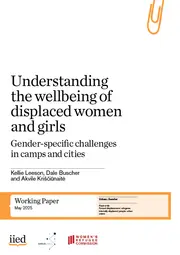
New website for research into refugee wellbeing and livelihoods
IIED and partners have launched a website that focuses on the wellbeing, self-reliance and livelihoods of displaced people in urban areas and camps in four countries
-
Rethinking humanitarian aid for refugees as investment in urban water and sanitation
This research looks at the issue of forced displacement through a new lens. It will model what could be achieved for refugees and their hosts if resources spent on camp populations were invested instead in services and infrastructure in towns and cities hosting refugees
-
City residents and urban refugees: from shared living to shared futures
Tools used to document the impacts of the COVID-19 pandemic in one of Nairobi's largest informal settlements are also being used to chart how the lockdowns disproportionately affected displaced people
-
Urban Crises Learning Fund
Urban areas are increasingly the sites of humanitarian crises, from natural disasters to conflict and displacement. Through a programme of research, documenting and learning from experience and development of tools and approaches, IIED is working to build the knowledge and capacity to respond of humanitarian actors working in urban areas, and of urban actors facing humanitarian crises
-
Introduction to urban crises and forced displacement
IIED’s programme of work brings together diverse perspectives on humanitarian emergencies and forced displacement, to inform new directions in urban crisis response
-
Community-led COVID-19 response: the work of the Philippines Homeless People’s Federation
Based on member interviews and accounts, the Philippines Homeless People’s Federation describes how community organisations have rallied to support vulnerable groups, hit hardest by the pandemic
-
Haiti earthquake 10 years on – a new chapter in disaster response
A decade after the devastating Haiti earthquake, Lucy Earle reflects on the humanitarian response to the tragedy and its urban setting – and the lessons that have been learned for disaster response
-
Learning from community planning following the Haiti earthquake
IIED has created an online learning archive to document community planning in post-earthquake Haiti
-
IIED publishes archive on post-quake planning in Haiti
IIED is marking the ten-year anniversary of the Haiti earthquake by publishing an online archive documenting post-disaster community planning work in the city of Port-au-Prince. IIED will also launch a working paper summarising the experience gained in Haiti and host a discussion meeting later this month
-
Towards more inclusive urban health systems for refugee wellbeing
The British Academy’s Cities and Infrastructure programme funded IIED to work with partners in Kampala, Uganda and Nairobi, Kenya to undertake research on access to healthcare and other basic services for urban refugees
-
Responding to protracted displacement in an urban world
IIED is leading a study that will compare the experiences of refugees and internally displaced persons (IDPs) in cities and camps in four countries – Afghanistan, Ethiopia, Jordan and Kenya
-
Kampala sets example for how cities can help refugees
On World Refugee Day Diane Archer looks at how one city in Africa is exploring ways to support its refugee and migrant population
-
Water in MENA: ripple effects in times of conflict
The Middle East and North Africa (MENA) region has been hit by a wave of conflicts and crisis. A new study looks at how to improve resilience of water services in the region
-
Urban crises conference: time to put learning into practice
An international conference on how best to respond to humanitarian crises in urban areas ended with calls to put research into practice and to improve engagement with local communities
-
Q&A: How to negotiate safe access to gang-ruled neighbourhoods in areas of urban crises
In the latest issue of Environment & Urbanization, Moritz Schuberth examines the added difficulties humanitarian actors face when dealing with crises in urban neighbourhoods ruled by gangs. Schuberth studied the neighbourhoods of Port-au-Prince, Haiti, in the aftermath of the 2010 earthquake to find out how agencies can deliver the most effective response
-
Stronger Cities Initiative
Urban crises challenge the traditional ways of working for humanitarian organisations. The International Rescue Committee, Norwegian Refugee Council and World Vision worked together to develop a suite of tools and practical guidance notes to promote improved responses to urban crises
-
Urban Crises Learning Partnerships
Two learning partnerships have helped IIED to address gaps in knowledge, skills and understanding among national and international humanitarian actors and local and national governments, in order to provide a better basis on which to prepare for and respond to humanitarian crises in urban areas
-
Coping with forced displacement: lessons from cities
People forced to leave their homes are often displaced for many years, and most end up in urban areas. So how can host cities become more resilient while managing such crises? A meeting last week shared learning from Africa, Asia and the Middle East, reports Diane Archer
-
Cash transfers in urban crises: do they work for women?
Twenty months on from the earthquakes in Nepal, new research will examine whether cash transfers are helping women to participate in, and contribute to, the Kathmandu Valley's local economy
-
Collaborations in urban humanitarian response – introducing the Global Alliance for Urban Crises
The way we prepare for and react to humanitarian crises in towns and cities will be enhanced by a more collaborative approach
-
Responding to cities under siege
How can humanitarian programmes improve civilian protection in war besieged cities?
-
Ten urban planning principles every humanitarian should know
As cities are increasingly where humanitarian action responds to crises, can urban planning principles help humanitarians intervene more effectively?
-
Why urbanisation matters in responding to humanitarian crises
While the plight of Syrian refugees trying to get to Europe is grabbing attention, far more are living in cities and towns in the region. IIED hosted a recent workshop to look at how their needs can be best met