If cities could speak: vulnerability, climate and health in the city
IIED and partners are working to understand the impacts of climate change on health in vulnerable urban settlements in India, Kenya, South Africa and Sierra Leone – in order to demonstrate the differential experience of climate change through compelling stories.

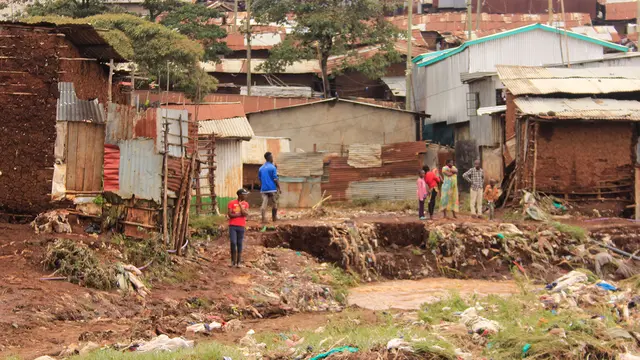
Informal housing in Kibera neighborhood in Nairobi, Kenya (Photo: klndonnelly, via Flickr, CC BY 2.0)
Cities in the global South hold some of the greatest, but most overlooked, climate-related health challenges. Yet, they are also places where there are major opportunities to not only tackle health and climate change together, but also overcome deeply entrenched urban inequalities.
This project, funded by Wellcome Trust under its Climate Impacts Award, will:
- Synthesise and contextualise the impacts of climate change on health in vulnerable urban settlements in India, Kenya, South Africa and Sierra Leone
- Co-produce stories of health-related climate impacts and the actions which could address them in order to bring the complex causes to life, and
- Develop innovative approaches to achieving impact at multiple scales.
What is IIED doing?
Historically, very basic data on vulnerable urban settlements is missing due to their exclusion from formal planning processes. Data on the impacts of climate on health in such settings is no different and, as a result, is poorly understood.
This lack of information is a reason why these settlements are distanced – both socially and spatially – from decision makers even though they are on the frontline of climate change and already experiencing the effects of associated health problems.
The work undertaken by this project sits between research, knowledge and policy, arguing that cities of low-and middle-income countries face an especially urgent imperative to adapt to current and projected climate change impacts while providing avenues for improving human wellbeing.
Work on urban health shows how social and environmental determinants mean that personal and household economic status, identity-based inequality, and social and physical environments, determine health outcomes.
The project team will collaborate with communities from vulnerable settlements, such as informal settlements and workplaces, communities living in occupied buildings and worker housing colonies, to show both the increasing and differential experience of climate change, as well as its impacts on health outcomes.
IIED will convene workshops with residents to shape and deliver community-led narratives of how climate change impacts health. Through continued engagement, project partners will tell stories about climate’s impact on health, as well as offer ways of engagement and response using geography-specific strategies.
This process will be enhanced by research showing household and community health histories to encourage evidence-based policy uptake. The project will utilise audio-visual storytelling, including documentary films as well as photo and film exhibitions.