Trailblazing in Tomé Açu: inspiring a global agroforestry transition in northern Brazil
Locking up carbon globally while also feeding the world requires an agroforestry transition – and fast. As part of new Brazilian initiative TERRA, a pioneering industrial-scale agroforestry system in Tomé Açu has almost doubled crop yields compared to monocultures, proving that food production, conservation and decarbonisation can go hand in hand.


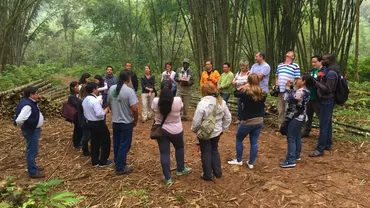
The Sistema Agroflorestal Dendê – or palm oil agroforestry system – in Tomé-Açu managed by Cooperativa Agrícola Mista de Tomé-Açu (Photo: Duncan Macqueen, IIED)
Tomé Açu is not well known outside of Brazil. Within Brazil, it has become a byword for sustainability. It is home to the Sistema Agroflorestal Dendê – known locally as SAF Dendê – a pioneering mixed industrial-scale agroforestry system encompassing 950 hectares.
Lines of oil palm are spaced with lines of other economically useful trees, bushes and vines such as açai palm, cocoa, banana, andiroba, cupuaçu, tapereba and black pepper.
Palm oil is a vital ingredient in processed foods and cosmetics. In this case, demand comes from Natura, one of the world’s largest and most ethical cosmetic companies.
Natura’s sociobiodiversity product lines source 33 native species from across 53 communities – 46 of them from across Amazónia. But they also need palm oil. Natura’s soap factory at the Eco Park outside of Belém in Brazil now produces a staggering 600 million soap bars a year – 3.2 billion in its 12-year operation. That’s a lot of palm oil.
Making higher yields and income – without harming nature
Normal palm oil monocultures are terrible for biodiversity and soil fertility. But mix it up with other trees and it not only becomes more biodiverse with better soils, it becomes more productive and profitable.
A single cultivated area of SAF Dendê can yield almost double the product value of monocultures. Compared to monoculture yields of around 130kg per palm, the palm trees in mixed agroforestry regularly yield upward of 200kg per palm.
Despite the wider spacing, palm oil yields per area exceed monoculture yields. And the multiple additional value streams from other crops also spread income for farmers across the year – especially when you include honey and three edible species of wild mushroom.
Underlying this SAF Dendê system is 18 years of research by CAMTA (Cooperativa Agrícola Mista de Tomé-Açu – Tomé-Açu Mixed Agricultural Cooperative) and support agencies including Embrapa (Empresa Brasileira de Pesquisa Agropecuária – Brazilian Agricultural Research Corporation) and the Landscape Alliance. But SAF Dendê is only one of almost 200 different agroforestry combinations pioneered by CAMTA that cover a rapidly expanding 7,000 hectares. They are not as biodiverse or carbon rich as natural forests: but for a production system, they are not bad!
CAMTA is where the magic happens. It is a 90-year-old collective organisation registered as a cooperative. It was established by generations of Japanese immigrant and now nationalised farmers. Founded to supply black pepper, and at one time the world’s largest exporter, CAMTA suffered a major setback in 1967 with the outbreak of the naturally occurring fusarium solani – soil fungal disease.
Monocultures are a nightmare for disease outbreaks: in CAMTA’s case, the outbreak swept through the ranks of uniform black pepper plants like wildfire. So in the wake of that outbreak, CAMTA began to experiment with more diversified planting arrangements, and worked with Indigenous Ribeirinho communities to mix in native fruit and timber trees.
Inspiring a global agroforestry transition
Fast forward to the present, and CAMTA’s SAF Dendê is the aspirational poster-child of a new Brazilian initiative aptly named Together for the Expansion of Resilient and Regenerative Agroecology and Agroforestry, or TERRA (in Portuguese, ‘terra’ means soil, land and planet earth).
Launched at the UN climate change conference (COP30) in 2025 in Belém (a three-hour drive from Tomé Açu), the TERRA initiative is Brazilian and was born and led by the Ministry of Agrarian Development and Family Farming (MDA).
Since 2024, Brazil had chosen a new agricultural path called the National Productive Forest Programme. It envisions farmland covered in trees – increasing food security, mitigating and adapting to climate change, conserving biodiversity and enhancing farmer incomes.
No longer need agriculture be the primary cause of tree-cover loss. Food production and conservation can walk hand in hand. That’s the vision – and SAF Dendê is one glowing testimony to what might be possible.
Brazil’s MDA is not the only agency that believes in the possibility. Among other founding partners of TERRA – such as the Agroecology Coalition (with its huge membership), the International Fund for Agriculture and Development (IFAD), NOW Partners and Alliance Bioversity & CIAT – is the Forest and Farm Facility (FFF).
The FFF is a partnership of the Food and Agriculture Organization of the United Nations (FAO), IUCN (International Union for Conservation of Nature) and its myriad members, the global alliance of agri-agencies (AgriCord), and IIED. Namechecking these organisations (and many more friends of TERRA) makes the point that many people believe in this possibility.
Making agroforestry magic: financing and support
An agroforestry transition has upfront costs as planted trees take time to produce.
Since 2012, the FFF has supported many hundreds of collective organisations such as CAMTA to improve agroforestry uptake across 15 countries. Working together and sharing know-how and funding is what makes the transition to agroforestry possible.
Collective organisations help their member-farmers understand the productivity and profitability benefits. They help members with planting tips, seed, inputs, loans, labour, routes to market and much more. FFF is helping spread the magic seen in cooperatives like CAMTA.
FFF is now working with the Brazilian MDA and TERRA partners to internationalise Brazil’s National Productive Forest Programme – acting as one of three dedicated TERRA funding mechanisms – and the FFF’s unique focus is the direct financing of collective organisations.
Our hope is that a Global Productive Forest Initiative will spread agroforestry to secure food, raise incomes, mitigate and adapt to climate change, and conserve biodiversity, soil fertility and water cycles.
Tragically, official development assistance (ODA) fell by 23.1% from 2024-25 led by the US (three quarters of the decline), but including also Germany, the UK, Japan and France (accounting together for 95.7% of the decline).
We need to reverse these declines which put our own young people at risk, stick with the 0.7% ODA target agreed by the UN General Assembly in 1970 to protect our and their futures, and invest in an agroforestry transition.
If you would like to support TERRA and the Forest and Farm Facility do get in touch with IIED or any of the TERRA or FFF partners.