Multilateral climate funds for climate adaptation
IIED is advocating for reforms in the multilateral climate finance architecture, through research and engagement with civil society organisations, practitioners and policymakers to improve the quantity and quality of adaptation finance reaching the local level in countries most vulnerable to climate change, including the least developed countries and the Small Island Developing States.

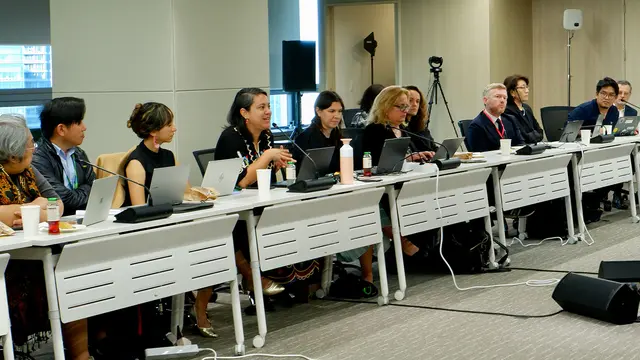
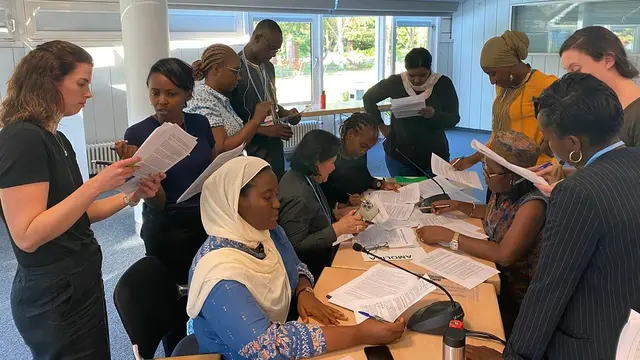
Multilateral climate funds are key to the delivery of adaptation finance (Photo: Green Climate Fund)
Climate change is having increasing and devastating impacts on millions of people around the world. But the provision of resources to those most vulnerable to address its impacts has been consistently inadequate.
With the world on track for a 2.3-2.5°C increase, it is more important than ever to ensure that no one is left behind in the face of increasing climate impacts. IIED is working with partners to get money where it matters.
The challenge: resourcing responses
In 2009, countries agreed to a goal of jointly mobilising US$100 billion a year by 2020 to address the needs of developing countries, with a balance between adaptation and mitigation, and to be channelled through effective and efficient fund arrangements. While this target was largely met in 2022, it remains riddled with issues of quality, balance and access.
In 2024, at COP29, parties agreed to the New Collective Quantified Goal (NCQG) (PDF) as the post-2025 global target. The NCQG sets out a commitment in mobilising $1.3 trillion a year by 2035 from all actors, with $300 billion a year as public finance from developed countries.
The NCQG also sets a target for outflows from multilateral climate funds to be tripled by 2030, relative to their 2022 baseline. This will significantly scale up the finance delivered through these funds.
In 2025, Belém’s Mutirão decision (PDF) included a target to triple adaptation finance by 2035 relative to the 2025 baseline, which further bolsters the NCQG target.
Source: OECD 2024 (PDF). Based on the Biennial Reports to the UNFCCC, OECD DAC and Export Credit Group statistics, complementary reporting to the OECD
Multilateral climate funds such as the Green Climate Fund, Adaptation Fund, Global Environment Facility and Climate Investment Funds are key mechanisms for channelling adaptation finance. Although only $3.4 billion was allocated through multilateral climate funds in 2022, these funds hold critical political significance, as a function for developed nations to fulfil their commitments under the UNFCCC and, as some of the most transparent mechanisms at the international level, they set the tone and the benchmarks for how adaptation finance can be delivered.
Several multilateral climate funds exist within the climate finance landscape – itself a complex landscape, where each fund has a different focus and entry point, governance and delivery structure, scale, and so on.
The landscape works through multiple actors, intermediaries and systems. This diversity is beneficial for providing improved reach and specialisation, but it can also create complexity that can be hard to navigate for stakeholders.
Some key challenges of accessing multilateral climate funds include:
- Very little funding reaches those most vulnerable to climate change, including least developed countries (LDCs) and Small Island Developing States (SIDS), and even less makes it to local communities who bear the brunt of climate impacts
- Finance flowing directly to national entities in LDCs and SIDS is still notably low, and reforms are urgently needed to ensure changes are made, and
- There are high transaction costs to accreditation and for developing and submitting proposals plus long timelines, which can be burdensome on recipients.
IIED's focus: money where it matters
IIED has a strong network of partners in LDCs, SIDS and other climate-vulnerable countries, and decades of engagement and expertise on climate finance and locally led adaptation. IIED has long engaged with the topic of multilateral climate funds and how they can be shaped to improve accessibility, effectiveness and enabling for those on the frontlines of climate change.
Our current focus is on taking a systemic and sectoral lens, to identify how coordinated change across multiple entry points within the multilateral climate finance system and broader landscape can lead to improved access and quantity of climate finance.
IIED is working in close partnership with civil society organisations (CSOs), governments and the funds themselves, to identify systemic pressure points that create barriers for access, alignment with the principles for locally led adaptation, and delivery. To advance these efforts, we are aim to:
- Strengthen the evidence base, including by bringing in diverse and marginalised perspectives: we aim to produce rigorous and accessible evidence on national, local and international climate finance needs and systems, through collaborative research with partners. We also seek to support the documentation of interventions that are proving innovative, to amplify what is working.
- Foster multi-stakeholder dialogue, communications and knowledge exchanges: we are seeking to foster an exchange of knowledge and learning among key stakeholder through highlighting research, evidence, findings and voices across different spaces and forums, supporting peer knowledge exchanges, multistakeholder dialogues and others.
These dialogues aim to:
– Create horizontal spaces for information sharing, discussions and networking
– Give voice to marginalised actors and stakeholder groups
– Increase understanding of local actors and dynamics
– Identify bottom-up and alternative solutions to relevant challenges in the funding systems, and
– Produce movement or critical mass towards such solutions.
- Support capability development: we aim to support national and local institutions to improve their capabilities to access and deliver climate adaptation and resilience finance effectively.
While the climate funds are already heavily scrutinised, there remain large gaps in bringing in community and local-level voices and experiences of locally-led project implementation.
Better understanding the complexities and nuances of financing processes (from project inception and design and through implementation) can help improve how funds operate, both through refining existing processes and more fundamental rehauls and reformation.
Our work is currently focusing on the following key areas through our lens:
- Direct access for national institutions
- Complementarity and coherence of the funds with each other and the wider landscape
- Use of financial and risk instruments and mechanisms
- Results and monitoring processes, and
- Delivery to under-resourced regions and sectors.
Looking ahead
Given the scale of what’s ahead – in delivering on current commitments of tripling adaptation finance by 2035, tripling the outflows from the climate funds, seeing through the Baku to Belém Roadmap, and on increasing the ambition to meet the needs – a wide-ranging and multi-pronged approach is required through reviewing national experiences and influencing the approach of multilateral climate funds to strengthen the catalytic potential of their work, reforms and implementation.
This research will be a springboard for further work that needs to be done around the risks and opportunities for multilateral climate funds to scale their potential, which may involve the following areas:
- Specific challenges and opportunities for multilateral climate funds in various sectors and geographies, including health, education and urban sectors
- Understanding and leveraging the roles and potential roles of national financial planning systems, national institutions such as national development banks, and subnational authorities
- Exploring where engaging the private sector in adaptation finance could be appropriate and useful, without compromising the objectives of the delivery of adaptation finance and the objectives of reaching the local level in a fair and transparent way, without adding to their burden
- Improving tracking and accountability of the delivery of adaptation finance by financiers, and
- Exploring how impact of investments could be measured and leveraged to improve flows.
IIED’s approach to research and policy has always been rooted in practice. We are actively engaging the funds, CSOs and our networks to document and learn from evidence, share experiences and lessons, and socialise and embed findings on how the funds could adapt their approach to increase climate finance and improve accessibility for those most vulnerable to the impacts of climate change.
If you would like to partner with us on this work by joining a workshop, reviewing our research or supporting the expansion of the work, then please get in touch with Rojy Joshi ([email protected]) and Sejal Patel ([email protected]).
Multilateral climate fund series of insights:






Key resources
Complementarity and coherence among climate funds: a tool for improved access in LDCs and SIDS?, Clara Gallagher, Shaila Mahmud, Rojy Joshi, Nora Nisi (2026), IED working paper
Measuring what matters: climate funds’ results and monitoring systems, Rojy Joshi, Nicola Sorsby (2026), IIED Briefing
The promise of direct access to climate finance: evidence and lessons from LDCs and SIDS, Pia Treichel, Anaa Hassan, Rojy Joshi, Clara Gallagher (2026), working paper
Shifting climate adaptation finance to local communities through effective intermediaries, Noemi Grutter, Leah Moss, May Thazin Aung, Rojy Joshi (2025), IIED Briefing
Locally implemented or locally led? Tracking finance for community climate action, Pia Treichel, Rojy Joshi, Edward N. Taylor, Malcolm Ridout, Paul Mitchell, Aaron Acuda (2025), Issue paper
Scaling locally led adaptation: closing the rhetoric-reality gap, Paul Mitchell (2025)
Insight: Gender equality and climate finance: from local realities to global commitments, Joy Hayley Munthali (2025)
Lessons for designing locally led adaptation programmes, Paul Mitchell, May Thazin Aung, Larissa Setaro (2025), IIED briefing
Rojy Joshi ([email protected]), researcher (climate finance), IIED's Climate Change research group