Faith in ecology: how one group of Indigenous people in the Philippines are advancing agrobiodiversity
The Philippines has recently experienced a series of back-to-back typhoons. Six of these tropical storms have hit the country within the space of a month, causing widespread devastation. As recovery efforts continue, IIED’s Duncan Macqueen reflects on a recent visit to partners in the Philippines, and explains how they’re building resilience to natural disasters by advancing agrobiodiversity in the farming systems.


Races at the Ikalahan Camote (sweet potato) awareness day as part of the 51st anniversary celebrations of the Kalahan Educational Foundation (Photo: Duncan Macqueen, IIED)
The wooden bunk rooms of the Imugan training centre at the Kalahan Educational Foundation (KEF) are set back from a new, steep road linking two municipalities across a mountain pass at Malico, in northern Philippines.
Rain from a succession of six climate-vamped typhoons, which struck the country in October and November of this year, have left landslides around almost every bend in the road and no electricity. Behind it, the training centre nestles in the early morning mist, while a river flows down from the spectacular Imugan waterfalls.
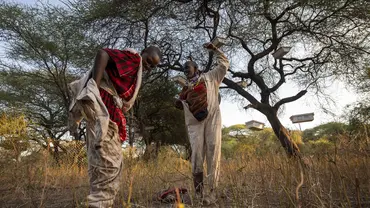
It is in this region that a group of Indigenous people, the Ikalahan (meaning ‘people of the forest’), inhabit an ancestral domain teeming with life – steep slopes festooned with rainforest trees and epiphytes (plants that grow on other the surface of other plants).
But it was not always this way. Half a century ago the mountain slopes were almost completely degraded grassland, unprotected from fires and incursion in the wake of the Japan-America Pacific War.
Within that historical context, on 13 May 1974, Memorandum of Agreement No.1 (the very first of its kind) was signed between a newly established KEF and the national Bureau of Forest Development: the main government forestry agency at the time. That signing was a significant step towards the protection of Indigenous rights in the Philippines.
Restoring forests, farming sustainably
The founders of KEF, under the guidance of an American missionary, the late pastor Delbert Rice, have since overseen a transformation. They have championed traditional sustainable farming practices, the restoration of natural forests and the protection of the Ikalahan culture.
The results are astounding. Fifty-one years since KEF’s launch, forests on the upper slopes have been almost completely restored. In the valleys, diverse traditional agroforestry systems provide multiple products for local subsistence. Coffee is grown under native trees. Traditional farms mix multiple varieties of the staple Camote (sweet potato) with a wide range of other crops and fruit trees.
Most traditional farms use a form of rotating organic agriculture to maintain fertility and manage pests and diseases. Agrobiodiversity maintains healthy nutrition, climate change resilience and functioning natural resilience.
In Imugan, communities have experienced better rights, livelihoods and ecological restoration. Although Pastor Rice died in the community he served a decade ago, his pioneering thinking blending faith and ecology is very much in evidence, and his impressive library in what is known as the ‘green house’ remains a local resource on forest land use, traditional legal systems, linguistics and theology. His legacy has been fondly remembered – especially during KEF’s recent 51st anniversary celebrations.
However, the burgeoning needs of local families has brought with it economic challenges. Children must be sent to school, university fees must be paid. New farm machinery must be fuelled and financed as traditional buffalo use declines.
As a result, several farmers are turning to ‘commercial agriculture’: the monoculture plantation of market garden crops – including some more productive but less nutritious types of sweet potato – in a system that requires significant chemical fertiliser and pesticide use. Bulk produce is sold at a commodity market in nearby Bambang. It’s a tough sell for farmers in the upland valleys, who live far from the markets.
Nurturing nature
It was against this backdrop that the question of whether a business can be made from the area’s traditional agrobiodiverse farming systems came under discussion, during a course on ‘Business unusual’ at the KEF training centre last month. Led by IIED, the course was funded by the Global Centre on Biodiversity for Climate’s (GCBC) Nature Nurture project and organised by the Non-Timber Forest Product Exchange Programme (NTFP-EP).
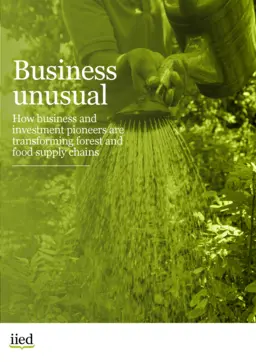
From across the world, IIED presented over 50 examples that illustrate the options for business models built on agrobiodiversity (ie the subset of biodiversity found within agricultural ecosystems: the full variability of animals, plants and microorganisms that make farms function, as well as any wild foods collected).
The challenges lie in the fact that market economics usually drive the homogenisation of the most profitable cash crops. But there are cases where consumers are willing to pay for special products from ‘special places’.
The Nature Nurture project is working with teams in Indonesia, Philippines and Tanzania to see what replication might be possible in diverse contexts.
During the KEF anniversary celebration, conversations with Indigenous leaders explored the option of distinguishing the Kalahan ancestral domain as one such ‘special place’. In addition, the Nature Nurture project is documenting the Ikalahan people’s myriad local crops and livestock – and the difference between traditional and commercial farms.
As part of this, 12 varieties of sweet potato have been collected and established at a Nature Nurture-funded demo farm. And at the anniversary celebrations, a Camote Awareness Day aimed to revitalise sweet potato varieties, in the face of a gradual decline in their use.
The business of agrobiodiversity
Late last month, representatives of IIED and NTFP-EP met with KEF and community elders, with our discussions leading to an emerging road map – exploring how to make more of a business out of agrobiodiversity.
Ideas included:
- Developing the existing ‘mountain fresh’ brand on KEF’s forest fruit jams and jellies as a broader concept
- Moving the entire ancestral domain to a fully-fledged member of the FAO-managed Globally Important Agricultural Heritage Systems
- Supporting the local coffee association to develop a single-origin organic, shade-grown coffee to add to its product portfolio, and
- Securing recognition for KEF’s work to diversify sweet potato varieties in traditional agroforestry systems.
We hope this will serve as an example to others. All over the world, traditional agrobiodiverse farming systems are being lost to land-consolidating commercial agriculture. Just three species of plant (rice, wheat, maize) now account for more than 50% of all plant-based calories. This is not a recipe for nutritional health, food security or climate resilience as the world’s weather goes awry.
That is why it is heartening to see many Indigenous Peoples and local communities like the Ikalahan fighting back, and advancing biodiversity while the climate crisis increases the frequency of intense storms like the recent typhoons in the Philippines.
A good dose of faith in ecology seem to provide a solid starting point. Together with collective organisation and entrepreneurial innovation, it really is the recipe for making a business of agrobiodiversity in our ever-changing world.