Community of practice on community eco-credit
IIED is hosting a community of practice on community eco-credit, bringing together practitioners, researchers, community groups, funders and other stakeholders across a number of countries and ecosystems.

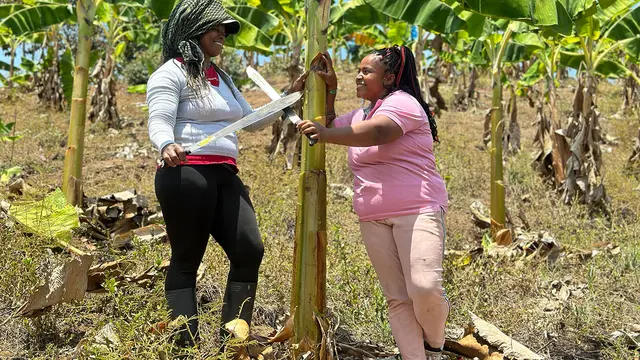
Members of the Bodo community eco-credit group visit a mangrove seedlings nursery in Bodo Village, Kwale County Kenya as part of their eco-loans commitment in an effort to support mangrove restoration and conservation (Photo: Obadiah Ngigi)
Community eco-credit (CEC) is an innovative incentive-based approach in which community groups manage funds and provide loans to members who commit to undertaking environmental activities such as ecosystem restoration, conservation and sustainable resource management.
CEC builds on the effective and widely used savings groups model, and mandatory actions in support of ecosystems and climate resilience are a part of the model.
Organisations are increasingly using and adapting CEC across diverse contexts, including fisheries, forestry, agriculture and protected areas. They use this approach to strengthen climate resilience, improve wellbeing, conserve biodiversity and achieve other goals.
As interest in CEC grows, there is an opportunity to strengthen collaboration among organisations implementing and researching the model, share practical experiences and lessons, and build the evidence base to inform its future development and use.
The community of practice brings together practitioners, researchers, community groups, funders and other stakeholders working on CEC and related approaches across different countries, including Kenya, Tanzania and Uganda, in both marine and terrestrial ecosystems. It aims to:
- Share experiences and lessons from CEC initiatives
- Improve how CEC is implemented, including by addressing ethical, legal and safety considerations
- Build evidence on CEC and its social, economic and environmental outcomes, and
- Identify opportunities and priorities for scaling up CEC responsibly.
What is IIED doing?
IIED is co-hosting the community of practice with two consultants:
- Robert Wild, honorary fellow at the University of York, and a co-developer and technical adviser to the community eco-credit model, and
- Dr Obadiah Ngigi, postdoctoral research associate at the Leverhulme Centre for Nature Recovery, University of Oxford, and a lecturer at Kenyatta University, Kenya. He is a co-developer and technical adviser to the community eco-credit model.
Working with individual and organisational members, IIED will provide logistical and technical support to the community of practice, helping members to collectively shape its direction, priorities and undertake activities to strengthen CEC practice and research.
The community of practice builds on the work of those involved in developing, funding, implementing, researching and participating in CEC programmes. This includes the CEC methodology (PDF) originally devised by Greenfi, adopted by Obadiah Ngigi in his doctoral research and further developed through its application in project cases, which has helped inform the establishment of this community of practice.
Get involved
The community of practice meets every three months to share updates and explore priority topics – such as emerging research needs, implementation challenges and funding opportunities – in greater depth.
Between meetings, members are encouraged to communicate and share resources through a dedicated communication channel and resource repository.
There are two ways to get involved:
- Become an active member: register as an individual or organisation to help shape the community’s direction and priorities, regularly participate in meetings, share knowledge and experiences, and contribute to collaborative activities.
- Join the wider network: sign up to the community of practice mailing list below to receive updates, resources and invitations to events
All information submitted is protected by our privacy policy.
News and updates

Additional resources
Article: Nature fundi: inclusive nature finance for Tanzania, rikolto (March 2026)
Article: Community eco-credit methodology, Greenfi
Community eco-credit: a description of the community eco-credit methodology and an analysis of its potential as a natural resource management tool (PDF), greenfi (2024), whitepaper
Economic analysis of environmental conditional credit as incentive for soil and water management in Sasumua sub-watershed, Nyandarua County, Kenya, Obadiah Hinga Ngigi (2022), Phd
Using inclusive finance to significantly scale climate change adaptation, Robert Wild, Moses Egaru, Mark Ellis-Jones, Barbara Nakangu Bugembe, Ahmed Mohamed, Obadiah Ngigi, Gertrude Ogwok, Jules Roberts, Sophie Kutegeka (2021), in African handbook of climate change adaptation (p1-26). Springer International Publishing
Article: Community eco-credit model, Mwambao Coastal Community Network
Article: Access to finance (eco-credit), COMRED