Energy-defence-AI convergence spurs demand for critical minerals
Josefina Lehnen and Lorenzo Cotula discuss how the energy, defence and AI sectors are driving demand for critical minerals and explore implications for just transition goals.



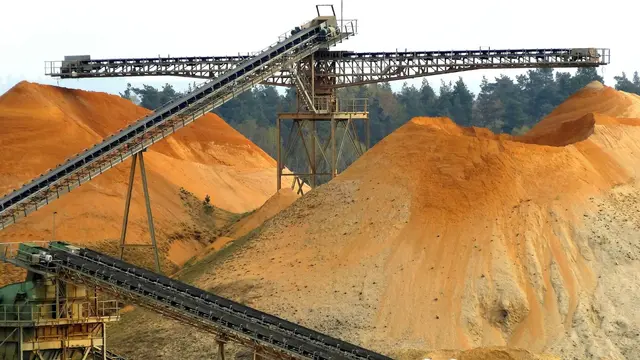
A mining site in Austria (Photo: Sebastian Pichler via Unsplash)
The politics of critical minerals is undergoing profound transformation as the control of key minerals and their processing becomes a central factor in competing visions of security, geopolitical influence and national interests.
Critical minerals are generally defined as raw materials that are indispensable for key economic sectors and have significant risks of supply chain disruption. In this way, criticality is not a fixed geological property, but a political construct shaped by perceptions of scarcity, competition and national security.
Until recently, much debate on critical minerals such as copper, graphite, lithium, rare earths and nickel focused on their role in the energy transition. But critical minerals policy development can no longer be understood solely through this lens, as emerging evidence confirms.
Among the many sectors that depend on these materials, the defence and artificial intelligence (AI) industries stand out for their strategic significance. Not only do these sectors reinforce aggregate demand, their trajectories also intersect in ways that reveal an emerging energy-defence-AI convergence.
These developments expose governance gaps and highlight the need for stronger evidence and more effective policies to support just energy transitions.
Critical minerals in the defence industry
Rising geopolitical tensions are fuelling military spending: global military expenditure is estimated to have reached approximately US$2.89 trillion in 2025. This spending drives production of modern weapons systems that crucially depend on some 40 minerals. As a result, access to minerals is increasingly framed as a national security issue.
While rolling back climate policies, the US has been decisively securing access to critical minerals for its defence industry. In 2025, US authorities invoked the Defense Production Act to accelerate domestic production of critical minerals and processing facilities for military equipment. The government also allocated billions of dollars to the National Defense Stockpile, soliciting 7,500 metric tonnes of cobalt and 49,400 metric tonnes of graphite.
Meanwhile, the EU has designated 34 critical raw materials under its Critical Raw Materials Act; 26 of these are used in defence equipment. The European Union (EU) has also designated 47 strategic projects' within its territory, 45 of which are linked to defence-relevant minerals. Some 11 of the EU's 13 overseas Strategic Projects are linked to defence-critical minerals.
AI: A growing driver of demand for minerals and energy
AI depends on computers, microchips and an extensive infrastructure of data centres, electricity grids, transmission networks and cooling systems. Producing these requires immense amounts of minerals, particularly copper.
In addition, AI computing and data centre cooling require huge amounts of energy. Data centres are driving an unprecedented growth in electricity demand that could reach 945 terawatt-hours in 2030 – equivalent to Japan’s total current electricity consumption.
A mutually reinforcing convergence
Developments in the defence, AI and energy sectors intersect and it is essential to explore their convergence rather than understanding them as separate, isolated trajectories.
For example, the wars in Ukraine and in the Gulf have highlighted AI’s increasing integration into military logistics, intelligence systems and autonomous weapons. As a result, investments in AI infrastructure can simultaneously strengthen military capabilities, highlighting the link between AI and defence-related mineral demand.
Further, the US Critical Mineral Assessments platform, a government initiative to support tracking of mineral production, trade and use, develops mineral assessments with the help of AI. In this way, AI functions not only as a driver of mineral demand but also as an enabling technology for expanding supply.
Implications for just energy transitions
This energy-defence-AI convergence has important implications for efforts to promote just energy transitions.
First, projected demand for critical minerals is likely to be substantially higher than levels suggested by analyses centred on the energy transition alone. This will further intensify the pressure on mining regions, with significant social and environmental impacts for affected people and ecosystems.
The socio-environmental impacts of extracting critical minerals have often been legitimised through energy transition narratives. Allocating growing shares of supply to defence and AI can erode public trust in critical minerals strategies.
Secondly, there are trade-offs between different resource uses. For example, it has been estimated that the minerals solicited for the US National Defense Stockpile could be used to produce some 100,000 electric buses.
If critical minerals policies are primarily shaped by geopolitical and security priorities, they risk redirecting public resources and state capacity away from energy transition demands and distorting pathways for equitable climate action.
Thirdly, the security framing, developed in the context of global geopolitical rivalries, can make it harder to promote just energy transitions both between and within countries. A security framing is in tension with multilateral cooperation and the international collaborations needed to promote just energy transitions, potentially making it more difficult for mineral-rich low- and middle-income countries to secure fair partnerships that maximise opportunities for local value addition and beneficiation.
Notions of “urgency” linked to military and economic security imperatives also risk intensifying pressures on legal rights, social and environmental safeguards and accountability mechanisms.
Towards better evidence and more effective action
The energy-defence-AI convergence is changing how critical minerals policy is being developed. Policies initially designed to support energy transitions are increasingly reshaped to fit within a geopolitical landscape defined by defence priorities, the rise of AI and a focus on national interests.
There are significant asymmetries in international guidance and support initiatives, as well as in information about critical mineral demand, supply and use in the energy, defence and AI sectors.
Current international policy initiatives on critical minerals are framed within the energy transition, such as the UN Critical Energy Transition Minerals principles and the UN Task Force on Critical Energy Transition Minerals (PDF). Comparable policy initiatives that address the implications of rising AI and defence sector demand are lacking. This is despite impacts linked to mining and processing being very much the same – and despite the strong links that exist across sectors.
Addressing these gaps requires supporting fair partnerships and reinforcing environmental and social protections across critical minerals supply chains. This was a central ask in an open letter signed by more than 100 research and advocacy organisations and released ahead of the UN High-Level Meeting on Critical Energy Transition Minerals in July 2026.
Further, while the uses of critical minerals for the energy transition are well-documented, information on the AI and defence sectors (such as reliable sectoral demand projections for different minerals) is limited. With the rapid growth in demand from the AI and defence sectors, we urgently need to build a strong evidence base to inform policy on advancing cooperative approaches and just energy transitions.