Producer countries and critical minerals diplomacy: entry points for agency
Lorenzo Cotula reflects on how mineral-rich low- and middle-income countries can shape their development trajectories by exercising agency in critical minerals diplomacy


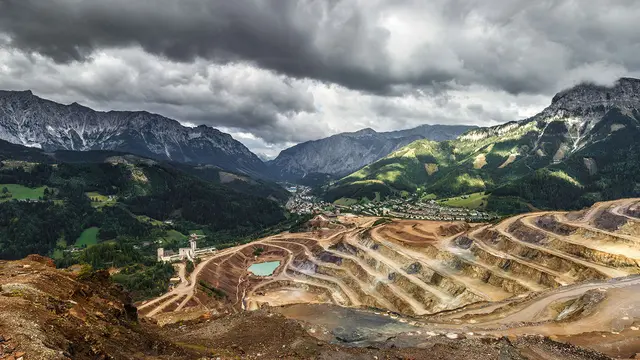
a large construction crane at a mine (Photo: Jandira Sonnendeck on Unsplash)
While large economies such as the European Union (EU), the United States (US) and China compete over control of raw materials supplies, many low- and middle-income producer countries are looking to harness their mineral wealth for transformative economic development.
This involves going beyond mining sector enclaves and supporting systemic shifts towards industrialisation, knowledge-based economies and broader transformations in livelihood systems and living standards.
Pursuing this goal in a global context where economic relations are shaped by great-power politics and intertwined with security considerations will require firm negotiation.
This highlights questions about how low- and middle-income countries can exercise agency in ‘critical minerals’ diplomacy: that is, how their governments can shape negotiation outcomes and how parliaments, civil society and citizens can scrutinise and inform government action.
Entry points for agency
Geological endowments create leverage for mineral-rich low- and middle-income countries, and developments in critical minerals diplomacy show that these countries can and do exercise agency.
Examples include Indonesia's measures to promote domestic nickel refining and the Democratic Republic of the Congo’s export control measures to address low cobalt prices.
At regional level, the African Green Minerals Strategy (AGMS) is a manifestation of collective agency, crystallising a shared understanding of the issues and providing foundations for more coordinated approaches.
Entry points for producer countries to enhance their agency lie both in their direct negotiations with trading partners and in the wider critical minerals diplomacy landscape.
Direct negotiations include bilateral critical minerals agreements, which are often non-binding memorandums of understanding (MOUs); and other agreements related to supply chain development and integration, such as MOUs for strategic infrastructure projects. Binding trade treaties also increasingly include critical minerals provisions.
Entry points for agency in these negotiations concern the format of deals, the process through which they are concluded and their substantive terms.
Leveraging collective action
Agency hinges on negotiating power and collective action is a key strategy for addressing power imbalances.
Collective action is also essential to address broader systemic issues.
Indeed, the supply chains the deals seek to develop and integrate are often likely to be regional. This is due to economies of scale, the need to mobilise complementary resources and skills across countries and the role of cross border transport infrastructure in developing the sector.
On a deeper level, the cumulative network of bilateral deals is more than the sum of its parts, because it sustains wider shifts in global economic governance.
Yet, the bilateral format of many critical minerals deals fragments negotiating spaces and severely reduces opportunities for collective action. This situation has prompted calls for groupings of producer countries to negotiate as one.
Regional organisations such as the African Continental Free Trade Area and subregional trading blocs can play a key role in catalysing coordination, building on regional frameworks such as the AGMS.
Opening up negotiation processes
Many critical minerals deals have been negotiated with little transparency. Although new deals are announced and fallouts in negotiations can be very public, opportunities for public scrutiny and participation during negotiations are often limited.
As executive agreements that do not require formal ratification, MOUs also bypass constitutional arrangements for parliamentary and public oversight that may apply to treaty ratification processes. And although the EU systematically publishes its MOUs and trade agreements, other global critical minerals deals have not been publicly disclosed.
Greater openness and transparency are necessary if parliaments, civil society and citizens are to exercise agency in scrutinising and informing critical minerals policy.
Aligning with transformative development objectives
Beyond negotiations, having clear, specific and trackable provisions in the deals sets markers that governments can rely on to exercise agency in the implementation phase, including as part of supply chain development initiatives. If the deals are to serve as instruments of transformative development, those provisions need to establish clear routes for achieving this goal.
Economic contexts vary and governments may have different policy priorities and negotiation objectives. But generally speaking, economic development issues relevant to critical minerals diplomacy may include:
- Ensuring companies pay the taxes they owe
- Creating upstream and downstream opportunities for local businesses
- Promoting local value addition
- Facilitating technology transfer and cooperation on innovation and on research and development
- Mobilising financial and other support to national centres of excellence, and
- Creating positive cross-linkages with sectors beyond mining, such as services and agriculture.
As resource extraction and economic transformation can destroy the environment and undermine land and human rights, robust social and environmental protections are highly relevant to defining deal terms.
Reforming the wider context
Beyond bilateral critical minerals partnerships, a vast network of trade and investment treaties shapes scope for agency. For example, World Trade Organization (WTO) rules and many bilateral investment treaties limit options for industrial strategies, by restricting requirements on local content, domestic processing and technology transfer.
Enhancing space for agency requires increasing policy flexibilities for low- and middle-income producer countries. At the WTO, the African Group put forward reform proposals to enhance ‘policy space for industrial development’ (PDF), calling for a review of WTO rules on subsidies, local content and technology transfer.
Emerging discussions about the just transition work programme in the UN climate could also offer entry points for discussing these issues, particularly as regards the role critical minerals trade can play in reducing emissions and in strengthening economies and thus climate adaptation capacity.
Just partnerships for resilient supply chains
Imbalances in negotiating power mean policy developments in large economies can have a major influence on critical minerals diplomacy. This includes: domestic policies in China, the EU and the US; bilateral critical minerals agreements, such as the US-EU MOU; coordinated actions by the G7; and other plurilateral initiatives such as the US-led Forum on Resource Geostrategic Engagement.
Such processes have repercussions on negotiations involving low- and middle-income countries, so enhancing agency requires tracking and, where possible, seeking a voice in these developments.
At the same time, large economies looking to secure raw materials should be responsive to producer country agency: to sustain reliable supply chains in the longer term, partnerships must be just and work for both sides.
This insight is a revised version of remarks made at the partner convening organised by the Open Society Foundations’ Resource Futures in Africa programme (17-21 May 2026).
Further reading
Article: Caught in the legal crossfire? Critical minerals agreements and international economic law, Jesse Coleman, Lorenzo Cotula (April 2026), EJIL: Talk
Article: Non-binding instruments in international economic diplomacy: a look at the US critical minerals deals, Lorenzo Cotula, Sunayana Sasmal (April 2026), EJIL: Talk
Critical minerals: international economic law in a global resource rush, Lorenzo Cotula (2023), Trade, Law and Development