Women producers’ dialogue series: gender-transformative approaches and services
This dialogue addressed how forest and farm producer organisations have the potential to provide gender-transformative approaches and social support services to their members.

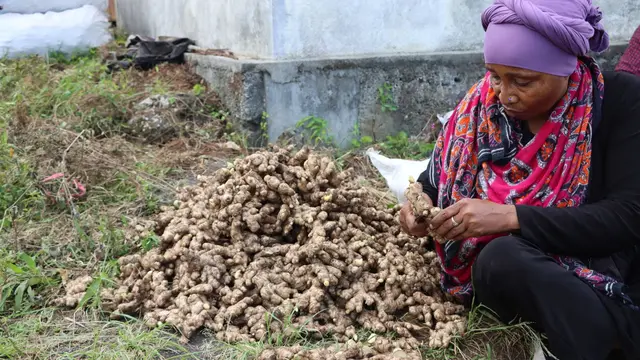
Indigenous seed varieties from a farmer-managed seed bank in Kambi ya Simba village, Karatu district (Photo: Roshni Lodhia/Panos/IIED)
As one of the implementing partners of the Forest and Farm Facility (FFF), IIED is hosting an online dialogue series for women-led or majority women forest and farm producer organisations (FFPOs).
The aim of the dialogues is to create a space for women producers, entrepreneurs and leaders to connect with each other, share and exchange experiences and ideas, and support and inspire one another around women’s empowerment in their own contexts.
The third dialogue focused on gender-transformative approaches, which aim to challenge and change the underlying social and cultural norms that limit women’s participation and leadership.
More than 40 women representatives of majority women or women-led FFPOs in 15 countries were actively engaged in the dialogue.
Speakers
- Kata Wagner (moderator), researcher, IIED
- Cathy Farnworth, gender equality and social inclusion researcher, UK
- Maria Pinan, responsible for the Globally Important Heritage Agricultural System Chakra Andina, Comite Central de Mujeres Union de Organizaciones Indigenas y Campesinas de Cotacachi (UNORCAC), Ecuador
- Voahangy Ramaromisa, president of the apex FFPO Nationale de la Plateforme Nationale Femme, Développement Durable et Sécurité Alimentaire (PNFDDSA), Madagascar
Event coverage
The event started with a presentation of a widely used and documented methodology for gender-transformative approaches: Gender Action Learning Systems (GALS)(PDF).
Two women leaders of FFPOs then shared experiences highlighting how FFPOs can implement strategies and offer services that contribute to dismantling structural gender-based norms that restrict the role of women. As with previous dialogues, there were language-based breakout groups for the participants to share their unique experiences around the challenges they face and what their organisations were doing.
After a brief introduction to gender-transformative approaches there was an overview of GALS as an approach that uses simple, visual tools – such as the Gender Balance Tree and the Vision Journey – to help women and men analyse inequalities in their daily lives, set personal and collective goals, and plan concrete steps toward more equal households, organisations and communities.
GALS has proven effective not only in shifting personal dynamics but also in catalysing policy changes – such as working with traditional leaders to reform local justice systems, or motivating men to share domestic responsibilities and support women's leadership.
The participants recognised GALS as especially powerful when adapted to local cultures and supported by a “critical mass” of community engagement.
Subsequent presentations by women leaders from Ecuador and Madagascar introduced initiatives and services that are helping women reclaim their roles as leaders, landholders and rights defenders.
In Madagascar, many rural women had no access to land, not because they were legally excluded, but through lack of awareness, fear of asserting their rights or insufficient literacy to navigate the process.
PNFDDSA, a national women’s FFPO, launched land rights training sessions with step-by-step guidance, supported by government officials who guided women through the legal process. This enabled women to formalise land ownership for the first time, unlocking new opportunities for diversified agriculture, income generation and long-term sustainability.
In Ecuador, the UNORCAC Women’s Committee is driving change by challenging gender norms at multiple levels, from the individual to the communal.
In their communities, violence against women was traditionally seen as a private matter, handled informally or ignored by communal justice systems. The committee addressed this by engaging traditional authorities through community discussions to co-develop a new justice mandate that recognises gender-based violence as a public concern, now backed by a formal ordinance.
At the same time, targeted training empowered women to move from passive beneficiaries to confident project implementers, designing and leading initiatives rooted in their lived realities.
A school for midwives furthers this transformation by blending traditional knowledge with intergenerational conversations on reproductive health and bodily autonomy. This is a powerful example of an FFPO working across levels – enabling women to claim their rights over their bodies, reshape community laws and build collective leadership around a shared vision of gender justice.
In the breakout language-based discussions, the participants shared common challenges that they face. Across contexts, women are time poor due to the burden of unpaid domestic care work, limiting their time and mobility.
Cultural and social norms still define women’s roles as confined to the home, while low literacy rates and language barriers prevent them from engaging in training or organisational processes.
Participants also highlighted their lack of access to land and economic resources, which fuels dependence on men and restricts decision-making power. Without confidence in public forums, many women are sidelined from leadership – viewed as recipients, not drivers of change.

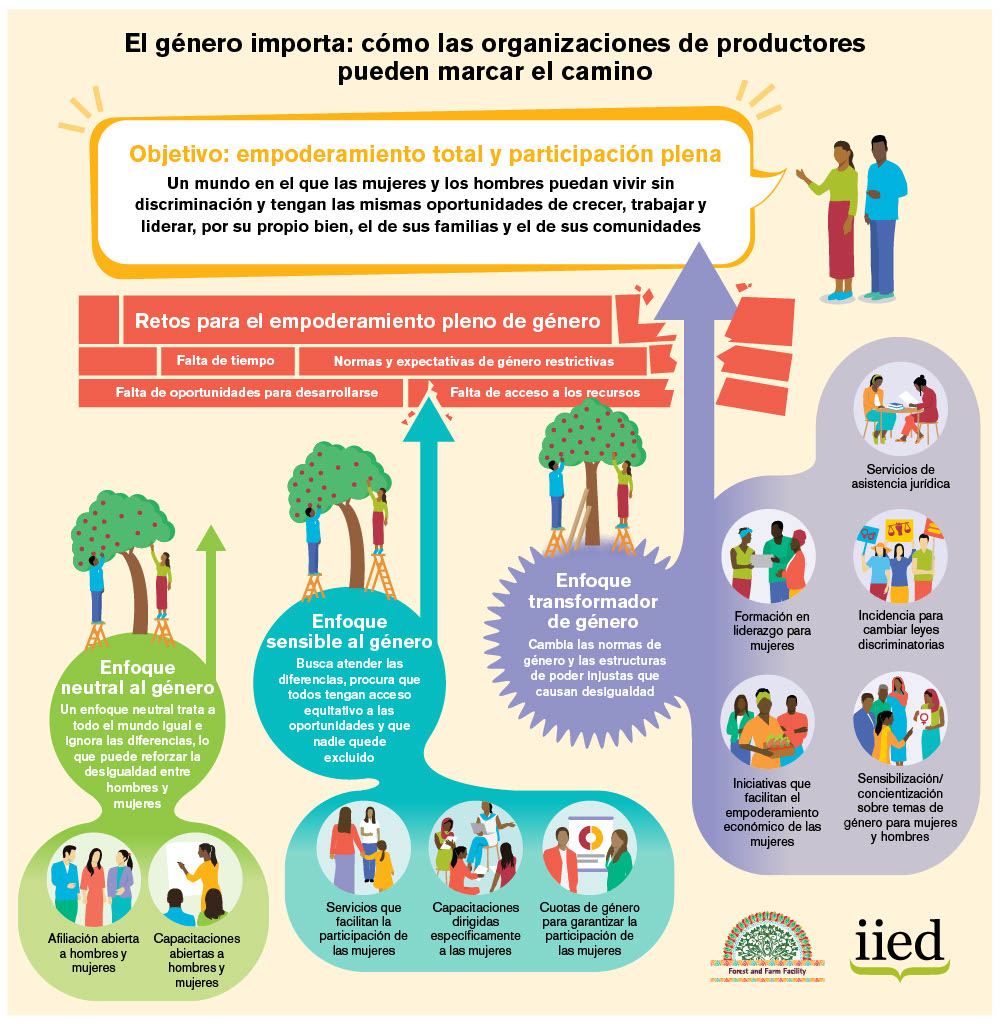
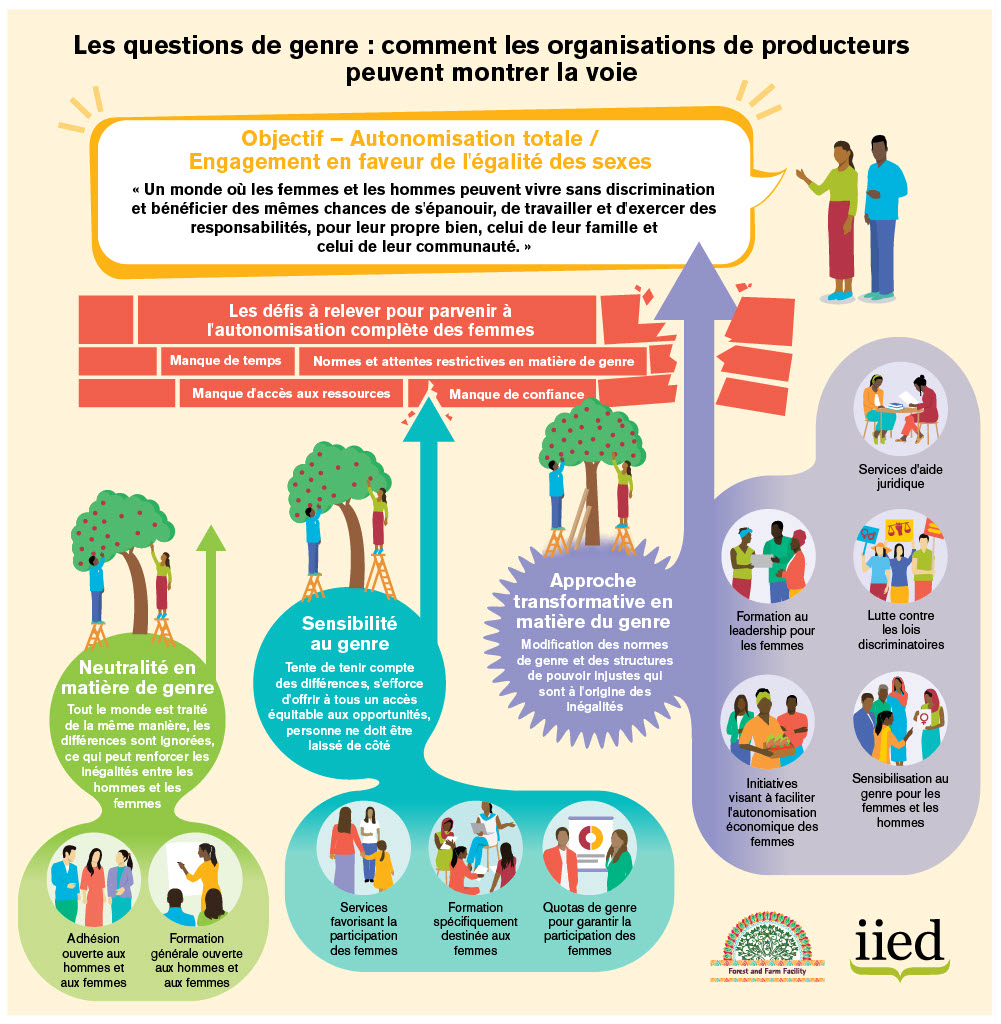
Click on the image to expand it. This infographic shows the practical and locally grounded strategies and services that FFPOs can offer to reach full gender engagement that the participants shared and discussed during the dialogue. You can also view the infographic on IIED's Flickr channel (en español | en français)
FFPOs can take action to help their members overcome these challenges and transform the structural underlying causes. Participants shared practical and locally grounded strategies and services that are contributing to this transformation:
- Leadership and inclusion: FFPOs that recruit and train women to lead projects and represent their communities can ensure that they move from beneficiaries to decision-makers
- Dedicated spaces for women: internal women's platforms or committees can collectively define concrete gender transformational objectives and jointly work towards them.
- Skills and confidence building: through leadership, advocacy and business training, women can gain the confidence to speak out and actively participate in public spaces
- Institutional reforms: internal regulations requiring equal participation of women and men help to embed gender equality into the core structure of FFPOs
- Gender-integrated learning: farmer field schools and peer learning initiatives are incorporating gender awareness into technical training, creating more inclusive spaces
- Economic empowerment: collective savings schemes and support for women-led enterprises are boosting women’s financial independence and reducing economic vulnerability
- Formal recognition and access: FFPOs can help women’s groups gain accreditation with local governments, unlocking access to public funding and policy platforms, and
- Engaging men: by using mixed-gender community spaces, organisations can engage men in conversations about gender, helping shift cultural attitudes from within.
These strategies are already helping women step into leadership roles, gain recognition, and contribute more visibly to their organisations and communities.
Across regions, FFPOs are showing that when women are empowered to speak, lead and organise, they become key drivers of change – shaping not only their own futures, but the future of forest and farm landscapes in the global South.
Watch the dialogue recording
Watch a recording of the third dialogue in English below or on IIED's YouTube channel. The recording is also available in French, Spanish, Filipino and Vietnamese.
Contact
Kata Wagner ([email protected]), researcher (forests and prosperity), IIED's Natural Resources research group