Why communities are key to unlocking renewable energy in climate-hit agricultural areas
The 6th International Off-Grid Renewable Energy Conference and Exhibition (IOREC) is currently under way in Botswana, organised by the International Renewable Energy Agency (IRENA). At the conference, IRENA’s Babucarr Bittaye and IIED’s Kevin Johnstone will present a new framework that takes a community-centred approach to ensuring efforts to widen access to renewable-powered energy supports climate adaptation in agricultural regions worldwide. Here, they explain why the framework matters and how it works.



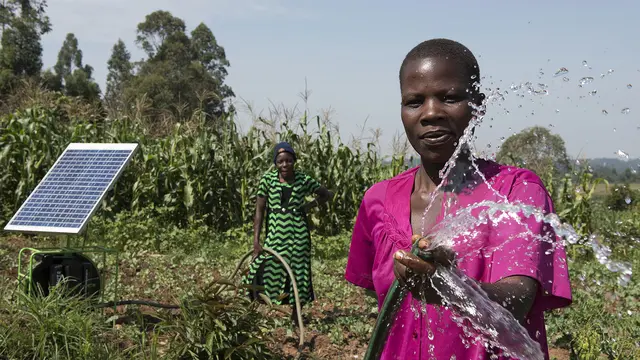
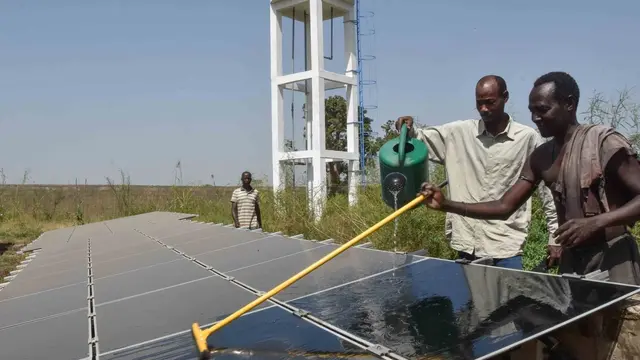
Solar-powered irrigation system equals less hardship and higher productivity for female farmers in Rwanda (Photo: IRENA)
At least a billion people living in rural areas worldwide rely on agriculture: a livelihood that is critically vulnerable to the effects of changing weather patterns and rising temperatures caused by climate change.
Many of these people must now rapidly adapt with new livelihood strategies to survive. These strategies will vary by locale, as climate change impacts different people and value chains in differing ways – depending on social norms, ecosystems, economic conditions and other characteristics that present both opportunities and constraints.
Products powered by renewable energy (PDF) – for example, solar energy powering irrigation pumps and refrigerators for storing crops – can be incorporated as a part of these wider strategies, while fulfilling many of the Sustainable Development Goals (SDGs), such as affordable and clean energy (SDG 7) and climate action (SDG 13).
Despite this, the household and livelihood energy deficit around the world remains enormous. And while finance for climate adaptation strategies reached US$32.4 billion in 2022 (PDF), the energy sector represented a sliver at only 3%.
We believe there is an enormous opportunity to bring together finance for adaptation and energy access investments. But there is limited evidence for what works for whom, where, under what circumstances and why, as IIED’s recent paper highlights. Building the evidence base can guide more efficient use of scarce funding and finance.
Note: 'All other sectors' mainly includes activities targeting multisector, general environment protection, government and civil society, social infrastructure and services, and disaster preparedness
Source: Climate finance provided and mobilised by developed countries in 2013-2022, OECD (PDF). Chart based on Biennial Reports to the UNFCCC, OECD DAC and Export Credit Group statistics, complementary reporting to the OECD
Energy access, climate action and agriculture
To respond to this need, the IRENA and IIED have developed a practical framework to guide stakeholders to incorporate renewable energy, climate action and agriculture into their investment projects, under the frame of the IRENA Empowering Lives and Livelihoods Initiative.
As part of this initiative, IRENA has established an adaptation working group with over 20 development organisations to foster institutional collaboration and knowledge sharing.
The IRENA-IIED framework builds on IIED’s earlier work, which emphasised that technologies alone are unlikely to be transformational when it comes to coupling energy access with climate adaptation. This is particularly true in rural areas that are usually characterised by a deficit of public and private goods and services.
In these places, people often need packages of support to buy and use technological tools – support such as asset financing and subsidies, or extension services and advice – provided by institutions, government and companies. What’s more, contextual norms often dictate different people’s needs and strategies, as well as opportunities and constraints through gender, age, caste systems and so on.
To help navigate this complexity, the proposed IRENA-IIED framework features six practical steps to improve the design, implementation and evaluation of investments in agriculture. It integrates best practices, approaches and sector-specific expertise across the climate adaptation, energy access and agriculture sectors.
Through the framework, we provide a foundation to guide investors, project implementers, companies and donors on how to measure changes – and for whom. The framework is adaptable and aligns with established indicators from the Global Impact Investing Network (GIIN) and the Green Climate Fund.
What’s more, the framework provides non-prescriptive guidance that aims to help diverse stakeholders with different needs and contexts when it comes to tracking adaptation benefits and building the evidence base on how renewable-powered energy access (for example solar-powered irrigation, processing and cold storage) supports climate adaptation in agriculture.
Six steps to climate resilience
The first step in the framework involves project implementers working with households to establish the socioeconomic dynamics of their community and understand the climate risks and impacts. They identify what they need to thrive. Next, they then design ‘bundles’ together – the energy technology with financing, training, extension support, supportive policies and so on – to address these needs (step two).
The third step involves deploying the bundles, gathering feedback and adjusting as necessary. The fourth step focuses on observing what works, for whom, and why, to build the evidence base. Outcomes related to climate adaptation and resilience are then evaluated employing the ‘Three As’ framework (PDF): adaptive, absorptive and anticipatory capacity (step five). Finally, the sixth step constructs a narrative around ‘general resilience’, focusing on flexibility, coordination, participation and learning.
In our experience, this approach ensures energy projects are community-centred, adaptable and contribute to building climate resilience in agricultural communities. The framework emphasises adaptive management (where actions are based on ongoing learning) and vigilance against maladaptation throughout the process. It recognises that climate risks and sector interactions evolve, making it necessary to continuously monitor, learn and manage changes.
In short, it’s essential to engage diverse groups of stakeholders early on in project design: this makes it possible to identify synergies, manage expectations, optimise resources and improve outcomes for communities.
Road testing the framework
IRENA and IIED will present the framework at the 6th IOREC taking place in Botswana this week, after which we’ll jointly publish it. We would encourage investors, financiers and donors to engage with the framework and actively consider how it can be adapted to different needs, constraints and circumstances.
A critical next step of the framework is to validate it with different households across the world. Our aim is to ‘road test’ it in ongoing and new energy interventions and investments in agriculture – and potentially modify it for other sectors like health and water.
Ideally, this will reveal where investments can work for different kinds of people in different circumstances; doing so will give agricultural households and communities a much stronger chance of not just surviving, but also thriving in the face of ever-changing climates.
A version of this insight was originally published on the IRENA website