Bringing housing justice and civic media together: three reflections
Many grassroots groups see digital and traditional communication as a key tool for their housing justice advocacy and mobilisation work: in other words, using civic media to challenge housing violations and push for residents’ rights. As IIED and partners embark on a new initiative looking at civic media’s ability to promote housing justice, and as the World Urban Forum begins, Alexandre Aspan Frediani and Camila Cociña share takeaways from the first phase of this work.



Favela, an informal urban settlement located within or on the outskirts of São Paulo (Photo: danilo.alvesd, via Unsplash)
Social movements are constantly pushing the limits of housing systems, propelling changes to contest injustices and advance the right to adequate housing for all. Behind these efforts lies a framework of institutional, political and communication capacities and resources that sustain their actions.
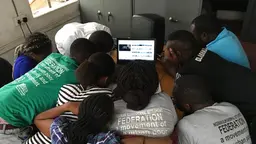
What is the role of communication in such efforts, and to what extent can collective media practices bolster grassroots capabilities to advance housing justice? With these questions in mind, IIED partnered with local organisations in Brazil and Nigeria in 2022 to carry out an action-research initiative, ‘Civic media for housing rights: lessons from struggles against evictions in São Paulo and Lagos’.
As the project reaches its midway point, and as we embark on a new initiative on civic media practices with partners in India and Nepal, we can share three takeaways that have emerged as we bring these two agendas – housing justice and civic media – together.
These reflections build on our work with União dos Movimentos de Moradia (UMM), Brazil’s largest housing social movement, in São Paulo, and with the Nigerian Slum/Informal Settlement Federation and Justice & Empowerment Initiatives (JEI) in Lagos.
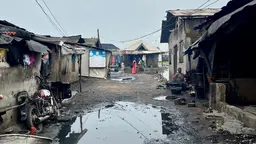
The impact of communication injustice
Takeaway 1: (Unfair) media landscapes intersect with housing justice struggles in several ways
Communication injustices have direct implications for housing struggles. We have documented how the existing communication landscape – namely, the infrastructures, norms, resources and power relationships that shape communication – impacts the struggle for housing justice experienced by movements in São Paulo and Lagos. This is outlined in our recently published working paper, 'Communication practices and the struggles for housing justice: early reflections from São Paulo and Lagos.’
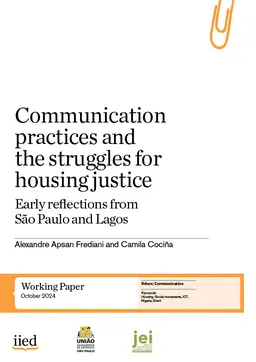
In this paper, we observe how (unfair) communication landscapes intersect with struggles for housing justice in at least three ways:
- The production of housing: related to the dynamics of urban data and its implication for land and housing markets, and to the communication challenges behind housing collective efforts
- The framing of housing narratives: related to the opposition of discriminatory housing discourses and the challenges of revealing often-ignored voices to dispute often-criminalising narratives, and
- The mobilisation of housing claims: related to how the media landscape constrains (or enables) the emergence and dissemination of grassroots voices to advocate for particular demands.
The IIED paper also examines the ‘functions’ that communication plays for movements in São Paulo and Lagos: that is, the purposes behind the range of communication and media practices they use. Functions vary and include mobilising and emancipating movement members, building people’s capacity, denouncing housing rights violations, documenting and supporting paralegal work against forced evictions, and changing narratives about informal settlements.
The importance of understanding media practices
Takeaway 2: Housing movements use a range of communication practices, even if they do not name them as such
Looking at the ‘functions’ of communication, the work with UMM and JEI also included the development of a historical timeline in which we collectively identified how their communication practices have changed over time. We compiled these through comprehensive timelines and reflections, recently published in a case study collection exploring the communication practices of housing movements in São Paulo and Lagos.
The media trajectories of UMM and JEI showcase the centrality and diverse functions that communication practices have played in their struggles. The timelines demonstrate that it is possible to identify ‘eras’ in which different political and social conditions have called for different approaches to their communication practices.
Reflecting on these trajectories requires us to revisit and interrogate the communication and media practices of grassroots organisations. Often, when we ask housing movements about their media activities, they tend to minimise them. But on closer inspection, it is clear they are constantly mobilising practices that require communication capacities – from pamphlets, social media and word-of-mouth, to video making, newsletters and printed journals.
Pursuing a better understanding of these methods can be a powerful tool for prioritising strategies in the struggle for housing justice.
The need to boost communication capacity
Takeaway 3: Actively strengthening communication capabilities can be strategic for consolidating housing movements
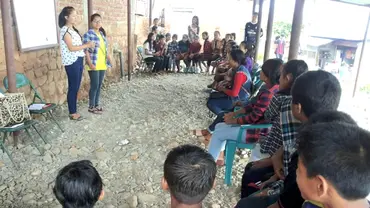
Central to this action-research project has been the implementation and documentation of media workshops for grassroots groups (which we call civic media labs). These took a different shape and emphasis in each city.
As the project moves closer to completion, we will share lessons from the documentation process of these workshops, carried out by researchers from the Territorial Justice Laboratory of the Federal University of ABC (LabJuta–UFABC), Brazil, and the University of Ibadan, Nigeria. However, here are two early reflections.
First, the structure, focus, location and content of each workshop was designed in ways that responded to strategic objectives for local movements and their current demands and aspirations.
For UMM, it was strategic to improve movement members’ communication capacities as a means to consolidate a more solid structure of communication linked to local territories. For JEI, it was about increasing the grounded presence of its already existing media team (Media4Change) in specific settlements, as well as recruiting ‘new blood’ with media abilities for their advocacy and paralegal efforts.
Second, the documentation of the civic media labs has demonstrated that there are several challenges in creating mechanisms to increase communication capabilities at grassroots level – such as challenging economic and political conditions, unequal access to equipment and literacy, and competing priorities around time commitment.
This process of supporting communication capacities for housing justice work has highlighted the critical need to mobilise explicit efforts in different sectors – including among researchers, policymakers and donors – as well as for the strategic development of housing movements themselves. As we begin a new phase of this initiative, we urge all stakeholders to join us in this journey.