Items tagged:
Urban development
-
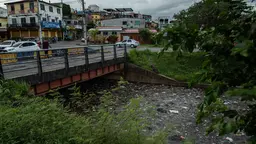
Rethinking household surveys reveals true picture of health inequality
Groundbreaking work by a Nairobi-based research institute, the African Population and Health Research Center (APHRC), shows the scale of health inequality in Nairobi and its informal settlements
-
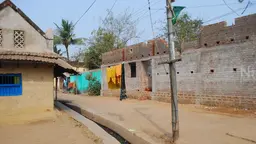
Multiple housing and climate-related vulnerabilities of informal workers in Indore, India
While informal workers in Indore, India contend with multi-faceted vulnerabilities, recent research shows a gradual transition towards resilience. Guest bloggers Siddharth Agarwal and Kanupriya Kothiwal discuss the findings.
-
Q&A: Citizen participation in planning − from the neighbourhood to the city
What is the current state of knowledge on making planning more genuinely inclusive? A panel of urban experts answer questions from a recent webinar that discussed examples and theories of participatory planning from around the world.
-
The case for sewers
On World Toilet Day 2021 we take a look at the surprisingly controversial role of sewers in countering poor-quality sanitation in cities in the global South
-
Definitions matter – part one
Why is it that many of the key statistics used to measure progress in development have no agreed definition – ‘city population’, ‘water availability’, ‘slum’ and ‘poverty line’ to name but a few
-
Citizen participation in planning: from the neighbourhood to the city
This event on Wednesday, 24 November reflected on the needs and challenges of citizen participation in the planning and development of informal settlements
-
Can we reduce urban poverty and inequality and achieve net zero cities?
This year, World Habitat Day focuses on how cities can develop practical, workable plans for a carbon-free world. Over half the world’s population live in urban areas, so it’s unsurprising that cities are responsible for 75% of carbon emissions. Anna Walnycki and Tucker Landesman explain why efforts to achieve zero carbon cities will only be successful if they simultaneously address pervasive urban poverty and inequalities
-
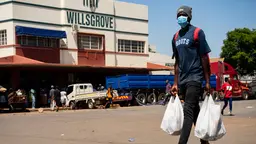
Making strides to improve health and climate resilience in Zimbabwe’s cities
Guest blogger Artwell Kadungure and Alice Sverdlik report on how real progress is being made to improve the lives and livelihoods of informal workers as a result of collaboration with key policymakers
-
Reducing urban poverty – lessons not learnt?
What have we learned from over five decades of initiatives meant to reduce urban poverty? And what, if any, benefits have been felt by the estimated one billion, and counting, residents of informal settlements and tenements in urban areas in the global South?
-
Rethinking urban climate resilience: time for a reset?
Aditya Bahadur and guest blogger Thomas Tanner discuss their new book which explores the changing nature of climate risk in towns and cities and explains why existing approaches for tackling this risk need a shake-up
-
Community-led COVID-19 response: an update from the Philippines
One year on, Ruby Papeleras and Migo Gaddi provide an update on the action of the Homeless People’s Federation of the Philippines in its fight against COVID-19, including case studies of what has been done in the cities of Davao and Talisay
-
Argentinian city Rosario wins award for urban sustainability
The World Resources Institute Ross Centre ‘Prize for Cities’ competition has awarded its grand prize to the municipality of Rosario, to recognise major progress in building climate resilience and equity through urban agriculture
-
Transforming cities, transforming lives
IIED and partners are developing, testing and disseminating a scalable approach for achieving key shifts in urban development to put cities on a path to achieving climate justice and zero-carbon emissions by 2050
-
Feeding all city inhabitants
Cecilia Tacoli explores how food and nutrition security in urban areas is often overlooked by policymakers and city governments
-
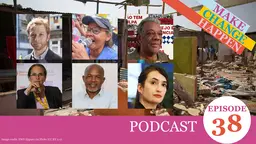
Wanted: an inclusive vision of urban recovery from COVID-19: Make Change Happen podcast episode 12
In this episode of Make Change Happen, expert practitioners discuss the effects of the COVID-19 pandemic in urban areas, and they share a range of inclusive, locally led responses from the global South
-
COVID-19 in cities: pathways towards a transformative urban recovery
COVID19-is asymmetrical and will impact differently as poorer countries battle to gain access to vaccines. At a time of diminished budgets and resources, their needs are the highest. We can only respond if we do our work more inclusively and strategically
-
What women want – part two: to map vulnerability to climate change
Guest blogger Sheela Patel continues her discussion of the priorities and needs of women living in informal settlements and tenements, highlighted by COVID-19. In this blog, she explains why women are ideally placed to map vulnerability to climate change in their community and city
-
Tricky questions and frank discussions: a participatory forum on protracted displacement in Afghanistan
Guest blogger Nassim Majidi draws together three key points emerging from a recent multi-stakeholder forum aimed at developing innovative and inclusive solutions to manage forced displacement in Afghanistan
-
Book summary: Urban poverty in the global South − scale and nature
In this book Diana Mitlin and David Satterthwaite offer a comprehensive analysis on the state of urban poverty in the global South, analysing aspects such as inadequate nutrition, poor health, lack of security, low incomes and bad working conditions
-
What women want – part one
Guest blogger Sheela Patel discusses how COVID-19 has highlighted the priorities and most pressing needs of women living in informal settlements and tenements
-
New coalition to transform cities – and lives
The new Transformative Urban Coalitions project brings IIED and partners together to change structures and values, build new urban coalitions and implement strategies leading to socially inclusive zero-carbon cities
-
Broadening the understanding and measurement of urban poverty
With the pandemic shining a spotlight on inequality and deprivation in cities across the global North and South, now is the time to try and understand what actually constitutes urban poverty so that funding and public services can reach those who need it most
-
African Cities Research Consortium
The African Cities Research Consortium brings together a range of international partners to explore and tackle the complexity around urban development in some of Africa’s biggest cities
-
Bringing urban refugees into local planning
Can we move from emergency to developmental response to the large and growing numbers of refugees living in urban areas by bringing them into local planning processes?
-
Cities’ development trajectories
David Satterthwaite examines the factors driving the development of cities
-
Internal and international influences on urban change
David Satterthwaite takes a closer look at drivers and influences of urban change
-
Invisiblising cities: the obsession with national statistics and international comparisons
David Satterthwaite discusses the vast gaps in city data, and explains why planning, governing and servicing cities calls for data that is broken down into city and sub-city level
-
Should cities invest in climate mitigation?
There are compelling economic opportunities for cities to reduce their carbon footprints – but will these measures be enough to stay below 2 degrees of warming?
-
Urbanisation and the environment
Growing urban affluence tends to have profound environmental consequences, but the net impact depends heavily on how the transition is managed. IIED worked to identify the best means of making urbanisation more environmentally beneficial and less destructive
-
Learning about urbanisation from the BRICS
It is critically important to draw the right lessons from the BRICS, and both the successes and failures of their urbanisation strategies have much to teach the rest of the urbanising world. IIED worked to draw out some of these lessons
-
Urbanisation and emerging population issues
Urbanisation is a defining trend of our time. IIED worked with partners around the world to promote the benefits of urbanisation while avoiding its destructive tendencies
-
Financing urban resilience
Cities need to adapt to climate change: but how it be financed? IIED is working to build the case for more direct control of funding for resilience by urban residents and local governments
-
World Toilet Day: People need equality and dignity when they 'have to go'
On World Toilet Day on 19 November, our photoblog details the work of IIED and its partners to tackle the fact that 2.5 billion people lack access to basic sanitation
-
Visualising urbanisation
We are living in what many call 'the urban century' and the many layers of complexity around the world's growth in urban areas have led IIED to develop new ways of looking at urbanisation
-
Namibia shows how to support low cost housing
Around a quarter of Namibians live in informal urban neighbourhoods; they live without secure tenure and without adequate access to services. So how has the country gained its reputation for progressive state action on housing?
-
8 points on financing climate change adaptation in urban areas
As the urgency for governments and international agencies to address climate change increases, an expert meeting identified eight key points on finance priorities.
-
Addressing the needs of urban children and adolescents
Not enough is known about practical and effective ways of addressing children's interests within urban development. Their concerns are rarely taken into account in most planning decisions, community development projects or housing and neighbourhood upgrading schemes