Transforming nature finance
IIED and partners work to effectively mobilise and deliver nature finance, supporting the needs and priorities of Indigenous Peoples and local communities, and boosting community-led financial mechanisms through research and advocacy. This page outlines IIED's nature finance strategy for 2025-2030, the outcomes we hope to achieve and current activities underway.

A vegetable farmer uses solar pumps for irrigation in the Kamalpur, Surunga, Nepal (Photo: Nabin Baral/IWMI, via Flickr, CC BY-NC 2.0)
What is nature finance?
We define pro-nature finance as the flow of funds from all sources to conserve biodiversity, ecosystems and species – from the mountains to the sea – and support positive outcomes for people. This includes self-generated community finance, private and public finance, philanthropy, blended finance and innovative finance mechanisms.
There is a clear distinction between pro-nature finance and harmful nature finance, which we define as the flow of funds from all sources that negatively impact the environment and people. This can include subsidies, incentives and investments in or for activities including industrial agriculture and fishing, resource extraction, deforestation and habitat destruction.
Crucially, nature finance is distinct to climate finance. Whereas nature finance refers to funding which supports conservation and restoration of biodiversity, ecosystems and species, climate finance refers to funding which supports mitigation (reduction in greenhouse gas emissions), adaptation to climate impacts, and loss and damage brought about by these impacts. There is, however, a close relationship between them.
Why is there a problem with nature finance?
While securing enough quality finance to protect nature and support people is critical if we are to reverse the decline of nature, Indigenous Peoples and local communities have been emphasising for years that the existing nature finance system is broken and there is an urgent need for a transformational approach to financing solutions for nature.
Significant amounts of finance still support activities which destroy nature, while not enough finance is available to support nature and biodiversity. The so-called ‘biodiversity financing gap’ – the amount needed to reverse the decline of biodiversity by 2030 – is in the order of US$700 billion per year.
In addition, not enough finance is reaching or supporting the priorities of Indigenous Peoples and local communities who are local stewards of nature and possess the best knowledge and skills to protect it.
Governments, funds, NGOs and various other stakeholders are finally starting to recognise the problem with nature finance. The Kunming-Montreal Global Biodiversity Framework (GBF) (PDF), agreed in 2022 by parties to the Convention on Biological Diversity (CBD), included ambitious new targets to finance the protection of nature and biodiversity. In 2025, a further roadmap was agreed by CBD parties to close the biodiversity financing gap by 2030.
However, it remains unclear how the GBF targets and roadmap will be implemented, where the money will come from and whether it will be delivered in line with the priorities of Indigenous Peoples’ and local communities. IIED and partners advocated for locally-led action to be at the heart of the GBF, and we continue to monitor progress towards the implementation of the GBF finance and related targets.
What is IIED doing?
IIED works with partners to mobilise and deliver nature finance effectively to the local level and enhance the visibility and capacity of community-led financial mechanisms. We achieve this through collaborative targeted research and impactful advocacy.
Our approach to nature finance is heavily influenced by our commitment to the principles for locally led adaptation, which respond to calls from the Least Developed Countries (LDC) Group and others to ensure that local communities have access to the resources they need to drive and control climate adaptation action at the local level.
Through our nature finance work, we are demonstrating that these principles can be applied to nature-related activities to ensure that nature finance reaches the local level, and local communities are at the heart of action to protect and halt the loss of biodiversity. We are working on a set of principles supporting locally led biodiversity action which build on the LLA principles and the Shandia principles. There is a lot to learn and share between nature and climate finance, and this is a growing area of collaboration both within IIED and with partners.
IIED has been working on nature finance for many years with work organised around three principal objectives: increasing the volume and diversity of international finance for nature, getting nature finance to the local level, and recognising the value of funds generated within local communities. In 2024, we consolidated our approach into an institutional strategy on nature finance which we will take forward over the coming 5 years.
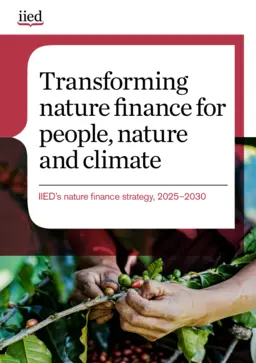
Our nature finance strategy 2025-2030
This strategy lays out our vision for transforming the way that nature finance is delivered and redirected, in support of locally led action for people, nature and climate. It builds on many years of work, draws on a wide breadth of expertise, and recognises that IIED and our partners have multiple offers and asks for nature finance.
Our long-term vision is to transform the way that nature finance is designed, delivered and redirected, in support of locally-led action for people, nature and climate.
Our strategy aims to achieve five key outcomes, which are highly interconnected and work together to support the delivery of the vision. These outcomes will be delivered in close collaboration with partners.
- More money for nature and for Indigenous Peoples and local communities: we will push for the mobilisation of larger volumes of finance for nature from diverse sources (including public, private and philanthropy) and better access to this finance for Indigenous Peoples and local communities who want it.
- Less finance harming nature and people: we will actively work to identify and reduce financial flows that contribute to environmental degradation and harm to people, instead advocating for policies and practices that reduce, redirect and repurpose these investments towards activities that are beneficial for nature and for Indigenous Peoples and local communities.
- More self-generated, locally controlled finance: we will showcase and advocate for self-generated and locally controlled finance models, resource management systems and self-sustaining economies designed and led by Indigenous Peoples and local communities, in which they have the resources and autonomy to sustainably manage their ecosystems and uphold their rights.
- Better quality nature finance supporting Indigenous Peoples and local communities: we will push to improve the quality of nature finance available for Indigenous Peoples and local communities, ensuring that funds are accessible, transparent, and influenced by and aligned with local priorities and needs.
- Building blocks for a reimagined system are identified: we will build a stronger understanding of what is needed to transform to a decolonised nature finance system that prioritises equitable partnerships and rebalances power, ensuring that Indigenous Peoples and local communities have greater control over financial resources and decision-making processes to support sustainable and inclusive outcomes for nature and people.
Current activities
We are already working on several topics under these outcomes and our portfolio of work in this area is growing. Below are some examples of our current and past work on nature finance.
- Biocredits emerging as a new innovative way to finance nature and people. Also known as nature certificates, biocredits are a coherent unit of biodiversity/nature that can be bought or sold.
- Increasing global awareness on the triple crisis of increasing debt, climate change and biodiversity loss that has resulted in a rising interest in debt for climate and nature swaps.
- The Forest and Farm Facility (FFF), a partnership between FAO, IIED, IUCN and Agricord, provides direct financial support and technical assistance to strengthen forest and farm producer organisations.
- Designing and administering a small grants initiative as part of the People and Conservation Learning Group (PCLG) to fund locally-led activities supporting people and great ape conservation across three great ape range states: Cameroon, Democratic Republic of Congo and Uganda.
- Designing incentives for local fishing communities in Myanmar’s Ayeyarwady Region to engage in more sustainable practices, demonstrating how finance could be channelled to the local level for fisheries management.
- Redesigning a compensation scheme for households in Bangladesh affected by fisheries regulations, contributing to a more cost-effective and equitable payments for ecosystem services-like programme, with greater potential to incentivise sustainable practices.
- Working in partnership with the International Indigenous Forum on Biodiversity (IIFB), our nature finance research includes findings that Indigenous Peoples and local communities representatives hold just 11% of board seats on funds that have been set up to deliver funds to their communities to help them tackle the biodiversity crisis.
- The Reversing Environmental Degradation in Africa and Asia (REDAA) programme that catalyses research, innovation and action in sub-Saharan Africa and South and Southeast Asia, by offering grants and technical support to fund work that is locally led and helps people and nature to thrive in times of climate, resource and fiscal insecurity.
- IIED’s work on biocultural heritage territories that has supported Indigenous and traditional peoples to establish collectively governed landscapes and related micro-enterprises that pay a percentage of revenues into communal funds, to provide a self-financing mechanism for biocultural heritage territories in centres of agrobiodiversity.
Nature finance: what's been done and is it working?
In June 2025 an episode of our Make Change Happen podcast focused on the importance of nature finance and the need for changes in practice to make sure money for nature resilience gets to Indigenous Peoples and local communities. Listen to the podcast below.
Additional resources
Transforming nature finance for people, nature and climate: IIED’s nature finance strategy, 2025-2030, (2025), IIED Project flyer
Insight: More GEF nature finance must reach Indigenous Peoples and local communities, Ramson Karmushu, Nicola Sorsby (May 2025)
Limited GEF finance for nature reaching the local level, Nicola Sorsby, Ebony Holland, Anthony Waldron, Minnie Degawan, Ramson Karmushu, Ruth Spencer, Madiha Chowdury, Brenda Mwale, Corey Huber (2025), IIED briefing
Press release: Key nature fund failing to get money to frontline communities (May 2025)
Press release: COP16 in Rome agrees way forward on biodiversity (February 2025)
News: Historic platform for Indigenous Peoples, but finance failure at COP16 (November 2024)
Insight: Emerging principles for supporting locally-led biodiversity action, Dilys Roe, Helen Poulsen (October 2024)
Insight: Finance for nature and climate: shared learning on common challenges, Nicola Sorsby, Pia Treichel (October 2024)
Contact
Nicola Sorsby ([email protected]), researcher, IIED’s Natural Resources and Climate Change research groups