Peru: campaigning for legal rights for Mother Nature
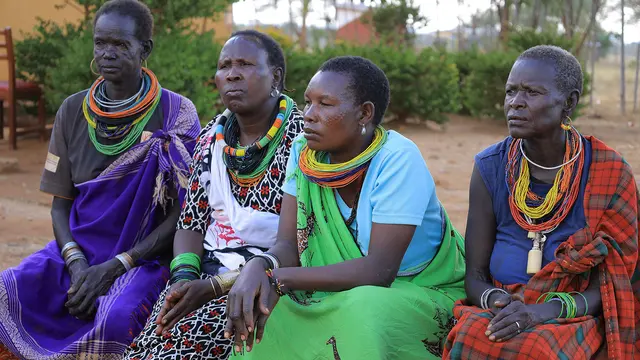
Indigenous women in Peru are fighting for their rights in a context of dispossession, environmental damage and violence. These women are not only fighting for their collective rights but also for the protection and care of Mother Nature.

Quechua members of the Huayllas Indigenous Community participate in community mapping to recognise their ancestral boundaries in the Cusco region (Photo: ONAMIAP)
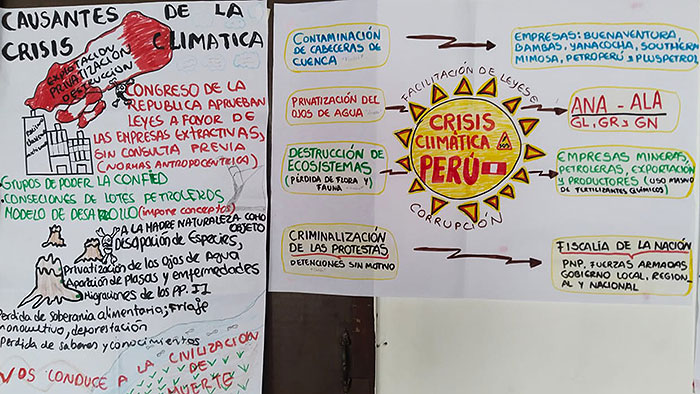
Peru is home to 10% of the world's species and has the second-biggest share of the Amazon Rainforest after Brazil. But damage to this natural abundance is reaching crisis levels: between 1985 and 2021, more than 3.6 million hectares of forest disappeared. A wave of destruction is rolling across Peru from the Amazon to the Andes, driven by extractivist economic policies and climate disruption.
For Indigenous women in Peru, this is an interconnected crisis that threatens their territories, livelihoods and cultural survival. They are responding by challenging the economic model that drives dispossession and environmental destruction.
This case study was developed with ONAMIAP, the National Organisation of Amazonian and Andean Indigenous Women of Peru, which organised a national workshop and two focus groups to collect information: one in Secclla, Huancavelica, with Indigenous Andean Quechua women, and the other in Yarinacocha, Ucayali, with Indigenous Shipiba women of the Amazon.
In the Andean highlands, in Huancavelica, Indigenous women are grappling with mining expansion and chemical contamination of the soil. In Ucayali, Amazon communities face deforestation, land grabbing, illegal economies and restrictions on traditional subsistence practices due to protected area regimes.

Drivers of destruction
Peru's economy relies on mining: the industry accounts for nearly two-thirds of the country's exports. As mineral prices rise, Peru is witnessing a mining rush, legal and illegal, artisanal and industrial, that is causing deforestation, pollution, violence and rights violations.
Forests are illegally logged, the mines pollute watersheds and rivers in Indigenous territories, while indiscriminate use of agrochemicals – often for illegal crops – degrades the soil, water and health.

Roxana Martin Manchi, Asháninka leader from ONIAASEC, accompanies a community mapping process in the Pachacutec Native Community, in the Junín region (Photo: ONAMIAP)
Indigenous communities are being displaced and threatened by illegal groups. Afflicted by poor governance, Peru is seeing illegal activities spread across Indigenous territories, creating an alarming spiral of violence and depredation.
Citing the need to control rising criminality, in 2022 the Peruvian government introduced Law No. 31494, permitting Indigenous communities to arm themselves for self-defence. Critics say this measure encourages paramilitarism and further exposes communities to conflict.
Meanwhile, the government maintains an extractivist economic model focused on exporting natural resources. Legal protections against dispossession and deforestation are limited and fragile. Mining and infrastructure projects are implemented on Indigenous territories without proper consultation. The 2011 Prior Consultation Law (No. 29785) requires consultation with Indigenous Peoples prior to projects affecting their territories – but, crucially, the communities have no veto powers.
We found out six months after construction had already begun. The deputy mayor came to my house and said 'You always oppose progress when the community wants it'. But that's not progress, it's dispossession
– Lourdes Urquía, ONAMIAP member, Shauaya community
In 2024, Peru passed the so-called "Anti-Forestry Law" (Law No. 31973), which allows changes to forest land use without zoning approval, effectively fast -tracking deforestation. In March 2025, the Constitutional Court declared several of its articles unconstitutional, but it continues to be applied, and forest protection remains precarious.
Climate change increases instability
Climate change is blighting food crops, and the loss of traditional local foods is undermining both food security and cultural identity.
Many communities have abandoned farming and now depend on products from urban markets. Farming losses are pushing many families to consider migrating.
People are concerned about what we are going to do, others say that if there is not going to be any planting, we have to migrate to the cities... go out to look for more work, more opportunities
– Mayorlina Anita Ccahuamanquishca de Huancasancos, Ayacucho, Feremía

Elida de la Cruz, Asháninka leader and head of the San Pascual Native Community in the Junín region, helps maintain the community forest nursery (Photo: ONAMIAP)
Rural people are increasingly dependent on trade with urban centres, but this dependency introduces new forms of economic vulnerability, especially for women in remote areas. Many are forced to sell their crops to intermediaries at exploitative prices.
My parents planted yucca, bananas, watermelon, beans… we cultivated everything. Now we don't: we sell out of necessity, to buy soap, school supplies. But buyers swindle us. In the community, they pay us three soles for plantains; in the city, they sell them for 15 or 20. And we also pay boat freight. We don't even know what price we should sell at
– Lourdes Urquía Keiruna, district of Tahuanía
Indigenous women face intertwined crises
The climate crises, environmental degradation and violence are mutually reinforcing, disproportionately affecting Indigenous women who are on the frontline of caring for the land.
Although they depend on the land for food and water, they face barriers to accessing property, participation and leadership. Even so, they organise themselves to transform inequalities, promoting their recognition as qualified community members and occupying decision-making spaces. Their defence of their territory exposes them to threats and harassment, especially from illegal actors.
Strategies for resistance
To counter the extractivist mindset that sees nature as something to exploit, Indigenous women are basing their resistance on a strategy that prioritises care for Mother Nature.
ONAMIAP is calling for Mother Nature to be recognised as an entity with rights that is subject to protection by the State. In April 2021, ONAMIAP and other civil society organisations submitted a draft bill for a "Law that recognises the rights of Mother Nature, ecosystems and species". The bill was approved by a Congressional Commission, but was shelved by Congress. ONAMIAP continues advocating for it.
One of ONAMIAP's most constant and sustained efforts is providing training on women's rights. The training includes discussion of the multiple forms of violence and discrimination that Indigenous women in Peru experience; this is an essential first step for claiming their rights.
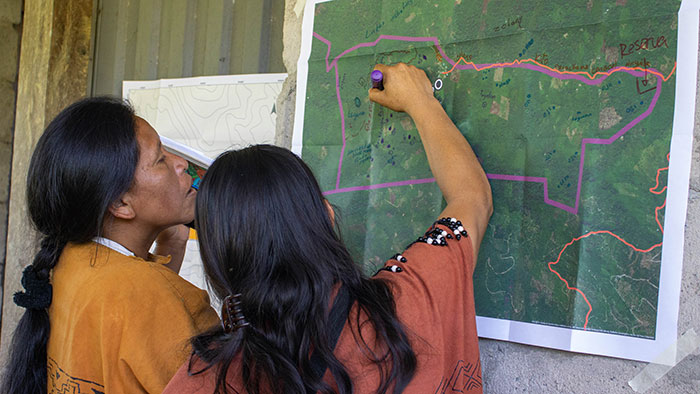
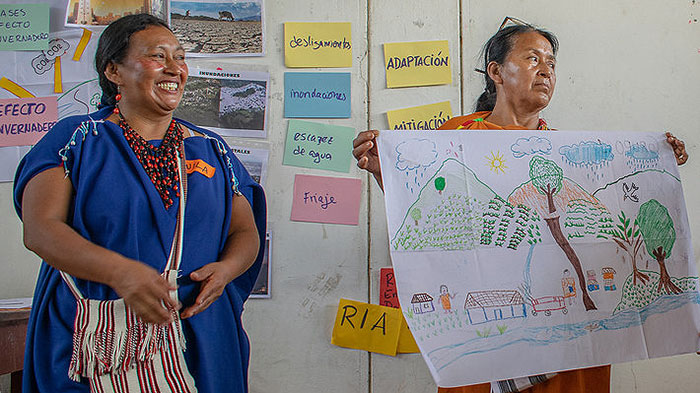
A gallery of photos showing members from the Pachacútec Native Community identifying sacred and communally important sites during a community mapping process in the Junín region. Click on the images to enlarge them and then scroll through (Photos: ONAMIAP)
ONAMIAP also works to increase the political participation of Indigenous women at the community and national levels. This includes changing internal statutes of peasant and Indigenous communities to recognise women as 'qualified community members', a key prerequisite for accessing land and leadership roles.
In 2019, this work contributed to a successful campaign to reform the General Law of Peasant Communities (Law No. 24656), so that it now requires that at least 30% of community board members be women.
ONAMIAP also organises ancestral seed exchange fairs, promoting the saving of ancestral seeds and exchanges between communities. The fairs also provide opportunities to interact with local authorities and state institutions.
Women members are also documenting and restoring water sources in their ancestral territories and recording them in communal registries to prevent privatisation or state appropriation.

Asháninka women walk along the Satipo River in the San Pascual Native Community during a community mapping process (Photo: ONAMIAP)
Changing the paradigm
In Peru, Indigenous women are responding to interconnected crises by challenging the economic paradigm that rests on maximising profit from nature.
Through ONAMIAP, Indigenous women are leading a collective resistance that proposes a new model of development in opposition to extractivism. This model is based on the recognition of Mother Nature as a living being and subject of rights, in contrast to the model that separates human beings from nature and turns resources into commodities.
In contrast to this logic of exploitation, the women of ONAMIAP promote a vision that recognises the interconnectedness and value of all beings, and which guides their strategies: the revitalisation of their traditional knowledge, training in rights, legal action, and alliances for political advocacy.
Giving priority to Mother Nature does not only mean recognising the right of Indigenous Peoples to territory but also recognising Mother Earth as a subject of collective rights, with the right to exist, develop naturally, regenerate and evolve.
This research is part of joint work with the Rights and Resources Initiative (RRI) and the Women's Global Alliance on Gender and Climate (WiGSA), of which ONAMIAP is a member.
This case study was co-compiled by IIED and ONAMIAP, the National Organisation of Amazonian and Andean Indigenous Women of Peru. ONAMIAP is composed of grassroots groups of Andean and Amazonian indigenous women from different regions of Peru, which together fight for the full exercise of their collective and individual rights.
This series of case studies is published in partnership with Rights and Resources Initiative and the International Land Coalition.