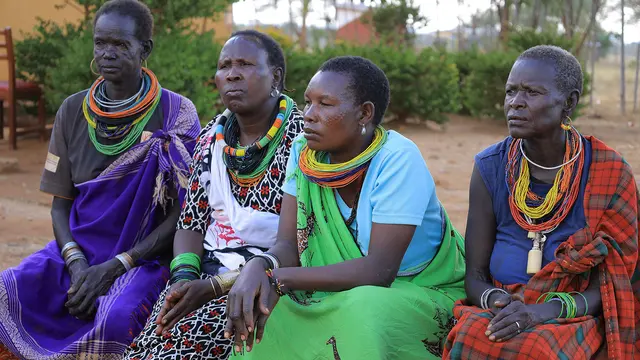
DRC: "Today, our forest is called a park"
When the Batwa people were expelled from their ancestral forests to create the Kahuzi-Biega National Park, the women of this Indigenous Pygmy community lost more than their home: they lost their equal status in Batwa society.

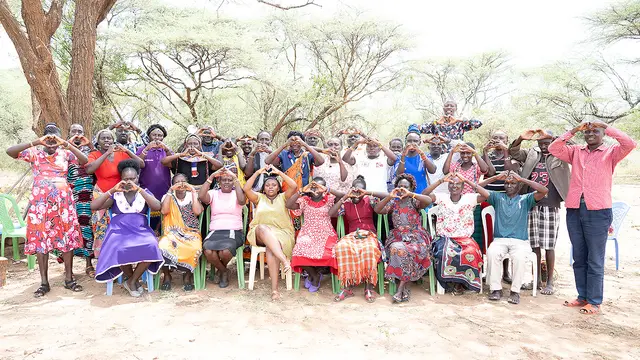
Batwa community members take part in a focus group in Kalehe, organised by the Union for the Emancipation of Indigenous Women (Photo: UEFA)
Kahuzi-Biega National Park (PNKB in French) covers more than 6,000 square km and shelters critically endangered eastern lowland gorillas. In 1980, UNESCO declared the park a World Heritage Site.
But PNKB has a grim history: when the government of Zaïre (now the Democratic Republic of Congo (DRC)) extended the park in 1975, Batwa people – an Indigenous Pygmy community – were forcibly evicted from their ancestral lands and left landless, marginalised and impoverished.
This case study examines the circumstances of the Batwa in Kalehe territory in South Kivu, eastern Congo. It was co-developed with the Union for the Emancipation of Indigenous Women (UEFA), which supports Indigenous Pygmy women to improve their livelihoods. UEFA conducted focus groups in the villages of Lukungula/Cibanda in the Buhavu chiefdom and Maibano in the Buloho chiefdom.

Expelled from their home in the name of conservation
Many governments see national parks as sources of tourism income and conservation funding. However, they often adopt a model – termed 'fortress conservation' – that involves evicting people from their lands and establishing heavily-policed state-managed protected areas.
Before their expulsion, the Batwa lived in small nomadic hunter-gatherer communities in the forest, with free access to the forest's abundant resources.
Today, more than 45,000 Batwa live on the park's fringes in makeshift villages. They have few resources and struggle to survive.
The Pygmy ancestors lived in the forest, and no one disturbed them. They lived with the animals. Today, our forest is called a park
– Marco Kadende, Indigenous leader
The Batwa have tried to return home, but have been met with violent repression from park rangers and soldiers.
Traumatic eviction followed by extreme poverty
Their eviction thrust the Batwa into extreme poverty. The Batwa were given small plots of residential land in Bantu villages as compensation, but no lasting rights to farmland.
Today, Batwa men and women earn a meagre living working as labourers for the Bantu people, making handicrafts, rearing guinea pigs or selling non-timber forest products. They are discriminated against by Bantu communities and marginalised in government policy, including locally.
Climate change is exacerbating their problems. Kalehe territory is seeing rising temperatures and increasingly intense rainfall, flooding and landslides. In Bushushu village, Buhavu chiefdom, nearly 500 people died in floods and landslides in May 2023.
The Batwa have few options for diversifying their livelihoods and suffer from hunger and sometimes starvation.
Women bear the brunt of losing the forest
Batwa women contend with the worst of the Batwa's marginalised lives. The forest's vast biodiversity offered women many ways to support their families. They relied on forest products to feed and care for their families and trade with neighbouring peoples.
Leaving the forest undermined their equality within their community. In the forest, Batwa women took part in all activities and were respected. Among the Batwa, decision making often involves heated discussions, and women participated as equals. In Batwa tradition, the voices of elder women carry unquestioned authority.
By contrast, in Bantu hierarchical society, women are more marginalised. The Batwa have adopted Bantu norms that relegate women to a subordinate position, shifting them from an egalitarian forest society to a village-based society in which women's status is weakened.
The women face triple discrimination: they are marginalised within their communities by new social norms and discriminated against by Bantus and the government because of their ethnicity.
We work for the Batembo, and we do not have the strength of our ancestors due to malnutrition. We are marginalised; we are not considered as human. We Indigenous peoples, we are truly marginalised
– Faida Nyarwangu, Indigenous woman leader
Women must sell their labour to Bantus, transport firewood and water, care for their children and homes, and, if possible, earn a marginal living selling items such as baskets or pots. Their heavy responsibilities limit them from participating in village politics. Meanwhile, Batwa men can no longer hunt or access materials for crafts; many are unemployed and spend their time drinking.
A context worsened by armed conflict
The Batwa's situation has further deteriorated with the intensification of armed conflict in South Kivu. Since 2022, the war has resulted in deaths, large-scale displacement and many families being left without humanitarian assistance after losing their livelihoods.
Young people and Indigenous leaders are falsely accused of belonging to armed groups and are now forced to live in hiding, without access to essential resources.
In addition, some areas of Kahuzi-Biega National Park are now under the control of armed groups, which exploit natural resources with impunity.
Responses: multiple strategies
The Batwa use a range of strategies to cope with their precarious situation. They work in Bantu fields in return for payment in kind or cash. The Batwa are cheap workers, and the Bantu exploit this.
Sometimes they rent a field for a season in exchange for a chicken, a goat, cash or bugabane (a form of sharecropping that involves farming a field for a season and handing over 50% of the harvest). However, Batwa women report that this method of accessing land does not yield them any profit; only the Bantu landowners benefit.
We, the Pygmy women, suffer too much because we are forced to ask for fields from others, and we do not harvest anything
– Emilienne Matene, Indigenous woman leader, Kalehe territory
In Lukungula village, in Kalehe, women from the grassroots organisation Buuma Misi have started fruit tree nurseries with the support of UEFA and UNDP. They sell trees to their Bantu neighbours - because they themselves don't have any land to grow them on.
Making handicrafts is limited by the difficulty of accessing raw materials.
Life became difficult when we were driven from our lands... I enter the forest clandestinely in search of vines. If I am caught, I risk prison. If I make three baskets a week, I can sell them for 12,000 Congolese francs (approximately US$5). But sometimes, they are not bought because there are already modern baskets
– Indigenous Pygmy woman, Kalehe territory

Making baskets can be an important source of livelihoods (Photo: UEFA)
"Cunning strategies"
Sometimes the Batwa have to take crops from Bantu fields. They only take what they need for a day's ration, not to accumulate. For them, this is simply a hunger-busting strategy.
We, the descendants of the expelled Pygmies, are suffering... When we are hungry and (have) nothing to eat, out of necessity, I go to people's fields to take something to eat as if it were in my own field – yet it's stealing. We do this because we do not have seedlings for our fields
– Indigenous Pygmy woman, Kalehe territory
There are frequent conflicts between the Batwa and their Bantu neighbours, whom they accuse of discrimination. Conflicts also pit the Batwa against the Congolese state and the PNKB authorities.
Seeking legal redress
The Batwa continue to seek redress for their eviction. Helped by a local NGO, they took the Congolese state to court in 2008, seeking recognition of the rights of Pygmy peoples and compensation for their many losses. The legal case repeatedly stalled: it reached the Court of Cassation in 2012, where it remains frozen.
In 2015, the Batwa appealed to the African Commission on Human and Peoples' Rights. In July 2024, the commission declared that the forced evictions without prior consultation or compensation violated multiple provisions of the African Charter on Human and Peoples' Rights and called on the Congolese government to allow the safe return of the Batwa people. Whether the government will accede to this request remains to be seen.
DRC adopted a law to promote and protect the rights of Indigenous Pygmy Peoples in 2022, but the lack of implementing measures severely limits its impacts.

The Batwa people were expelled from their ancestral forests to create the Kahuzi-Biega National Park (Photo: UEFA)
A durable approach: securing land
To access farm land, UEFA and the Batwa have co-developed a land acquisition process. It begins with identifying land that the Batwa can purchase from local chiefdoms. With donor support, UEFA provides the purchase funds.
Meanwhile, communities develop participatory land management structures with UEFA technical support. A key component is a community land management charter with democratic governance rules. Villagers elect an eight-member land management committee, half of whom are women. The committee then applies to the local chief for a customary land certificate confirming collective Batwa ownership.
UEFA then facilitates participatory development of a land use plan involving all relevant stakeholders. Finally, the land is divided into plots and allocated to Batwa households. Each household signs an agreement stating that land cannot be individually owned or sold.
Thanks to support from the Swiss Agency for Development and Cooperation (SDC), eight Batwa groups from the Buhavu, Buloho and Ruzizi Plain chiefdoms have acquired a total of 71.70 hectares of land through this initiative.
A step toward justice
Half a century after their eviction, the Batwa still endure the consequences of fortress conservation: landlessness, poverty, and social exclusion.
The community-led land acquisition and management model supported by UEFA offers a promising path forward, embedding gender equity into land governance. Batwa women are represented on land management committees, participate in public forums and influence community decisions.
Our women now speak, lead, and are heard. [In Lukungula village in Kalehe territory] even the village chief recognises their authority
– Shauri Milimo, Kalehe territory
This case study was co-compiled by IIED and Union for the Emancipation of Indigenous Women (UEFA). UEFA promotes the rights of Indigenous Pygmy women and young people in DRC. It promotes community-based mechanisms for achieving their rights and improving their socio-economic situation.
This series of case studies is published in partnership with Rights and Resources Initiative and the International Land Coalition.