How securing land rights is building women's resilience in Kenya
Nearly a decade after Kenya passed laws to protect collective land rights, pastoralist communities – and especially women – still struggle to secure their grazing lands from drought, conflict and land-based investments. This case study explores contrasting experiences of land registration in Baringo and Laipikia counties.

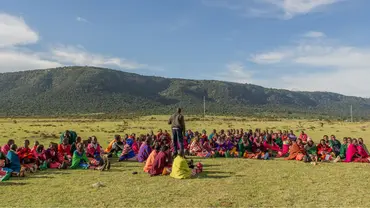
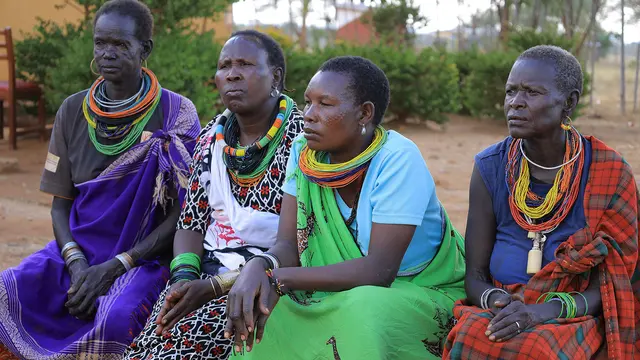
A community in Baringo County discuss registering communal land and securing land rights (Photo: copyright GROOTS Kenya)
Neli Keshine, a pastoralist woman in Laikipia county, starts her daily struggle to find water at 5am.
I wake up at 5am to provide bathing water for my children to go to school. After that, I set out to find drinking water, which is quite far away, nearly 25 kilometres from here. Then I return to take care of my goats, sometimes struggling to find enough water to give them
– Neli Keshine, Laikipia County
In pastoralist communities, women are responsible for finding and collecting water, managing the household and taking care of small livestock. They are hardest hit by the increasingly frequent droughts; often they have to walk long distances in the heat across unsafe areas to gather the water their families need.
Now women face a double crisis: climate change is making droughts more frequent, while large-scale land-based investments are taking over the land that is crucial to the grazing patterns that sustain their communities.

How drought and conflict are leaving families destitute
Across Kenya’s semi-arid regions, droughts are increasing herds’ vulnerability to disease and reducing meat and milk production. With animals in poor condition, livestock prices fall, and families are forced to sell at a loss. During extreme droughts, thousands of animals die, leaving families destitute.
Shrinking resources are intensifying conflicts as herders increasingly cross into neighbouring territories in search of water and pastures. Cattle raiding - a long-standing issue – has become more frequent and deadly. Armed cattle raiders steal livestock and injure and kill herders, often leaving women widowed and families without protection or income.
Land-based investments eroding community rights
Added to this is increasing pressure on land for development. In Baringo, much of the community's land is unregistered. It is "held in trust" by the county government; in practice, this has enabled large-scale investment projects to proceed with minimal consultation.
For example, Chinese investors are initiating ventures ranging from mining to making glue from donkey bones. A 2019 study found that often these investments bypass official scrutiny, operating "under the radar" of both the Kenyan and Chinese authorities. Local leaders are often implicated in backroom land deals, leaving communities confused and powerless.
For local residents, the consequences are stark. Moses Katewon, from Chemolingot in Baringo County, described how his family's ancestral land was taken for a sand factory:
It is widely acknowledged here that this land belongs to my grandfather. I don't understand how these Chinese investors managed to take this land using deceptive means. No one in this entire area possesses title deeds, and I don't even blame the Chinese investors. The problem lies with the area chiefs and principals who made a deal with them
– Moses Katewon, Chemolingot, Baringo County
The Community Land Act recognises communal land, but is it working?
Kenya's pastoralist communities are particularly vulnerable to land dispossession because for decades, they didn't have formal recognition of their customary land rights and their territories remained unregistered. In 2016, the government introduced the Community Land Act, formally recognising community land rights.
The act provides a legal framework for communities to register their land under communal tenure. It mandates Community Land Management Committees (CLMCs) to oversee land use and governance.
The act offers important safeguards against exploitation:
- Any lease, sale, or use of community land by outsiders requires free, prior and informed consent from the full community.
- Decisions about land must be made through the community assembly – a forum of all adult members – rather than just committee elites.
- Crucially, the law says at least one-third of CLMC members must be women.
Weak implementation undermines impact
But in counties like Baringo, implementation of the act has been slow, underfunded and politically contested. There is a lack of political will at both the national and county levels: until the communal territories are registered, governments remain custodians of community lands. County officials often resist registration so that they can strike deals with outside investors.
A decade after the act became law, the majority of land in Baringo remains unregistered, and communities continue to face an uphill battle to secure their rights.
In a worrying development, there are current proposals which seek to ease mechanisms for the compulsory land acquisition for large infrastructure projects.

In Baringo County poor climate conditions, such as drought, have prevented children from attending school (Photo: copyright GROOTS Kenya)
Pastoralist women remain excluded
For women, the disconnect between the law's progressive provisions and on-the-ground realities is especially stark.
Despite their central role in managing household economies, women are shut out of land ownership and decision making, leaving them without legal recognition or ways to protect their livelihoods.
In this area, men own the land, cows and goats. Women have only hens – and no voice in the community
– Nemutul, Keptnoi Lachakori
Even when community land is registered, women's names aren’t on community membership lists and they have no say in decisions about how the land is used.
Language barriers, low literacy and lack of information hinder women from claiming their rights, compounding their exclusion in a system that was meant to protect them.
A more positive story in Laikipia
Two hundred km to the north, in Laikipia North sub-county, a more positive story is emerging. There, 115 pastoralist communities have successfully completed the process of mapping and registering their communal ancestral lands.
GROOTS Kenya worked with Laikipia women to get them involved in the registration process. As a result, the registers that accompany each title deed list both women and men, women were supported to join and participate in CLMCs and annual updates to the registers ensure that women's names are retained and added over time.
Before obtaining title deeds, women, girls and mothers with no boy child were not permitted to own land. After participating in GROOTS Kenya's training sessions alongside our men, women are now permitted to own land. As a woman, I am now a landowner and a leader
– Mary Maasai
Training for both women and men focused on the importance of including women in land governance, and local champions advocated for inclusive practices.
Land ownership has been incredibly beneficial for us women, especially for single mothers. With a title deed, we can secure loans from banks to educate our children or engage in farming to produce food to meet our daily needs. It has truly empowered us economically as landowners
– Janet Kamishna
Secure land rights improve resource management
With secure land rights, Laikipia communities have established community bylaws to share natural resources. New water management bylaws help regulate access to river water, specifying how and when each group can draw water, reducing tensions and, crucially, improving access for women.
Laikipia North shows what is possible. When land registration is supported, inclusive and gender-responsive, it not only secures tenure, it also strengthens community cohesion, reduces conflict and enhances resilience to climate stress.
Kenya's Community Land Act offers a powerful legal framework to address these injustices. But without political will, investment and sustained support for communities, the Act risks being an unfulfilled promise. Kenya must move to real implementation and women must be supported to claim their rights and participate fully in the decisions that shape their futures.
This case study was co-compiled by IIED and GROOTS Kenya (Grassroots Organisations Operating Together in Sisterhood), a national movement uniting grassroots, women-led self-help groups. GROOTS Kenya works to increase women’s participation in land and resource governance and to improve community understanding of women’s potential roles in land governance.
This series of case studies is published in partnership with Rights and Resources Initiative and the International Land Coalition.