Nature finance: what’s being done and is it working? transcript
[Music]
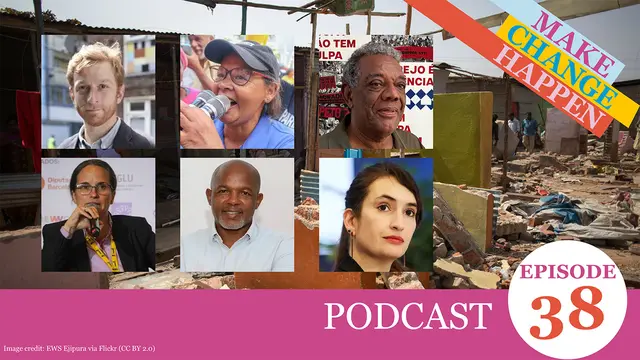
Simon Cullen [00:06] Hello and welcome to the Make Change Happen podcast from the International Institute for Environment and Development. I'm Simon Cullen. Reading the news, you'll see lots of stories about climate finance and the need for rich countries to do more.
And it's a topic that will surely be the focus of this year's climate talks in Brazil. But there's another key aspect to the funding debate that often sits in the shadows of climate finance, and that is nature finance.
So, in this episode, we're going to take a look at nature finance, how it's different from climate finance, what's being done, and ask the question, is it working? I'm excited to say that joining me on the podcast is Ebony Holland, a principal researcher at IIED, who is involved in both our climate and our nature work. Ebony, welcome to the podcast!
Ebony Holland [00:52] Thank you so much for having me, Simon. Great to be here.
Simon Cullen [00:55] So I'm really excited to delve into this topic because I really don't think it gets enough attention. I think it might be helpful for our conversation if you could just quickly explain what nature finance is and the similarities and differences with climate finance.
Ebony Holland [01:10] Thanks, Simon. It's so great to have a bit more attention on nature finance at the moment. It really does sit in the shadows of climate finance, as you say. So it's fantastic to devote some time today on this topic.
Put really simply, nature finance is the flow of money that supports good outcomes for nature and for people. In IIED's new nature finance strategy, we define nature finance as the flow of funds that conserve biodiversity, ecosystems and species and support positive outcomes for people. And I'll come back to that in a minute.
And so we're really looking at funding that cuts across multiple landscapes from the mountains to the sea, including forests, wetlands and oceans. And this finance can come from different places. It can come from the international level, sort of between governments and other governments or other places in different countries, from multilateral development banks, from philanthropies. There's also a lot of nature finance that's generated at the domestic level within countries and, of course, finance for nature that is also supported and generated within local communities as well.
And so, there's lots of different types of nature finance that IIED works on that can include village saving schemes and communal funds, biocredits and agrobiodiversity credits, debt swaps, micro and small grants, looking at incentives and subsidies, and a whole lot more.
You also asked about the links between nature finance and climate finance itself. And what I would say is that IIED has a really long history of working with climate finance and also on nature finance. And to be honest, there's much more in common between them than there isn't.
Their similarities are that they are working on interconnected goals to address both global and local challenges and often when one is funded, that funding benefits the other two, so there's a nice synergistic relationship between the two. There are also similar challenges that both nature and climate finance experience in terms of people accessing the finance, there's really complex procedures.
Often someone in a very faraway country is deciding how that climate or nature finance is being spent and of course there's not enough finance for either getting to the local level. There are some differences in how the machinations of the finance flows, where it comes from, how it's reported on and monitored, etc. But overall there is much more in common between them than not.
Simon Cullen [03:29] And so if we just look at that nature finance, I've been reading reports from the World Bank and others that talks about a US$700 billion dollar a year need to restore nature. Are we anywhere near that figure yet?
Ebony Holland [03:44] We are not. I wish I was the bearer of better news, Simon, and this is indeed the billion-dollar issue that many working on nature finance are facing at the moment. As you say, it's estimated that around $700 billion a year is needed to really effectively tackle the biodiversity crisis and to meet the international goals that many, many countries have signed up to.
However, current investments fall significantly short of this amount. And I want to point to the state of the finance for nature report that the United Nations Environment Program put out in 2023. And in that report, they estimate that the current finance flows for nature are only around $200 billion annually. So that's about a third of what is needed. And that's worrying enough in itself. What is more worrying is that in this same report, for the first time, the United Nations Environment Programme looked at nature negative finance flows.
So, these are flows of finance that are harming nature, things like investments in industrial agriculture and fishing, subsidies for activities that result in deforestation, habitat destruction and pollution. And that figure is staggering. It's almost $7 trillion per year. And so, what this means is that globally, we are potentially spending 10 times more on activities that harm nature than on activities that support nature.
Simon Cullen [05:06] They are some sobering statistics. It almost feels a bit overwhelming when we sort of think about just the need that we're talking about here and where the money is going at the moment.
[Music]
Simon Cullen [05:19] Part of the challenge here, I think, is getting our heads around where the money flows. So, you've talked about $200 billion a year of money coming into nature and biodiversity. Can you just talk us through the process of where that money travels?
Ebony Holland [05:33] It's a really complex question to answer, but I'll try and answer this succinctly. We spend a lot of our time at IIED exactly looking at this issue: where does the money go?
We particularly look at the public finance side of things. So, what will usually happen is a government or a funder will have funding that they will make available. And that money is generally passed to a middle organisation or an intermediary, as it's sometimes called, who will then manage that funding and distribute it to wherever it's going, perhaps at the local level or to a national government or to really anywhere in between.
And although this sounds efficient, it actually can be incredibly inefficient. What it means is that the fund provider or the intermediary often have already decided what the funding will be doing before it's being properly distributed. And so we spend a lot of our time looking at how much of that funding actually reaches the place where it's intended to go, and it can be very difficult to actually properly get to the heart of that.
Simon Cullen [06:29] So the Global Environment Facility, that fits into this because it's one of those big distributing funds, isn't it?
Ebony Holland [06:36] That’s right, the GEF, the Global Environment Facility, is a really major funder of nature and climate finance. They provide grants and funding primarily to support developing countries to support the environment and sustainable development goals that they have.
Simon Cullen [06:50] One of the things that you've looked at recently is where the money from the Global Environment Facility ends up. So could you just talk us through what you found there?
Ebony Holland [06:59] The reason we're looking into this at the moment is because a number of the partners that IIED has worked with for a long time, particularly Indigenous Peoples and local community partners, have been raising concerns about their challenge accessing multiple different funds, in fact, including the Global Environment Facility.
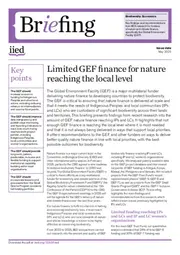
So what we set out to do was to analyse how much of the GEF funding reached Indigenous Peoples and local communities and how much of this also went to women and girls. I'm going to try and not get too technical here, Simon, and I'd really encourage anyone who wants to really get into the details to go and have a look at the briefing paper that we've put out.
But basically, what we did was we looked at GEF project documents and we worked with partners across five countries to interview a subset of people receiving the funding from the GEF to look at how much of the funding actually reached the local level in the GEF replenishment phases between 2014 and 2022. So that's the replenishment phases number six and number seven.
And my colleague, Nicola Sorsby, was leading this work with partners from the UK, Malawi, Bangladesh and Vanuatu and in the Caribbean as well. And what this found is that 24% of the total funding from the sixth replenishment of the GEF and 30% of the funding from the seventh replenishment of the GEF was targeted towards Indigenous Peoples and local community actors. However, being targeted doesn't actually mean receiving. And it's very difficult to actually get the evidence to suggest that Indigenous Peoples and local communities received much of that funding directly at all.
Simon Cullen [08:34] So it's potentially quite a small amount that ends up in those communities. Why is it so important that the money does get there?
Ebony Holland [08:41] Actually what is at the heart of your question, Simon, is touching on issues of justice, of autonomy and of power redistribution. And this is where initiatives like the principles for locally led adaptation are really important, as are the more recent principles for inclusive, gender-responsive, locally-led biodiversity action.
At the heart of this issue is that Indigenous Peoples and local communities have a deep understanding of their environments. They take care of huge parts of nature and have the best knowledge and practices and long legacies of dealing with the nature and the biodiversity in the areas that they are in.
Yet for a really long time, decisions on where and how nature finance should be used has been decided in boardrooms far away from the reality on the ground in the communities affected by climate change.
When we look at the governance of some of the funds and the finance mechanisms, the seats available to local actors, to Indigenous Peoples, to local communities is really limited as well. And this really needs to change.
[Music]
Simon Cullen [09:43] Maybe if we switch briefly and talk about some of the opportunities that you see over the coming few years to strengthen finance reaching Indigenous Peoples and local communities.
Ebony Holland [09:52] Yeah, thank you. I think it's always good to sort of start to end on a note of optimism rather than kind of continually reinforcing the doom and gloom that sometimes exists in this space.
I’ll recommend our research points to a number of recommendations. So firstly, we need to really increase the access to funding for local actors, including reducing reliance on the intermediaries and the country focal points in the GEF.
They have a role to play. It's an important role to play, but actually more of that power needs to be distributed to the local actors. And in fact, a number of our Indigenous partners and local communities really reinforce the importance of being able to choose the intermediaries that they work with and be able to really set up and call the shots in terms of the partnerships and the ways that they receive that funding.
A second really important point is that we need to improve the data transparency around GEF funding and in fact, across all funding. This is not just a GEF specific issue. The third point I want to really emphasise is that it is essential to provide long-term, patient and predictable funding and to ensure that that funding is inclusive and flexible also. And it's not just about doing the actual work itself. It's also about ensuring that the institutions right along that funding pipeline have the capacities and the skills and the things that they need to really deliver on the work around supporting nature.
The fourth point I want to mention here is not something we've spoken too much. One of the aspects of our research that we did look into quite a bit is a sort of smaller part of the GEF Trust Fund, which is the Small Grants Programme, the SGP. And actually the explicit intention of this grant programme is to ensure that there is much more direct access to GEF funding for Indigenous Peoples and local communities.
And in fact, the recipients that we interviewed that received funding from this part of the GEF actually had much more positive experiences. I think for us what this shows is that the Small Grants Programme is an example of what the GEF can do differently and how the GEF can distribute funding in in better, more innovative ways. And actually they need to do much more of that across their full trust fund.
Simon Cullen [11:53] Ebony, is there a sense that you're getting that there is an appetite for making some changes and for making sure more money gets to the local level and Indigenous Peoples?
Ebony Holland [12:02] I do think so, yes, and I think this is partly because I'm just a naturally an optimistic person, Simon, I'm a glass half full type. But I do feel that in the conversations that we and many others are having in the places that have traditionally held that power with governments and with foundations and with others, that there is a real recognition that not only is it the sort of ethical right thing to do, which is to get the funding to the local level and designed in ways that work at the local level, but it's also the best use of the money as well.
So, in terms of effectiveness of the funding, it's better to get it into the hands of people that know what to do with it.
[Music]
Simon Cullen [12:38] Well, given this is called the Make Change Happen podcast, given all we've talked about today, what's the one big change you'd like to see when it comes to nature finance?
Ebony Holland [12:46] Thanks, Simon. You know me, I'm a chatterbox and I'm struggling to think of one. The one thing that I would say is that personally, I'd like to see the funds and the donors take on more responsibility themselves for shifting their own practices and upscaling their own staff so that they are better able to work with and adjust to working with local level actors.
For too long, the very colonial approach to capacity building has placed that burden on local actors themselves to really shift their ways of working, work in different languages that that perhaps they haven't grown up with or worked in before. And so, I'd like to see this power shift and I'd like to see more onus put on the donors themselves to shift their practices instead.
Simon Cullen [13:25] Ebony, thank you so much for your time and your expertise and your enthusiasm today. It's been great having you on the podcast.
Ebony Holland [13:32] Thank you so much, Simon, it’s been a pleasure.
Simon Cullen [13:33] Ebony Holland is a principal researcher at IIED. To listen to previous episodes or to read more about what we're doing in the world of nature finance or indeed any of our other work, head to our website, iied.org. That's iied.org. Thanks for listening.
 Soundcloud
 TuneIn
 Spotify
 iTunes