Weaving resilience: biocultural territories and agrobiodiversity zones in the Southern Andes
IIED is working with local partners and Indigenous communities in the Southern Andes to strengthen biocultural heritage territories, agrobiodiversity and climate resilience.
Principal researcher and team leader (biocultural heritage), IIED's Natural Resources research group

Experts from the Potato Park, Peru in 2024. As a centre of origin of crops, the Potato Park has been designated an agrobiodiversity zone and other communities are seeking to learn from their experiences to protect their own territories (Photo: Krystyna Swiderska, IIED)
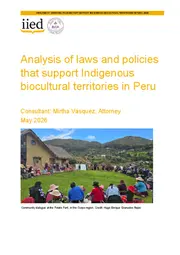
The Andean communities in Cusco and Apurímac regions of Southern Peru are custodians of rich agrobiodiversity and ecosystems shaped by ancestral knowledge. This biocultural heritage includes high levels of crop diversity and ecological knowledge that are critical for resilience to climate change, but that face a number of threats, such as youth out-migration and extractive industries.
Peru is rich in 'critical minerals' for clean energy technologies, such as copper. This presents both economic opportunities and social and environmental challenges, such as loss of biodiversity and displacement of Indigenous communities, driven by the rising global demand for copper for renewable energy (such as electric cars).
The 2016 law on agrobiodiversity zones offers an opportunity for communities to recreate and protect agrobiodiversity-rich traditional landscapes. This law recognises and protects areas of exceptional agrobiodiversity, enabling communities to enhance climate resilience and sustainable livelihoods.
What is IIED doing?
The law on agrobiodiversity zones was developed in recognition that Peru is a centre of origin of crops, and was inspired by the work of the Potato Park in Cusco, where communities have developed an effective biocultural territory model for protecting agrobiodiversity and enhancing climate resilience and local economies.
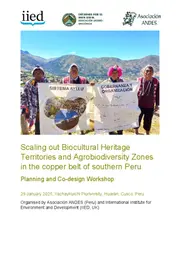
Building on that success, this project is working with ANDES and the Potato Park to scale out this approach to other communities in Cusco and Apurimac regions, and adapt the Potato Park’s governance and economic strategies to their community contexts. In Apurimac, we are working with a local NGO, Entornos para el Buen Vivir.
The project is using a decolonising action-research approach, centred on community-to-community horizontal learning. This recognises that communities are the real experts in how to establish collectively governed biocultural territories rooted in Andean cosmovision and traditional knowledge that has conserved biodiversity for millennia.
IIED and Asociacion ANDES aim to establish a network of biocultural territories and agrobiodiversity zones in Peru. These territories will strengthen Indigenous communities’ capacity to preserve biodiversity, adapt to climate change, enhance their livelihoods sustainably and protect their rights to land.
The main aims of the project are to:
- Develop inter-community governance models and biocultural protocols to manage biocultural territories
- Support new biocultural territories and agrobiodiversity zones to emerge in Cusco and Apurímac
- Promote biocultural enterprises to provide sustainable and equitable economic alternatives, and
- Build a network of agrobiodiversity zones to foster learning and collaboration.
Publications
Additional resources
Partners
This project is working with local partners in the Cusco and Apurimac regions
Donors
Swift Foundation