Insurance regulation falling behind as climate risks rise, study suggests
Governments failing to balance protections for insurers and people.

Major economic players like the United States and European Union are failing to make the most of their power to regulate the insurance industry, leaving either insurers, consumers or both vulnerable to the impacts of increasingly frequent extreme weather, new IIED research suggests.
The study found regulation also does little to encourage the insurance industry to scale back its huge investments in fossil fuels – the cause of the climate change now battering its balance sheets.
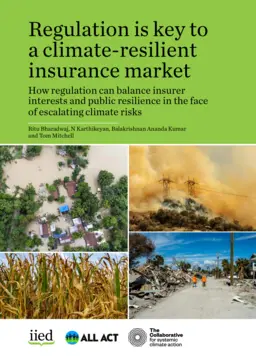
Researchers analysed seven jurisdictions to see how effectively regulators a) push insurers to protect themselves from climate risk (the ‘prudential’ score), and b) ensure ordinary people could still access insurance in the face of rising premiums and shrinking coverage (the ‘resilience’ score).
The jurisdictions analysed were: the European Union, the United Kingdom, the United States at the federal level, the states of Florida and California, Australia and India. They were judged against the International Association of Insurance Supervisors’ 2025 global standard on supervising climate-related risks, using a new methodology that allows comparisons between regulatory regimes.
Attributing a score out of 100 for each side of this equation revealed major imbalances: either insurers’ balance sheets were markedly better protected than the public’s access to cover, or regulation protected access today without ensuring the companies providing it could withstand rising climate risks.
The starkest contrast was between the EU and the US federal government, which have built opposite halves of what’s needed. Brussels has strong laws protecting insurers, but leaves the question of whether people can get and keep cover almost entirely to member countries. Washington leaves states to create rules on how insurers should manage risk, but runs one of the world’s largest public schemes for sharing disaster losses through its national flood programme.
While the scores varied widely, researchers were encouraged to find a law or a regulation working well somewhere in the world for 17 of the 19 regulatory features analysed in each jurisdiction. The two blind spots were in monitoring whether insurers are pulling out of poor or vulnerable communities, and in requiring insurers to shift their investments towards reducing climate risk.
This means regulators trying to design a system able to withstand climate change, but who currently lack effective protections in one of these 17 areas, can likely draw on successful examples from elsewhere.
Ritu Bharadwaj, director of climate resilience, finance and loss and damage at IIED, said: “All the jurisdictions we studied are falling short of one or both of the international benchmarks we judged them against.
“Yet these standards were defined by the international association of the world’s insurance supervisors, a body which includes the supervisors of every jurisdiction we researched, and which has described those standards as appropriate practice.
“At the same time, insurers invest billions of dollars in the activities driving climate change, feeding capital into the very phenomenon pushing them to withdraw from affected markets.
“The overarching problem we identified with regulations that bear on resilience – protecting people’s coverage – was that they’re generally not designed for the climate change era. While Australia’s cyclone pool and California’s new wildfire rules, for example, are clearly influenced by changing weather patterns, they respond only to present risks.
“Extreme weather is expected to become more frequent yet less predictable in the future, and regulators need to think about whether their current systems will hold up. The coming El Niño is only the most obvious example.”
Notes to editors
For more information or to request an interview, contact Jon Sharman:
+44 7407 727 886, or [email protected]