Food security to crumble in face of climate change
New research suggests cracks will begin to show even at 1.5°C of warming, hitting all countries.
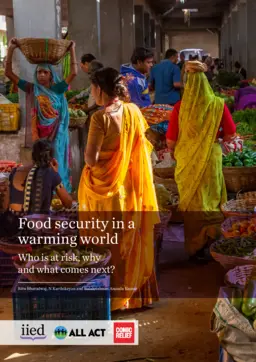
People around the world face being unable to buy good-quality food or even enough food to survive following repeated climate-driven shocks, research from IIED suggests.
Data from a new food security index shows how even wealthy and higher-income developing countries will feel the effects of extreme weather on farming, imports and supply chains.
Poor and war-torn nations whose systems are already fragile are expected to see precipitous declines in food availability and nutritional variety at 2°C of global temperature rise.
Analysis suggests even 1.5°C of warming above the 1850-1900 average, which the world is likely to reach soon, will create serious dietary instability in lower-income countries.
Temperature increases are predicted to widen the already considerable food security gap between rich nations and poorer ones, notably in sub-Saharan Africa and south Asia. (Baseline ratings reflect current climatic conditions.)
Key points
- Food security in 162 countries was assessed according to four ‘pillars’: the availability, meaning existence, of adequate food; the accessibility of that food to households, for example, whether it’s affordable; its nutritional value and whether people are healthy enough to absorb those nutrients (‘utilisation’); and the sustainability, or resilience, of food supply systems
- Countries were ranked using a scale of 1 to 10. The global average was 6.74. Iceland (9.26), Denmark (9.17), Austria (9.15), Ireland (9.13) and Belgium (9.07) scored highest. The lowest scores were Afghanistan (3.31), Madagascar (3.15), Haiti (2.57), DR Congo (2.51) and Somalia (1.29)
- All G7 members placed outside the top five (though data for Japan was unavailable). Germany (8.86) led the group, followed by Italy (8.82), Canada (8.78), the USA (8.74), the UK (8.73) and France (8.55). Of these, the USA saw the biggest drops in food security at 1.5°C and 2°C of warming (-0.20 and -0.44 points from baseline respectively) and the UK the smallest (-0.13 and -0.29)
- China’s base score was 7.62, falling to 7.06 in a 2°C warming scenario
- Notable large economies falling below the average score were Brazil (6.72), Mexico (6.36), Indonesia (5.87) and India (5.31). Analysis showed India’s food security to be particularly vulnerable to climate change, with its score falling to 4.96 at 1.5°C of warming and just 4.52 at 2°C (-0.35 and -0.79 from baseline)
- Some 3.19 billion people (41.12% of the world) live in countries scoring above the 6.74 baseline average, while 4.56 billion (58.88%) live in countries scoring below it. At 2°C of warming, an extra 291 million people could fall below that original line
- Each additional US$1,000 per capita of GDP translates roughly, on average, to an additional 0.2 points on the food security scale. This varies across the four pillars, with the effect on availability (0.26), accessibility (0.18) and utilisation (0.25) far outstripping that on sustainability (0.10). In other words, economic growth does improve food security, but doesn’t automatically create resilience to extreme weather.
Ritu Bharadwaj, IIED’s director of climate resilience, finance and loss and damage, said: “This research shows that, yet again, it’s the poorest countries with the least responsibility for climate change that will suffer its worst effects.
“But crucially this work also provides tools for understanding the possible impacts and potential solutions in detail. Climate change is likely to worsen food security at least in the short term no matter what we do, but catastrophic declines in availability or nutritional value are not inevitable.
“Investing in social protection schemes that can be activated based on early warnings is one way to prevent disasters becoming full-blown crises.
“Helping farmers adapt to extreme weather, through improving water management, soil quality and crop variety, is another vital protective measure.”
She added: “Food supply problems in poorer countries will have knock-on implications for richer ones. For example, because of highly inter-dependent supply chains climate instability in one major crop-producing region can create volatility elsewhere in the system.
“Even if high-income countries can expect to remain largely food-secure, they won’t be insulated from global price changes.”
Notes to editors
- Insufficient data was available to include some countries in the index. They are: Andorra, Benin, Brunei, Central African Republic, Cuba, Dominica, Equatorial Guinea, Eritrea, Grenada, Japan, Liberia, Liechtenstein, Marshall Islands, Micronesia, Monaco, Nauru, North Korea, Palestine (observer state), Palau, Saint Kitts and Nevis, San Marino, Singapore, South Sudan, Syria, Timor-Leste, Togo, Tuvalu, Vatican City (observer state), Venezuela, Yemen
For more information or to request an interview, contact Jon Sharman:
+44 7407 727 886, or [email protected]