Santa Marta conference highlights legal barriers to the energy transition
Reflecting on the First Conference on Transitioning Away from Fossil Fuels (TAFF), Lorenzo Cotula and Kyla Tienhaara argue that progress will require concrete solutions to overcome legal barriers constraining climate action.



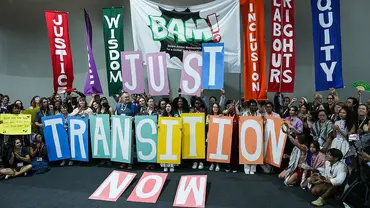
Closing plenary of the First Conference on Transitioning Away from Fossil Fuels (Photo: Lorenzo Cotula, IIED)
The first TAFF conference, held in Santa Marta, Colombia from 24-29 April, injected new momentum into policy efforts to advance the energy transition. But our visit to La Guajira department in northern Colombia, a three-hour bus ride away, highlighted that to make real progress, countries must tackle the structural factors that sustain the fossil fuel economy. And that includes the international system of investment treaties and Investor-State Dispute Settlement (ISDS).
The conference
Co-convened by the governments of Colombia and the Netherlands, the Santa Marta conference was designed as a step towards accelerating the energy transition (PDF) beyond the pace set by the annual United Nations climate talks.
Bringing together representatives from 57 states and many non-state actors – from Indigenous Peoples to trade unions, nongovernmental organisations and research institutions – a high-level segment led by government representatives was preceded by a range of stakeholder events, including a science-policy preconference. A co-host takeaway document (PDF) distilled key outcomes.
New political momentum
A good spread of countries attended the conference, including some major oil producers. This added to the sense of ambition and momentum, which was also facilitated by the conference format: it was a discussion, rather than a formal negotiation.
The agenda did not shy away from themes that are both key for climate action and present in entrenched interests, such as public debt, fossil fuel subsidies, trade, finance and ISDS. The conference marks the start of a plurilateral process designed to complement the regular climate talks: the second TAFF conference will take place in Tuvalu in 2027, co-hosted with Ireland.
Energy transition realities
Developments in La Guajira expose how structural factors entrench the fossil fuel economy and the risk that renewables will not bring local benefits if not carefully regulated.
La Guajira hosts Latin America’s largest open-pit coal mine, currently owned by Swiss mining giant Glencore. This mine has been at the centre of disputes about community displacement (in Spanish), water diversion and public health concerns.
Legal action by Indigenous communities led to a 2017 Constitutional Court decision suspending a mine extension that would have entailed further water diversion (in Spanish). In 2021, the company initiated ISDS proceedings against the Colombian government, arguing that Colombia breached its bilateral investment treaty (BIT) with Switzerland and seeking damages for nearly US$500 million (PDF). The case is ongoing.
Glencore’s concession expires in 2034 and Colombia’s Minister for Mines and Energy has urged the company to begin discussing closure plans with local authorities and communities.
The mine is a major source of public revenue for La Guajira, highlighting the need to develop alternative livelihood systems. The spread of renewable energy projects, particularly wind power, is a potential new source of income and jobs here.
But Indigenous communities have raised concerns about how these projects are being rolled out, with disputes flaring up over consultation and compensation. And now a windfarm company is suing Colombia for more than $600 million in ISDS, based on the Colombia-Spain BIT, over new consultation and environmental requirements that delayed issuing operating permits (in Spanish).
A barrier to the transition
Worldwide, the global system of investment treaties protects vast fossil fuel investments, including coal-sector projects, against adverse public action. So when governments regulate, restrict or phase out fossil fuels, they may face expensive legal claims.
In its 6th Assessment Report, the Intergovernmental Panel on Climate Change noted that the prospect of costly litigation and large payouts to fossil fuel businesses can make it harder for states to take necessary climate action. These treaties also protect investments in renewables and critical minerals, in ways that can restrict governments’ ability to regulate and maximise local benefits.
Low and middle-income countries are particularly exposed to the risk of ISDS claims. This is partly because European and North American governments have reduced their exposure by amending, terminating or withdrawing from treaties. Low- and middle-income countries also tend to have more limited fiscal space to deal with large claims and payouts.
Political pledges, legal complexities
Irene Vélez Torres, Colombia’s Minister for Environment and co-chair of the Santa Marta conference, has been outspoken about the ways ISDS can hamper climate action – and President Gustavo Petro has pledged to withdraw from the system. But acting on this pledge is complicated by presidential elections at the end of May 2026 and the inherent difficulties in renegotiating and terminating investment treaties.
Most BITs contain survival clauses that protect investments for a further period of 5-20 years when treaties are terminated unilaterally. Avoiding such continued application requires mutual agreement between the treaty parties. Removing the effect of survival clauses for an extensive network of BITs would require coordinated, plurilateral action that can change many treaties in one go.
Dealing with ISDS clauses in wider trade agreements would require a similarly coordinated approach. These treaties cover many topics beyond investment and most governments consider them too important to terminate over concerns about ISDS. But it is possible to modify agreements to remove ISDS or ensure it does not apply to certain parties, as New Zealand and Australia have done with side letters in various agreements.
A space for plurilateral action
The Santa Marta conference promised to offer an avenue for discussing plurilateral action on ISDS, which organisers explicitly listed as an agenda item. The science-policy preconference put forward concrete proposals (PDF) for states to work together to eliminate ISDS as a barrier to climate action, which were met with interest from environmental ministries, NGOs (PDF) and trade unions (PDF).
A major success of the conference was that it substantially raised general awareness about ISDS in climate policy circles – as one participant put it, ISDS went ‘from nerdy topic to mainstream’. But the co-host takeaways on the conference (PDF) do not include a clear outcome on ISDS. Although three workstreams will be established to facilitate cooperation in the lead-up to the second conference in 2027, none expressly includes ISDS.
Going forward
To avoid becoming a talking shop, the new ‘coalition of the willing’ that has emerged from the conference must take concrete action on the structural drivers and enablers of the fossil fuel economy, such as economic dependence, public debt, fossil fuel subsidies and ISDS.
Tuvalu and Ireland will co-chair the next TAFF conference. Although neither country has any BITs, Ireland does have experience with fossil fuel industry ISDS claims under the Energy Charter Treaty and officially withdrew from that treaty while the Santa Marta conference was ongoing.
One challenge that came up in Santa Marta is that key economic governance issues such as ISDS are outside the remit of the environment ministries that typically represent states in climate talks. To ensure progress at the next conference, trade, finance and environment ministries must work together in the run-up to the event.
In addition, non-state actors – from research institutions to campaigning organisations – play a key role in highlighting the links between climate action and economic governance, including ISDS. In Santa Marta, the emphasis on an inclusive process created avenues for tapping into this work and advancing the collective reflection on ISDS.
Going forward, this must continue, supporting the government of Tuvalu’s commitment to ‘ensure inclusivity in every facet of our preparations and in the conference itself’.