Women land rights defenders connect across continents
Across Africa and Latin America, women don't have equal rights to land. During the Global Land Forum, IIED brought together women land rights defenders from Kenya, Uganda, Peru and Colombia to share their strategies and explore synergies for collaboration. Philippine Sutz reports on the discussions.


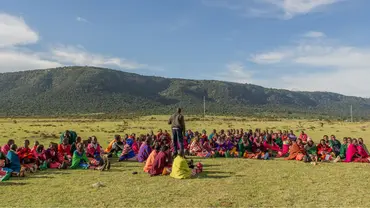
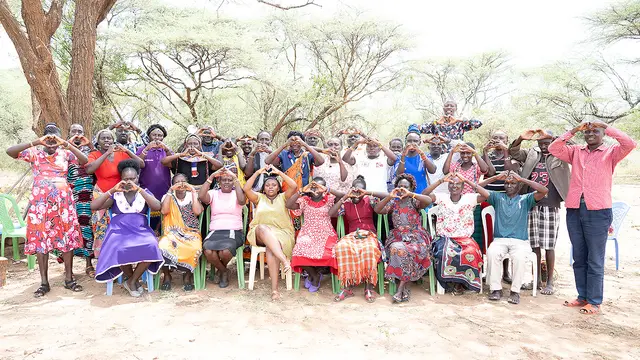
Focus group discussion on women's land rights in Tiaty, Kenya led by GROOTS (Photo: copyright GROOTS)
On 16 June 2025, in the margins of the ILC Global Land Forum in Bogotá, IIED brought together partners from four countries – Kenya, Uganda, Colombia and Peru – to talk about their respective experiences. IIED has been working with these partners over the past year to develop case studies that document women's struggles for land rights. This was the first time the project partners had the opportunity to meet face-to-face, learn from one another and exchange ideas.
The room was filled with energy and the excitement that comes from recognising shared experiences across borders. Each organisation presented the findings of their case study, which explored the intertwined impacts of climate change, land-based investments and biodiversity loss on women from marginalised communities.
These studies, which are being developed collaboratively with IIED, aim to amplify the voices of women defending their land and livelihoods in contexts of rapid social and environmental change.
Shared struggles, distinct contexts
Despite the diversity of settings – from the drylands of the Rift Valley in Kenya to the fertile valleys and contested territories of the Northern Cauca in Colombia – common threads quickly emerged. Diana Angulo, a project coordinator with the Association of Afro-descendant Women of Northern Cauca (ASOM), a grassroots organisation in Colombia, captured it clearly: "Although we live in different countries and continents, our struggles as women face the same challenges: patriarchy, land dispossession, inequality in land tenure and environmental degradation."
Metenkus Asten, a grassroots champion from our partners GROOTS Kenya, also commented on the fact that women’s inequality persists across continents, saying: "There is a sad reality that the cases of land injustices especially for grassroots women and girls remain consistent throughout the globe, regardless of our ethnicity, our race, our skin color and even the continents we come from."
Although we live in different countries and continents, our struggles as women face the same challenges: patriarchy, land dispossession, inequality in land tenure and environmental degradation.
Diana Angulo, ASOM
Partners discussed the centrality of tenure security to women's identity, livelihoods and wellbeing – and the many barriers they face in claiming and defending it. From Karamoja in Uganda to the Peruvian Andes, the need for women's participation in decision-making, stronger tenure security and investment in solutions led by women were recurring themes.
Participants also emphasised the importance of achieving formal acknowledgement of equitable tenure rights in national and international policies and frameworks – especially those related to climate action, development planning and land governance.
Our partners from Colombia and Peru described how women environmental defenders are being criminalised and the continuing deadly legacies of armed conflict and land dispossession in Latin America.
These contexts underscore the need not just for legal recognition, but for concrete measures that enable women to remain safely on their land – including physical security, emotional support and resources to develop sustainable livelihoods.

IIED and partners at the Global Land Forum (Photo: Philippine Sutz/IIED)
Power in connection
The meeting was more than a space to present findings. It was a moment of cross-continental learning. For some, the meeting had personal significance: Clemencia Carabali, the cofounder and President of ASOM, spoke about the impact of meeting the project's African partners for the first time, describing it as a powerful moment that connected directly to her heritage.
All the participants agreed on the need for a space to exchange ideas and propose collective action. The discussions sparked new ideas for joint advocacy and follow-up.
Caroline Kayanja, a programme officer from UCOBAC in Uganda, stressed the importance of translating research into action, saying: "The case studies should inform an action plan. Some regions, like Karamoja, need concrete steps forward. If we can work on this in the next six months, we'll be able to bring stronger messages."
The women also called for improved sex-disaggregated data on land ownership, deeper reflection on patriarchal norms and more attention to the role of the state in guaranteeing equitable tenure rights. Across the board, the collective dimension of women's struggles came through strongly – as did the value of learning from each other's organising strategies.
Deepening the conversation
Participants also discussed the importance of highlighting women’s land rights at key international meetings on climate and biodiversity. As one partner put it: "These spaces allow us to amplify our voices and be heard, so that our work as defenders of territory and life is recognised – not just locally, but globally."
At IIED, we are deeply grateful to our partners – GROOTS Kenya, UCOBAC from Uganda, ASOM from Colombia, and ONAMIAP from Peru – for their trust, insights and leadership. This meeting reaffirmed the importance of creating spaces for reflection and solidarity that transcend regions and languages.
We are committed to deepening these interregional conversations.
The 16 June meeting was a first step. We look forward to continuing this journey, including at the upcoming Conference on Land Policy in Africa in November – and to finding new ways to support women-led strategies for just and equitable land governance across the world.