Gender justice: why is progress so slow? transcript
[Music]
Simon Cullen [00:05] Hello and welcome to the Make Change Happen podcast from the International Institute for Environment and Development. I'm Simon Cullen. In this episode, we're delving into the issue of gender justice and the environment.
And in doing so, we're going to look back at one of the world's most groundbreaking blueprints for achieving equal rights for women and girls. And yet it's one that a lot of people have probably never heard of. In 1995, in Beijing, world leaders signed what became known as the Beijing Declaration and Platform for Action.
Its commitments are still considered unprecedented in scope. It wasn't just about setting an aspiration for equality. It was also about charting a path for making it happen. And so 30 years on, has the world made good on this declaration? And what's the environment got to do with gender justice?
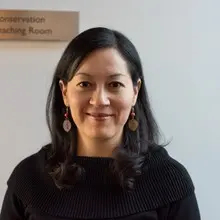
Let's find out. Joining me today is IIED senior researcher, Karen Wong-Perez. Karen, welcome to the podcast.
Karen Wong-Pérez [1:06] Thank you for having me, very happy to be here.
Simon Cullen [1:09] Well, as I mentioned, the Beijing Declaration is 30 years old this year. Its goal was and is to achieve equality for women and girls. So if there was to be a report card on how we've done, what might it say?
Karen Wong-Pérez [1:22] I would say a report card will say, hopeful start, slow and uneven progress around the world. It needs a whole-of-society approach, deeper connections across sectors and deeper transformation. I will start saying that the Beijing Declaration was never just a statement of intent. It was never like a dry document.
It was a very bold and actionable blueprint for achieving equality, gender equality and women's empowerment. And it defined 12 critical areas from education and health, violence, economic justice, women and environment. And it had very clear objectives and actions for governments, international organisations and civil society as well.
So in 30 years, we have seen some progress. For example, many countries now have gender equality laws. Girls are in schools in greater numbers than ever before, particularly in primary school. Women's political participation has grown, not at the scale and pace as we have wished, but has grown.
I will say the report card will also show that no country has yet achieved full gender equality and that progress, as I mentioned before, has been very uneven across regions, very fragile, and what we are seeing today is an increasingly [big] attack on very hard-worn rights.
And I will say, for example, in some areas like unpaid care, gender-based violence, reproductive rights, what we are seeing today is in regression.
Simon Cullen [3:05] That's interesting because, as you say, we have made some progress, but more recently it does seem, as you've said, that we are regressing. So there is this ongoing battle in this space, isn't there?
Karen Wong-Pérez [3:16] What we're seeing now in a geopolitical context has shifted dramatically from 1995 when the Beijing Declaration was signed.
In 1995, 30 years ago, it was a very hopeful moment. It was a post-Cold War moment with a lot of hope in multilateral cooperation. There was a real sense of optimism and Beijing was part of that very hopeful moment.
Now in 2025, we are navigating an entirely different moment, a very fractured global order, backlash against gender rights, a shrinking civil society and multiple overlapping crises like climate, economic and humanitarian.
[Music]
Simon Cullen [3:58] Now, we've talked about gender equality. Another term that often comes up in this discussion is gender justice. And I'm just wondering if you could give us a quick overview of the differences between those two terms. What do we mean when we talk about gender equality and what do we mean when we're talking about gender justice?
Karen Wong-Pérez [4:15] We are talking about slightly different things. Gender equality is often seen as the gold standard. It is a framing that is used in UN, in the Beijing Declaration, and in many different organisations it’s used as the gender ambition. It entails equal rights, equal opportunities, equal pay, that sort of thing. But equality on its own can fall short. It can miss out the bigger picture, especially when it's focused narrowly on comparing men and women as if they were homogeneous groups.
That is why many organisations, including IIED, are starting to shift their framing from gender equality to gender justice. Because gender justice is more than counting just how many men and how many women are in a room.
So for us, gender justice means looking at the root causes of inequality and not just at the symptoms. It means acknowledging how institutions and laws and norms and histories shape who gets to live safely and with dignity, who has choices, who has advantages and disadvantages.
If we talk about just ensuring equal numbers of men and women at the table, that is good. But we also need to ask, do they have decision-making power? Are we addressing the colonial and economic and environmental threats that have created their own vulnerability in the first place?
I don't want to send a signal that we are against gender equality. What we are thinking is that gender justice is the bigger frame, and that bigger frame includes gender equality, but it pushes us to go further to think systemically, act intersectionally and aim for liberation from all forms of oppression, not just a part.
Simon Cullen [5:56] Just thinking about the linkages between gender and the environment, obviously, one of the things we do at IIED is look at those linkages. And specifically climate change, how women and girls are being affected. So just wondering if you could talk about that difference, especially when we consider how men and boys are affected.
Karen Wong-Pérez [6:17] There is a prevalent assumption that the impacts of climate change are gender neutral, and that is not the case at all. The impacts of climate change we know are not felt equally because people have different vulnerabilities and different capacities to adapt. And these capacities are deeply shaped by gender and other forms of inequality. So that's why, traditionally, women and girls often face worse effects for climate change, but let's be clear, women are not a homogeneous groups and women and girls are not inherently more vulnerable.
But it is due to gender norms and gender-based inequalities and economic disparities that make them more vulnerable in certain circumstances and with less capacities to adapt and to cope with different crises, including climate change.
So, for example, in many parts of the world, women and girls, because of gender norms, are responsible for collecting water and firewood. And as climate change leads to drought or deforestation, these resources may become harder to access. So women and girls have to walk longer distances, which increases their exposure to gender-based violence.
Some other regions, for instance, have seen increased child marriage or taking girls out of the school to assist in household tasks because women are seen as responsible for household chores and care. Those roles make them more vulnerable to be part of those coping strategies after a disaster as means to secure funds or assets.
[Music]
Simon Cullen [7:50] Now, Karen, during Women's History Month, which of course is in March, you and some of your colleagues at IIED co-hosted a couple of events at the UN headquarters as part of the 69th Commission on the Status of Women to highlight the need for better data on the links between women's equality and the environment. So given what we've just discussed, talk me through what is needed here. Where is the gap in the data?
Karen Wong-Pérez [8:13] Yes, the Beijing +30 was intended to be a moment to have an appraisal and review of the progress achieved. And the fact is that if we don't have gender-disaggregated data, it is very hard for us to really assess progress. So data is crucial.
The second problem is that when we have data, it's often not used for policymaking or it is very sectoral. And the third problem is that there's some data collected by different actors, for example, grassroots organisations or non-state actors, qualitative in terms of storytelling, testimonial, that is not credible or considered legitimate to be used to inform policy and decision making.
So our events were focused on that, on raising attention to the need for data and the need to integrate and recognise the contributions of grassroots and other non-state actors in data production.
Simon Cullen [9:11] So what would it look like then to have a whole-of-society approach to better integrated data? What would that practically look like, do you think?
Karen Wong-Pérez [9:19] For us, a whole-of-society approach means that everyone has a role in generating and using data. And by everyone, I mean not only government, but civil society organisations, grassroots organisations, private sector big institutions and an approach that is inclusive, collaborative and grounded on real world experience. And we are already seeing powerful examples of that.
We saw the power of collective impact. We worked with the Gender and Environment Data Alliance, UN Women and the CBD Women Caucus, along with more than 20 different organisations backed with the sponsorship of Chile, Ireland, Colombia, Mexico and Canada, which are seen as progressive actors that are willing to integrate whole-of-society approaches to data.
And the events, I think, showcase many good examples that are already happening. For example, GROOTS in Kenya. They are a grassroots women's organisation collecting data on how women manage land and natural resources. And what they shared is that their data isn't just sitting on the shelves, it's being used to influence land governance policies. So they are collaborating with the government to make women's contributions more visible.
One example that they shared is that from their own data collection, they show that only 3% of women in Kenya own agricultural land individually and over 70% contribute to the labour on that land. That information is helping them to advocate for increased land governance policies and to make women's contribution visible.
Simon Cullen [11:01] It's helpful to hear those examples, actually, because getting that data is one part of the equation, but the flip side is then who uses that data. And that's where we also need to see gender equality. So if we look at the annual climate talks, for example, research has shown that there's a significant imbalance playing out when it comes to who's actually involved in the negotiations.
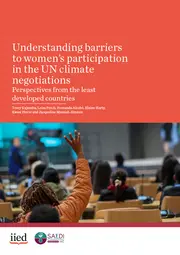
And IIED has published some research from a survey earlier this year that looked at why that imbalance is happening within the Least Developed Countries Group, which, as you would know, is a group of about 40 or so of the world's poorest countries. Karen, what are some of the barriers that women are facing in being part of those negotiations, which is obviously fairly crucial to the direction of travel when it comes to climate policy in the world?
Karen Wong-Pérez [11:44] Great that you mentioned this, it’s a fantastic research report that was produced by IIED colleagues, Tracy Kajumba, Fernanda Alcobé, Elaine Harty, among other co-authors.
We know as part of the findings of the report that barriers women face fall into four broad categories: cultural norms, institutional and governance structures, access to knowledge and skills, and economic and financial limitations. These cultural gender norms are so powerful and very invisible.
When policies support gender equality on paper, those social norms can still keep women out of the room or silent once we're there. It's not just about opening the space, it's not about presence, but really have the political capabilities to be able to have a meaningful contribution in the negotiation table.
There are also other challenges like institutional and governance structure barriers. For example, many countries lack transparent selection criteria for who gets to attend the UNFCCC negotiations. And that means that decisions are often made informally through networks, personal networks, that usually favour men.
Simon Cullen [12:54] If we were to look at then, if we were to make progress on some of these areas, what would it look like? Or what difference would it make if we had gender balance at that top negotiating table?
Karen Wong-Pérez [13:04] Yeah, that's a very important question. Gender equity is a matter of rights. Everyone has the right to be represented in decisions that affect their lives and to have a say in decisions that affect their lives. And that includes climate and environmental policy.
When women are excluded from climate and environment negotiations, it's a democratic failure. It undermines legitimacy and it violates commitments that countries have already made under the UNFCCC Gender Action Plan and the Paris Agreement.
So in this sense, this is about rights and fairness. In other words, gender balance or having a gender balance at the negotiations makes negotiations better. Women often bring different priorities to the table like health, livelihoods, community resilience, care systems, and those are very essential for shaping climate and environmental action that actually works on the ground.
[Music]
Simon Cullen [14:01] Karen, one last question, and this is something we like to ask all the people who appear on our podcast: if there was one big change that you could make, what is that one big change you would like to see?
Karen Wong-Pérez [14:03] I think one big change is implementation of policies. We have progressed in more ambitious legal frameworks, more gender action plans, but it's the implementation. And if I'm allowed a second one, it's ensuring that climate and nature finance are accessible to grassroots organisations, it's also a big element. Those will be, I think, very good enablers to move things forward.
Simon Cullen [14:39] Excellent. Well, Karen, given it's your first time on the podcast, we'll let you have a few big changes that you'd like to see. Karen, thank you so much for joining us on the podcast, great to have this discussion and look forward to having you on the podcast in the future.
Karen Wong-Pérez [14:52] Thank you for having me.
Simon Cullen [14:53] Karen Wong-Pérez is a senior researcher at the International Institute for Environment and Development. Well, to listen to any of our previous episodes or to read more on what we're doing in the world of gender justice or any of our other work, head to our website: iied.org. That's iied.org. Thanks for listening.
[Music]
 Soundcloud
 TuneIn
 Spotify
 iTunes