Fair Water Footprints: making responsible water stewardship in supply chains the global norm
This project supports companies, governments and financial institutions to deliver fair water usage in their supply chains, transform the way the world’s water resources are managed, and ensure people have access to water in line with the 2021 Glasgow Declaration for Fair Water Footprints.
Laura Kelly was director of IIED's Shaping Sustainable Markets research group until May 2026

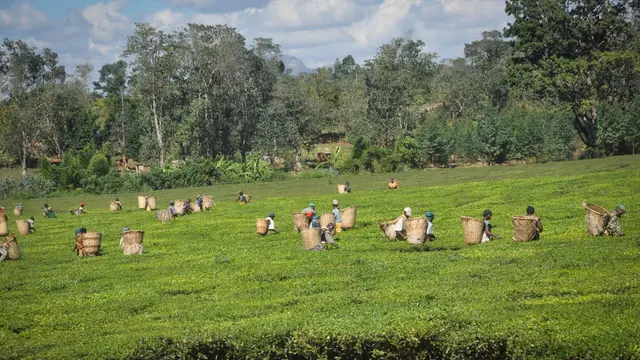
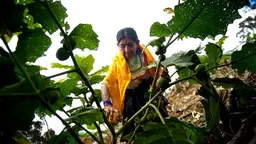
Local farmer harvesting tea leaves in Malawi (Photo: JimmyM, via Flickr, CC BY-NC-ND 2.0)
The global community stands on the threshold of rapidly intensifying water insecurity, which will shape the wellbeing of billions of people for generations to come.
Across the world, the demand for water is predicted to outstrip freshwater supply by 40% by 2030. At present, inadequate access to safe water, sanitation and hygiene locks almost half of the world’s population into ill-health and hardship.
At the same time, global production and consumption of food, clothes and other goods is having a significant influence on society’s climate and water-challenges, and their solutions. For instance, the water used within farms, factories and mines, and for the growing, extraction and processing of raw materials, can cause pollution and resource degradation and depletion.
This results in less water and poorer quality water, increasing communities’ vulnerability to climate variability, drought, disease and conflict.
But the ‘embedded’ water – or ‘water footprint’ – of consumer goods and international trade links consumers and producers.
Fair water footprints are about people, communities, companies, investors and governments working together to trigger positive change by ensuring that everything we produce and consume ‘does no harm’ and, further, ‘does good’ for water security, climate resilience and progress towards the Sustainable Development Goals.
Objectives
Water’s role in food security, economic productivity, the clean energy transition and in driving instability and migration, means that water security is a collective and urgent global priority. In recognition of this, the Fair Water Footprints programme unites the power of enterprise, government and civil society to stimulate action and investment on water and climate risks in our global supply chains.
Through trade, policy, procedural reform, new knowledge and incentives, the programme sets out to reshape the political economy on water and establishing water stewardship as a norm – in order to drive sustainable, resilient and inclusive growth.
The declaration aims to transform the way the world's water resources are managed – to build climate resilience, support the needs of communities, businesses and ecosystems, and ensure water and sanitation for all by 2030.
Signatories to the Glasgow declaration are committing to work towards a fair water footprint. This means:
- Zero water pollution
- Sustainable and equitable withdrawal and water use
- Full access to safe water, sanitation and hygiene for workers
- Working with and protecting nature, and
- Planning for droughts and floods.
What is IIED doing?
Fair Water Footprints partners, including IIED, have formed a programme management unit to oversee the delivery programme for the Glasgow declaration.
The unit:
- Provides evidence of best practice and innovation on fair water footprints
- Supports signatories to implement their commitments
- Supports a community of practice where signatories share experiences, and discuss and resolve thematic or technical issues, and
- Supports diplomatic efforts to grow the signatory community through outreach to partners and other initiatives.
Fair Water Footprints partners are also jointly developing the strategy for the programme’s overall communications.
IIED in particular is responsible for monitoring, evaluation and learning. This sees us identifying Fair Water Footprints’ evidence and lessons about effective approaches and tools, sharing that with consortium members and signatories, and developing a repository of knowledge.
IIED is leading on gender and social inclusion (GESI) for the programme. We are aligning a results framework and programme delivery for GESI, while setting and monitoring targets for this. IIED is also developing knowledge products that share best practice on how GESI can become more mainstream in the water sector.
In June 2026 an animation was produced drawing together lessons from the last two years on how to tackle the complex challenge to transform how the global economy values, manages and interacts with water. Watch it below or on IIED's YouTube channel.
News and updates

Publications
Additional resources
Video: Learning how to make water use fair (June 2026)
Making water use in global trade more sustainable, Leslie Morris-Iveson, Joe Ray, Richard King, Laura Kelly (2026), Chatham House research paper
Triggering market transformation for fair water footprints: insights, lessons and evidence from other natural resource sectors (PDF), Laura Kelly, Rose McCulloch, Lucy Cullinane, Alexander Ford, Cristina Pita, Alejandro Guarin, Bill Vorley, Jan Willem Molenaar (2022), Fair Water Footprints report
The Glasgow Declaration for Fair Water Footprints for climate-resilient, inclusive, and sustainable development (PDF) (2021), Fair Water Footprints