New IIED toolkit supports LDCs and SIDS with climate reporting
IIED has launched a new toolkit to support the governments of least developed countries (LDCs) and Small Island Developing States (SIDS) to include loss and damage and adaptation information in key climate reports.


A mangrove forest, on the north side of Viti Levu, Fiji’s main island, is captured by the Advanced Land Imager on NASA’s Earth-Observer 1 satellite. Environmental monitoring can help countries measure progress and document gaps (Photo: NASA)
To achieve international climate goals, countries must report on their plans and progress, but the reporting requirements can be onerous for LDCs and SIDS, which have limited resources and technical expertise.
IIED's new toolkit is designed to help the countries most vulnerable to climate change to report on objectives and track progress on adaptation and loss and damage.
The toolkit is designed for national focal points and technical experts. It provides an overview of the reporting mechanisms and requirements for two key instruments of the Paris Agreement: nationally determined contributions (NDCs) and biennial transparency reports (BTRs).
Ambassador Adão Soares Barbosa, chair of the LDC Group within the United Nations Framework Convention on Climate Change (UNFCCC), welcomed the toolkit, saying: “This toolkit shows NDCs and BTRs are not just an administrative exercise but a strategic opportunity for LDCs to communicate our priorities and mobilise support."
I warmly welcome this practical guide. It is a valuable contribution to the LDC Group’s efforts to keep adaptation and loss and damage at the centre of the global climate negotiations
– Ambassador Adão Soares Barbosa, LDC Group chair
Practical guidance on how to report
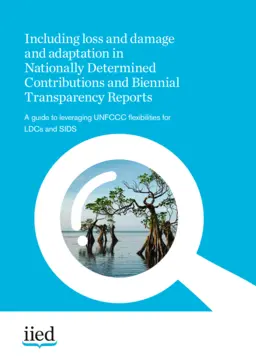
The 38-page document, entitled 'Including loss and damage and adaptation in Nationally Determined Contributions and Biennial Transparency Reports', provides practical suggestions for how to include loss and damage and adaptation in national reports without creating additional burdens, including by starting with existing, easily accessible information. It will help governments to communicate key priorities, plans and goals, and report on implementation and support needs.
It is designed to help them measure progress towards objectives, identify gaps where further support may be needed and note where goals may be conditional on finance, capacity and/or technology support, highlighting the international funding support they need.
It includes nine short case studies of how LDCs and SIDS have addressed reporting requirements. It also signposts further resources on more detailed considerations on what to communicate and how to report on national plans and priorities under the UNFCCC.
Helping countries leverage a strategic opportunity
For LDCs and SIDS, communicating their national priorities through NDCs and BTRs is not just an administrative exercise; it is a strategic opportunity. While certain elements of NDCs and BTRs – such as mitigation contributions and greenhouse gas inventories – are mandatory, countries can choose whether to include information related to adaptation, loss and damage and support needs.
Even when data and capacity are limited, including available information can help national planning and coordination. It can also communicate national needs and priorities which, in turn, can help countries mobilise finance and support.
Effective reporting can also feed into global processes such as the Global Stocktake, the Paris Agreement's formal process for reviewing progress toward meeting climate goals, by improving political visibility and increasing the international community’s focus on adapting to the inevitable impacts of climate change and addressing resulting loss and damage.
Practical examples of generating evidence to drive action
One of the authors, Lina Yassin, IIED senior researcher and adaptation advisor to the LDC Group, says climate negotiations must reflect the realities of the most vulnerable states. "The strength of the climate process depends on whether countries’ lived realities shape the decisions it makes," she said. "The LDC Group has shown leadership in this: despite limited funding and capacity, countries are documenting climate impacts, adaptation efforts and the support they need."
Yassin says the toolkit is firmly grounded in existing climate reporting, noting: We developed this toolkit by drawing on examples from countries’ own reports, showing how practitioners can build on information they already have.
"As the next round of reporting approaches, we hope it helps more LDCs bring their experiences into the evidence that guides negotiations, and turn that evidence into stronger action and support.”
LDCs and SIDS are among the countries least responsible for, yet most affected by climate change. In many cases, they lack sufficient resources and capacities to effectively manage the resulting loss and damage, the negative impacts of climate change that occur when human societies and natural systems reach their limits to adapt.
The Paris Agreement sets out three overarching goals: limiting temperature increase to below 2°C above pre-industrial levels; increasing the ability to adapt to the adverse impacts of climate change and fostering climate resilience; and making finance flows consistent with low-emission, climate-resilient development. To achieve these goals, countries must join global efforts and report on their progress.
Parties to the Paris Agreement are due to submit their second BTRs by the end of 2026. LDCs and SIDS are given flexibility due to their special national circumstances.