Introduction to urban crises and forced displacement
A programme of work on towns and cities affected by crisis, with a special focus on urban refugees and internally displaced people, and how humanitarian, development and municipal policymakers can respond to their needs and aspirations.

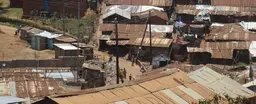
Settlement for internally displaced people in Haiti. The majority of forcibly displaced people move to towns and cities, but current humanitarian approaches don't work well in complex urban environments (Photo: GAiN USA via Flickr, CC BY-NC-ND 2.0)
Urban areas around the world are increasingly vulnerable to the effects of climate change and extreme weather events. At the same time, climate, conflicts and other forms of violence are generating millions of displaced people, the majority of whom move to towns and cities.
IIED is working to ensure the interventions of humanitarian agencies are informed by an understanding of the challenges and opportunities of working in cities, and that city actors are able to respond to the needs of all residents, including displaced people.
This research and policy engagement on humanitarian interventions in towns and cities builds on the long-standing work of the Human Settlements research group on urban poverty, governance, risk and resilience. It takes our understanding of urban systems to new audiences involved in humanitarian policymaking and in responding to disasters and displacement crises.
This is important as many of the tools and approaches familiar to humanitarians were developed in remote border regions and rural areas, and may not work well in complex urban environments.
One important strand of our work focuses on the experiences of refugees and internally displaced people (IDPs) in towns and cities. This is generating understanding of their interactions with formal and informal urban systems and host communities, and of how they seek livelihoods, shelter and social support in towns and cities.
What is IIED doing?
Protracted displacement in an urban world
IIED increased its focus on forced displacement in 2020 with the launch of the Protracted Displacement in an Urban World (PDUW) project, a four-year, mixed methods study of the livelihoods and wellbeing of displaced people in camps compared with urban areas.
We explored how urban areas can be safe, welcoming and productive places for refugees and IDPs to live.
The project partners also worked with municipal authorities to change attitudes and policies towards people living in protracted displacement, and an IIED longread delves into our overall approach to urban displacement, and the project’s aims.
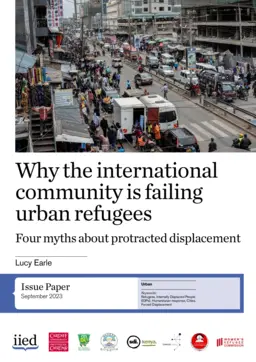
With its own website, the PDUW project produced multiple publications, blogs, articles and podcasts – as well as a project flyer. One key publication, an issue paper, debunks four ‘myths’ about urban refugees and summarises some of the most important findings.
A working paper and policy brief were produced for each of the four countries where the project was active, as follows:
- Afghanistan: working paper | policy brief
- Ethiopia: working paper | policy brief
- Jordan: working paper | policy brief
- Kenya: working paper | policy brief
Working with municipalities on protracted displacement
The PDUW project had a participatory component: partners convened municipal authorities, service providers and refugee representatives 4-5 times in each of the cities in the study (IIED produced a podcast on the topic).
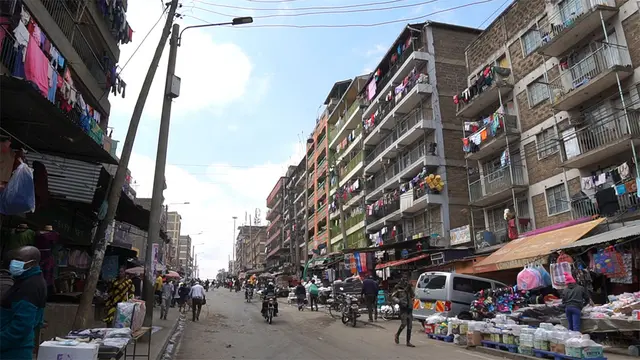
The relationship between our partners in Nairobi, SDI-Kenya, and the county government has been particularly fruitful. The county recently drafted an urban refugee strategy – the first of its type nationwide – with support from IIED and other partners.
In Addis Ababa a new donor, Hilton Foundation, provided funding for a further four participatory forums in the city after the project ended, to maintain the dynamic conversations and consolidate refugee issues as integral to the municipal government’s mandate. The forum methodology has also been picked up by UN agencies in Afghanistan seeking to expand its use beyond the original city of Jalalabad.
In Nairobi, again in collaboration with the county, we recently completed a short study on ‘refugee penalties’ – exploring the hidden costs and other burdens experienced by refugees running businesses in Nairobi. These findings are feeding into county discussions on the roll-out of its urban refugee strategy. We published a brief outlining the work and its implications for policy.
Measuring refugee wellbeing
The development of a refugee wellbeing framework was another key output from the PDUW project. This metric can be used to assess wellbeing across five different dimensions, and is discussed in a working paper.
The team has received funding from the Swiss Development Cooperation to further refine the framework through a mixed qualitative and quantitative approach. As well as returning to two original project PDUW sites – Nairobi and Amman – this new phase of the work, which began in late 2024, will pilot the metric in Kampala and Istanbul.
Ethnographic documentary films
With funding from the Arts and Humanities Research Council and the IKEA Foundation, we have worked with youth film-makers in Nairobi to document the everyday lives of refugees in the city. The first film, ‘Far away from home’, is complete and has been submitted to film festivals. The second film focuses on the experiences of LGBTQ+ refugees.

Data justice for refugees
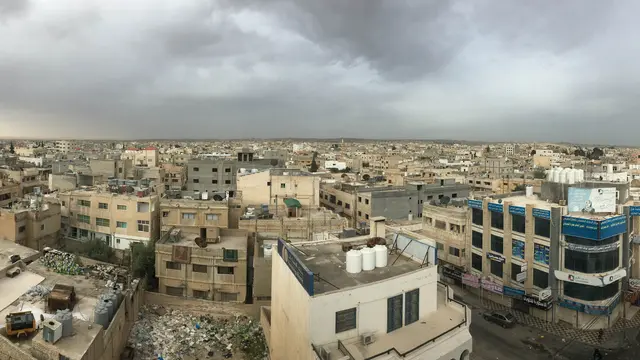
Supported by the Open Society Foundation, we joined forces with three refugee researchers in Amman to build their research skills and work with their communities to map out key concerns and priorities.
A policy brief outlined the main findings from their work, which is also summarised in an article.
Urban refugee dividend and the cost of camps
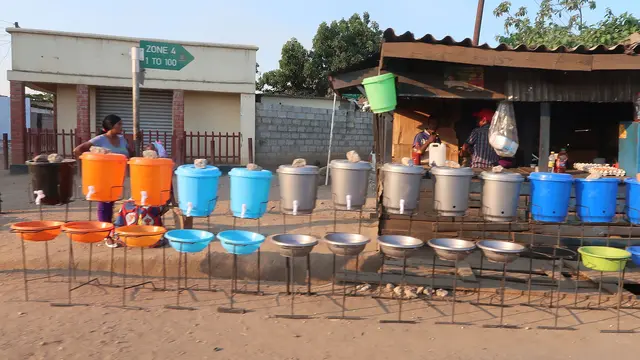
Through a Knowledge Frontiers grant from the British Academy, we undertook a three-year study of refugee access to water and sanitation (WASH) in Jordan (2021-2024). We wanted to understand what could have been achieved for Syrian refugees living in Mafraq City if funds spent on WASH in a nearby refugee camp had been invested in urban water and sanitation instead.
A number of resources and publications stemmed from this work.
Drought in displacement
Launched in 2024, this project focuses on Jordan and Zambia, and supports claim-making around displaced communities’ right to water. Through policy research, the project aims to ensure that water access for, and water strategies created by, displaced communities are included in municipal and national WASH plans.
Framework for the UN and government on urban internal displacement
Funded by UN-Habitat, and developed in collaboration with the UN Secretary General’s special adviser on solutions to internal displacement, the framework was launched at the World Urban Forum in November 2024. It sets out the shifts in mindset, practice, policy and funding needed if the international system is to respond to the increasingly urban nature of internal displacement.
This framework builds directly on IIED’s policy engagement on the topic of urban IDPs, which began in 2021 when we convened a group of partners to engage with the UN Secretary General’s High-Level Panel on Internal Displacement.
We drew attention to the specific characteristics of urban displacement by formulating a joint submission to the panel that called for a complete rethinking of how government and other actors respond to internal displacement in urban areas. These ideas were developed further in an article in Refugee Survey Quarterly.
We also helped to facilitate a series of dialogues with members of the high-level panel and leaders of municipalities affected by displacement in Ukraine, Burkina Faso, Honduras, Colombia, Iraq and Somalia. Lessons from the dialogues and an expert roundtable were captured in a synthesis report (PDF) to the panel, and in a policy brief.
As a result of this work, the panel’s final report and the UN Secretary General’s Action Agenda highlight the urbanisation of displacement and reference IIED’s work on the topic.
Earlier work on urban crises and forced displacement
The institute’s first project to explicitly explore the relationship between humanitarian crises and urbanisation was the DFID-supported Urban Crises Learning Fund (2014-17). Through a programme of small-scale research and documentation, and the development of tools and approaches, this built the knowledge and capacity of humanitarian actors working in urban areas, and of urban actors responding to humanitarian crises.
A series of working papers and briefing notes were produced on a wide range of topics, and the broad findings of the project were summarised in a longread.
As part of one working paper – on community planning in Port-au-Prince following the Haiti earthquake in 2010 – an online archive of planning materials, maps, photos and videos was created, launched in January 2020.
Building on this work, and expanding the group’s long-standing expertise on urban poverty to a newer focus on displaced people, British Academy funding was secured for a research project in Kampala and Nairobi examining refugees’ access to healthcare, housing and basic services. Running from 2017-19, this established a new partnership with YARID, a refugee-led organisation in Kampala.
The theme of urban displacement was also under focus in a Mogadishu case study of a research project on housing in East Africa. This identified and analysed the barriers to decent housing and basic services for the city’s many IDPs.
Contact
Lucy Earle ([email protected]), principal researcher, Human Settlements research group