Capacity Strengthening in Least Developed Countries for Adaptation to Climate Change (CLACC)
Through CLACC, IIED works with researchers in 15 least developed countries (LDCs) to generate knowledge, strengthen capacity and encourage action on climate adaptation.

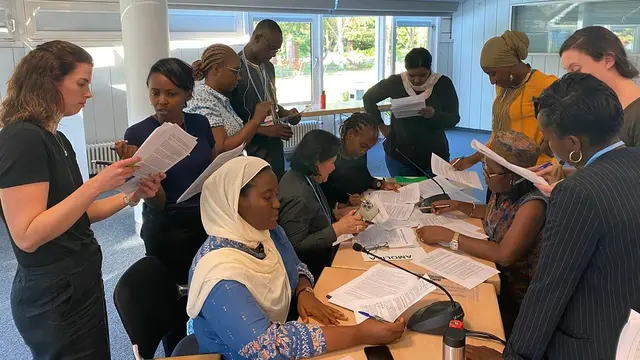
CLACC fellows gather in Durban, South Africa
The CLACC programme incorporates a range of activities: fellowships, attendance at meetings, research, regional workshops and outreach.
Its objects are:
- To strengthen the capacity of civil society in LDCs to adapt to climate change and fostering adaptive capacity among the most vulnerable groups
- To eEstablish an information and knowledge system to help countries to deal with the adverse impacts of climate change, and
- Integrate adaptation to climate change into the work of key non-government institutions, and mainstreaming the National Adaptation Programmes of Action (NAPA) process with these institutions.
What is IIED doing?
IIED conceived the CLACC programme 2003, in recognition of the low capacity for tackling climate change within civil society in the LDCs.
The CLACC programme is part of the Southern Voices Capacity Building Programme, which was coordinated by CARE Denmark.
CLACC began with a fellowship programme designed to build capacity within NGO partners and wider civil society in the LDCs.
More than half of CLACC fellows were invited to join their national negotiating teams at the 2011 UN climate negotiations, in recognition of the expertise they had gained through CLACC and other projects.
The annual UN climate talks provide an important venue for conducting advocacy at national and international levels: meeting key national contacts, donors, project partners and NGOs.
Research
The CLACC network began undertaking research in 2005. The research looked at grassroots adaptation activities in various sectors, including coastal areas, water management, disaster preparedness and response, health, agriculture and forestry, and fed this information into national adaptation planning and international decision-making.
The first research topic focused on climate change and health in the LDCs. CLACC partners engaged with in-country health experts, and with support from the London School of Hygiene and Tropical Medicine (LSHTM) and conducted an assessment of key climate change and health issues in their countries. This information was fed into national adaptation planning (including NAPAs) and international decision-making processes.
The CLACC programme also embarked on a research programme on climate change and cities. This acknowledged the lack of attention given to how urban areas in the poorer nations will cope with climate change impacts. The research involved a mapping exercise, identifying vulnerable areas and illustrating them on maps. Fellows met a range of stakeholders in order to assess where key vulnerabilities lie. This type of information is not presented on official city maps.
Regional workshops
The CLACC programme has convened like-minded actors from civil society to discuss, brainstorm and plan next steps on the adaptation agenda in their respective regions and countries.
In collaboration with ecbi, four workshops were held in 2008, in West Africa, Botswana, Guinea and Maldives. In 2009 and 2010 workshops were held in Senegal, South Africa and Kenya to bring together national civil society networks operating in West, Southern and Eastern Africa respectively.
CLACC partners played a major role organising and attending these workshops. The events helped to reflect a growing acknowledgement in the South of the need to share at a regional level intelligence, lessons and best ways forward for advocacy activities targeting international, regional and national processes.
Film and audio
CLACC has generated a number of videos:
Dago Tshering interviewed CLACC fellows about their work on adaptation to climate change for least developed countries during the COP16 climate change negotiations 2010. You can see the video below or watch it on IIED's YouTube channel.
A series of paricipatory video films were screened at the Development & Climate Days film festival, which took place during the United Nations Climate Change Convention talks in 2008 and 2009.
2008, Poznan, Poland
- Community Based Adaptation in Malawi – CURE, Malawi
- Rainwater Harvesting – BCAS, Bangladesh
- Integrated Hedgerows – LI-BIRD, Nepal
- Land Restoration – ENDA, Senegal
2009, Copenhagen, Denmark
- Water is fire – ZERO, Zimbabwe
- CBA in Oyolla – ACTS, Kenya
- Clean Water Clean Energy – GED, Mozambique
Films completed in 2010
- Vulnerable communities' fight against desertification – AMADE-PELCODE, Mali
- The importance of arabic gum to local commerce in Mauritania and its link to the stop of desertification and climate change – Tenmiya, Mauritania
Publications


Additional resources
Southern voices on climate policy choices: Analysis of and lessons learned from civil society advocacy on climate change, Hannah Reid, Gifty Ampomah, María Isabel Olazábal Prera, Golam Rabbani, Shepard Zvigadza (2012) IIED
Production guidelines for CBA videos, Isabelle Lemaire (2010), IIED and CLACC
News: Civil society plays key role in policymaking in a changing climate
Q&A: Interview with Sumaya Zakieldeen of Sudan
Project: An overview of work done on Forests, resilience and climate change
Building Capacity to Cope with Climate Change in the Least Developed Countries, Reid, Hannah (et al.) in Changing Climates, Earth System and Society, John Doson (Ed.) (2010), Springer
Partners
CLACC Fellows' Organisations
ABIODES (Biological agriculture, Biodiversity and Sustainable Development)
African Centre for Technology Studies (ACTS)
AMADE-PELCODE
Bangladesh Center for Advanced Studies (BCAS)
CURE, the Coordination Unit for the Rehabilitation of the Environment
Energy and Environmental Concerns for Zambia (EECZ)
Environment and Development Action in the Third World (ENDA)
Environmental Protection and Management Services (EPMS)
Local Initiatives for Biodiversity Research and Development (LI-BIRD)
Organisation of Women's Management of Energy, Environment and Integrated Development (OFEDI)
Royal Society for Protection of Nature (RSPN)
Donors
Royal Norwegian Ministry of Foreign Affairs
Foreign, Commonwealth & Development Office (FCDO)
Dexter Trust, Embassy of the Federal Republic of Germany
Norwegian Agency for Development Cooperation - NORAD