Where to find IIED and partners at COP29: event listing
The 29th Conference of the Parties (COP29) of the United Nations Framework Convention on Climate Change (UNFCCC) is a pivotal moment for advancing climate action and securing the scale of finance needed to support resilience and adaptation, particularly for communities in the least developed countries that are most impacted by climate change. IIED researchers and partners led and presented at several events in-person and online throughout COP29.


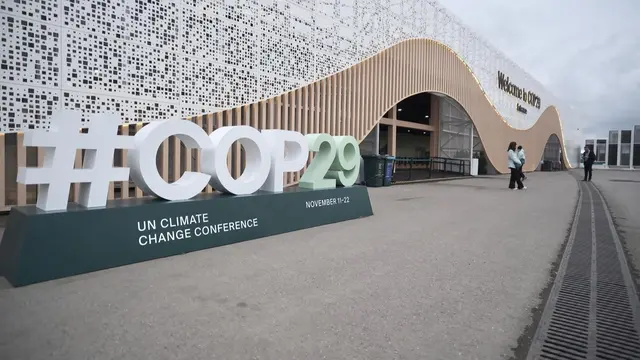
Logo of COP29 held in Baku, Azerbaijan
The climate change negotiations ran from 11 to 22 November in Baku, Azerbaijan.
Labelled the ‘finance COP’, one of the focus areas of COP29 was around negotiating the New Collective Quantified Goal (NCQG) to secure the scale of finance needed to support resilience and adaptation, particularly for communities in the least developed countries that are most impacted by climate change.
It was also a key moment for countries to present their updated national climate action plans under the Paris Agreement (known as Nationally Determined Contributions (NDCs)), which were due by early 2025. The plans intended to limit global warming to 1.5°C above pre-industrial levels and doubled as investment plans advancing the Sustainable Development Goals.
IIED’s key areas of focus included:
- Urging the delivery of an ambitious new finance target that delivers on those most impacted by climate change
- Getting money where it matters – locally led adaptation and scaling up finance for climate and nature
- Reforming the global financial architecture and tackling the debt crisis
- Amplifying and centring the experiences of Indigenous Peoples and local communities in the COP processes, and
- Supporting negotiators from the least developed countries (LDCs).
The conference followed the biodiversity COP16, highlighting the interconnected nature of climate and biodiversity challenges and reinforcing the need for more integrated solutions that can tackle the interconnected crises of climate change, nature and inequality.
IIED works with the LDC Group of the UNFCCC to level the playing field for their engagement in the international climate change negotiations. Together with strategic partners, we organised training workshops and provided direct support to delegates to strengthen their negotiating skills.
Part of that training comes through pre-COP training workshops. As part of the implementation of the LDC Group’s capacity building programme, IIED worked with the LDCs to organise a training workshop on November 8 to inform new LDC delegates of key issues to be negotiated at COP29.
COP29 also served as an essential milestone for building momentum on the road to COP30 (10 years since the adoption of the Paris Agreement in 2015 and ahead of the 2030 climate targets deadline) and other critical junctures such as the Fourth International Conference on Financing for Development (FfD4), where global ambition and accountability must be deepened.
IIED researchers and partners led and presented at several events in-person and online throughout COP29.
To see the events involving IIED and partners in weeks one and two, click on the following links:
Week 1
Tuesday 12 November
Launch of the SHARE Hub: fostering collaborative solutions for climate action and resilience
Pavilion event
Hosted by: International Centre for Climate Change and Development (ICCCAD)
The global fight against climate change requires a new approach that integrates research, policy, and action in ways that are responsive to the urgent challenges faced by vulnerable communities. The Saleemul Huq Action Research Exchange Hub (SHARE Hub) is an innovative platform designed to bridge the gap between climate research, policy formulation and real-world practices. Named after Dr Saleemul Huq, a globally recognised climate scientist and advocate for climate justice, the hub aims to foster collaboration among researchers, policymakers, and practitioners to accelerate climate resilience and adaptation.
The SHARE Hub will be a global nexus for action-oriented research that directly informs and supports climate policy at national and global levels, while also driving ground-level implementation. By prioritising locally led adaptation (LLA) and participatory approaches, to address climatic impacts like loss and damage, the hub will ensure that solutions are inclusive, context-specific, and aligned with the needs of the most climate-impacted communities.
LIFE-AR partnership dialogue – implementation of LLA from principles to practice
Pavilion event
Hosted by: LDC Initiative for Effective Adaptation and Resilience (LIFE-AR)
The LIFE-AR Partnerships Dialogue is a celebration of progress being made by LDCs to advance LLA to achieve the LDC Vision 2050. It is an opportunity for LDCs to emphasise their climate adaptation ambitions, for countries to showcase their delivery and for development partners to reconfirm their support and provide commitments to accelerate implementation.
This high-level event included:
- Hearing high-level stories of change from ‘frontrunner countries’ on where they are in their implementation journey and importantly, what is required to spearhead further action.
- Building the foundational pathway to scale-up LIFE-AR delivery to realise the goal of LDCs being on climate-resilience pathways by 2030.
- Renewal of and further development partners commitments to LIFE-AR and the LDC vision and changes.
- Networking to informally share learnings and exploring opportunities for solidifying partnership.
Related reading: Demonstrating locally led adaptation principles in practice | LDC Initiative for Effective Adaptation and Resilience (LIFE-AR)
Operationalising Global Small Island Developing States Debt Sustainability Support Service (DSSS)
High level pavilion event
Hosted by: Co-chairs of the sgrategic advisory group, H.E. Gaston Alphonso Browne, Prime Minister of Antigua and Barbuda, and H.E. Dr. Mohamed Muizzu, President of the Maldives and IIED
Co-hosted by the co-chairs of the strategic advisory group and IIED, this event examined how the DSSS can create debt sustainability among SIDS exacerbated by climate change. The programme outlines a multifaceted debt relief and resilience plan, including innovative financial instruments and advisory support, aiming to facilitate sustainable, resilient prosperity.
Related reading: Global Small Island Developing States (SIDS) Debt Sustainability Support Service: a new financial compact for resilient prosperity | Sinking islands, rising debts: urgent need for new financial compact for Small Island Developing States
Wednesday 13 November
Financial innovations in national systems: scaling ambition and capacities for locally led adaptation research and action
Pavilion event
Hosted by: Adaptation Research Alliance; Community Resilience Partnership Program (International Institute for Environment and Development, Asian Development Bank, Huairou Commission); LDC Initiative for Effective Adaptation and Resilience
This event highlighted the various financial mechanisms that enable locally led adaptation (LLA) that policymakers can innovate and scale. This includes the development or strengthening of national financial vehicles, such as national climate change funds, the use and support for small scaling granting initiatives, and the strengthening of national delivery mechanisms.
The event provided the opportunity to hear directly from those who have instigated, developed and are implementing different mechanisms for channelling finance to the local level to deliver community-led priorities.
Related reading: LDC Group initiatives | Community Resilience Financing Partnership Facility (CRFPF) | Grassroots Action Research Micro-grants
Aligning for impact: programmatic approaches to adaptation finance through NAPs and NDCs 3.0
Pavilion event
Hosted by: IIED on behalf of the Champions Group on Adaptation Finance and the Climate and Development Ministerial (C&DM)
Partners: E3G, SouthSouthNorth
This discussion explored high-level and technical advances towards shifting to programmatic approaches in delivering adaptation finance. Drawing from evidence and successful models such as LIFE-AR and the Bridgetown Initiative 3.0, the discussion showcased how LDCs and SIDS can lead the charge in delivering impactful adaptation strategies.
Additionally, the event launched the C&DM’s landscape mapping exercise, which aims to catalogue ongoing adaptation finance initiatives, identify gaps and overlaps, and uncover new opportunities for collaboration.
Related reading: Good practices in accessing and delivering adaptation finance to support SIDS and LDCs | Climate and Development Ministerial: bridging trust and accelerating action for climate-vulnerable nations
Scottish government panel: learning from loss and damage programmes
Pavilion event
Hosted by: Scottish government
Partners: IIED, ALL ACT (Alliance for Locally Led Action on Loss and Damage), Caritas Malawi, Oxfam, C40
This panel, moderated by IIED’s Ritu Bharadwaj, built on Scotland’s leadership in addressing loss and damage and provoke meaningful discussion ahead of the COP29 finance day.
Panellists discussed the effectiveness of grants not loans, community-led interventions, rapid access to funding and gender responsive approaches. Attendees heard from successful funding mechanisms and gain practical knowledge applicable to the UNFCCC Loss and Damage Fund.
Related reading: Loss and damage fund: two funding frameworks reimagining climate finance delivery
Thursday 14 November
Signalling change: one year on from the Getting Ahead of Disasters charter
Pavilion event
Hosted by: Risk-Informed Early Action Partnership (REAP)
Partners: IIED, government of Samoa, Start Network, UK FCDO, Centre for Disaster Protection, government of Senegal on Anticipatory Social Protection (tbc), FAO (tbc), government of Somalia, IFRC (tbc)
Organised by the Risk-Informed Early Action Partnership (REAP), this event reflected on the progress of the Getting Ahead of Disasters Charter launched at COP28.
The session reviewed innovative strategies by charter endorsers to implement its principles and encourage further endorsements to address disaster risks proactively. Discussion centred on case studies and evidence on the effectiveness of anticipatory actions for vulnerable communities.
Related reading: Scaling up social protection for food security in a climate-constrained world | Anticipatory Social Protection Index for Resilience – ASPIRE
Bridging local and global: empowering communities for climate action
Pavilion event
Hosted by: ALL ACT (Alliance for Locally Led Action on Loss and Damage), IDRC, UNOHRLL, UNDESA
The ALL ACT initiative is driving climate action by establishing a collaborative ecosystem that brings together stakeholders from diverse sectors and regions, designed to foster knowledge sharing, innovation and practical solutions for addressing the impacts of climate change, particularly in the context of loss and damage. Over the past year, ALL ACT has focused on empowering local organisations in LDCs and SIDS, providing them with the tools to address multifaceted climate challenges.
This event put the spotlight on locally led solutions to climate-induced loss and damage. It introduced the Saleemul Huq Memorial Scholarship and foster dialogue on implementing the Loss and Damage Fund with a focus on empowering local organisations from LDCs and SIDS. High-level representatives discussed pathways for practical, community-driven climate resilience.
Related reading: Tackling loss and damage in countries vulnerable to the effect of the climate crisis: improving evidence and co-generating pathways to impact | Announcing the Saleemul Huq Memorial Scholarship finalists and C-CIQ toolkit launch
Partnering to deliver the LDC 2050 Vision: what makes for positive collaboration?
Pavilion event
Hosted by: LIFE-AR
Partners: IIED, UNIDO, Adaptation Fund, Senegal, Uganda, ENDA Energie
The LIFE-AR initiative of the LDC Group hosted a rich discussion to highlight the strength of collaboration, inclusivity and partnership present in the new LDC secretariat and existing LIFE-AR approach.
The discussion highlighted 'business-unusual' approaches, showcasing the LDC-led progress through LIFE-AR, the achievements and obstacles in realising the LDC vision, and the advancements in locally-driven climate adaptation. Stakeholders reflected on the LDCs’ inclusive governance of climate action, emphasising the importance of participatory methods and sharing insights on fostering gender equity and social inclusion in climate adaptation initiatives.
Book launch: 2024 Stories of resilience – lessons from local adaptation practice
Pavilion event
Hosted by: Global Center on Adaptation (GCA), UK FCDO
Partners: IIED, OECD, The Netherlands, USAID, Indonesia, World Bank Group, Asia Development Bank, UNDP, International Institute for Sustainable Development (IISD), Adaptation Research Alliance, BRAC International, GIZ, SPARC, Fossil Fuel Treaty Initiative
COP29, dubbed the ‘finance COP’, will have a key focus on climate finance as negotiators are expected to conclude negotiations on a new collective quantified goal on climate finance. The Paris Agreement calls for this new goal to be agreed prior to COP30, from a floor of US$100 billion per year. In addition to quantity, however, discussions on ways of delivering the finance to vulnerable communities most in need are critical. Longstanding issues around access, flexibility, predictability and community-oriented monitoring and evaluation processes need to be resolved.
This event launched the latest edition of ‘Stories of Resilience’, a collection spotlighting successful locally led adaptation (LLA) strategies from around the globe. Contributors from international organisations discussed the significance of the LLA principles and practical steps to enhance climate finance accessibility and effectiveness. The event highlighted success stories in adaptation finance, promote best practices in LLA, and encourage actionable commitments from funders and stakeholders to support vulnerable communities.
Related reading: Introduction to locally led adaptation | Putting locally-led climate adaptation principles into practice: insights from CBA18
Delivering loss and damage financing to the most vulnerable: local insights from the global South
Pavilion event
Hosted by: International Development Research Centre (IDRC)
Partners: IIED, International Centre for Climate Change and Development (ICCCAD), Institute for Study and Development Worldwide (IFSD)
The establishment of the Loss and Damage Fund, along with ongoing efforts to operationalise it, offers hope for countries vulnerable to climate impacts and communities facing escalating climate-induced losses and damages. While progress is being made on the fund's procedural and governance aspects, challenges remain in securing pledged contributions and scaling up its operations to directly provide support to the most affected communities.
This session shared local-level insights from multi-country research on loss and damage financing. It emphasised the need for tailored, inclusive finance mechanisms and explored how the loss and damage fund can best support vulnerable communities in countries like Vanuatu, Nepal and Senegal. The event aimed to foster a deeper understanding of loss and damage financing and provide actionable inputs for fund governance, focusing on equitable, context-specific approaches to climate resilience.
Related reading: Loss and Damage Research Observatory | Loss and damage fund: two funding frameworks reimagining climate finance delivery
Friday 15 November
Locally led adaptation: how to hold ourselves accountable for delivery? Voices from the global South
Side event
Hosted by: Fauna & Flora International
Partners: IIED, Huairou Commission, Partnership for Governance Reform, ICCCAD, El Centro para la Autonomía y Desarrollo de los Pueblos Indígenas (CADPI), Fundación Futuro Latinoamericano (FFLA), Fundación Avina
Community leaders shared insights on how to deliver locally led adaptation (LLA) that benefits people, climate and nature, backed by tangible results and metrics. They discussed questions of accountability and roles, including those of donors, in delivering the LLA principles and effective climate adaptation finance.
Related reading: Scoring adaptation finance for locally led adaptation: a way to make it accountable | Principles for locally led adaptation
Bridging the adaptation financing gap: challenges and potential solutions
Pavilion event
Hosted by: International Monetary Fund
Managing the impact of climate change demands significant investment in climate resilience, especially in emerging markets and developing economies (EMDEs), which are disproportionately affected despite contributing the least to the problem. It is estimated that adaptation finance flows to these countries will need to significantly increase at a time when they already face the challenge of mobilizing funds for their development needs. Despite increasing awareness of the urgent need for adaptation action, financial resources to implement remain inadequate.
In this session, IIED’s Tracy Kajumba joined a group of panelists to discuss how to enhance partnerships and cooperation to scale up adaptation financing for EMDEs and explore the role various stakeholders – including public institutions, private sector, and civil society – in attracting private capital for adaptation investments.
Related reading: Towards equitable partnerships: addressing barriers and enabling equity among unequal partners | Demonstrating locally led adaptation principles in practice
Saturday 16 November
Resilience rooted in tradition: integrating Indigenous and local knowledge for adaptation and loss and damage solutions
Pavilion event
Hosted by: Government of Vanuatu, IIED, Fauna & Flora International, Fundación Avina, BRAC
The interactive session foregrounded the importance of incorporating Indigenous and local wisdom in decision-making on climate adaptation and loss and damage through voices from the global South. It explored the diverse perspectives on knowledge, how different knowledge types can be meaningfully integrated, and how we can assess the effectiveness of these efforts in relation to the first, second and fifth LLA principles, ecosystem-based adaptation as well as in responding to loss and damage.
It also provided insights on how intensifying climate change has impacted Indigenous approaches to resilience, and ultimately, how Indigenous Knowledge can set the agenda for resilience building, peace with nature, and better impact response rather than feeding into planning processes as a secondary input.
Related reading: Scoring adaptation finance for locally led adaptation: a way to make it accountable | How to fix funding bottlenecks and pave the way for locally led adaptation
Catalysing climate resilience in Africa: leveraging experiences from locally-led and global climate-informed innovative financing models
Pavilion event
Hosted by: Africa Adaptation Initiative (AAI), Adaptation Consortium (ADA)
Despite growing recognition of the urgent need for climate action, African countries face significant challenges in accessing the necessary financial resources. This is especially critical for adaptation and mitigation projects, where climate financing needs far outstrip available funds. The global climate finance architecture, including mechanisms like the Global Environment Facility (GEF), Green Climate Fund (GCF) and Adaptation Fund remain complex and many African countries face challenges in accessing them, particularly those seeking to implement locally-led adaptation initiatives.
IIED's Tracy Kajumba joined this panel discussion to share experiences and explore innovative climate-informed financing mechanisms that effectively align global climate finance flows with local adaptation needs, enhancing resilience and sustainable development in Africa.
Related reading: Demonstrating locally led adaptation principles in practice
Week 2
Monday 18 November
A holistic approach to finance for climate-resilient and just development: from evidence to action
Side event
Hosted by: International Institute for Applied Systems Analysis (IIASA)
Partners: IIED, German Council on Foreign Relations, National Institute of Public Health and the Environment (RIVM), The Energy and Resources Institute (TERI)
Addressing the urgent need for climate resilience and justice, organisers of the event presented a model-based assessment of equitable financial needs for mitigation, adaptation and loss and damage. Taking a holistic approach, it explored how quantitative insights and justice-focused pathways can be translated into action.
The event featured speakers on justice along with finance experts, discussing the finance needs for just adaptation and mitigation, as well as a diverse panel sharing perspectives from SIDS and LDCs.
Related podcast: Money, politics and power – reforming the international financial architecture
Thursday 21 November
Advancing a just transition and securing new opportunities for LDCs
Pavilion event
Hosted by: WTO Enhanced Integrated Framework
Partners: IIED, ODI
There are just five years left to secure the Sustainable Development Goals and achieve trade-related gains at the same time as maintaining the Paris climate target of below a 1.5°C rise in average global temperatures. Trade is an important tool for securing development and climate objectives for LDCs. However, many unilateral policy initiatives are working in the opposite direction with potential negative spillover effects, dubbed the ‘green squeeze’.
In addition to mitigating this squeeze new opportunities are arising, from supplying new markets to futureproofing investments in green productive capacity while better aligning the key flow of climate finance from developed to developing countries, including LDCs.
This session sought to highlight practical entry points within the global green transition including new market access opportunities for LDCs, to support a transformative agenda that boosts green credentials, competitiveness and sustainable structural economic transformation.
Evidence-based innovations for nature-positive impact through aquatic food systems
Pavilion event
Hosted by: WorldFish
Partners: IIED, World Economic Forum, Center for Participatory Research and Development, FCDO
Climate change is posing significant risks to food systems and the benefits they provide for people, nature and climate. For instance, aquatic food systems provide livelihood opportunities and high-quality, affordable and low-carbon nutrition to billions of people worldwide. However, the sustainability of aquatic food systems is increasingly challenged by climatic stresses. Investments in locally-led and evidence-based approaches are therefore urgently needed to strengthen the climate resilience of these systems and the communities that depend on them.
This event highlighted examples of climate-resilient and nature-positive solutions for aquatic food systems from Africa, Asia and the Pacific, building on experiences from the FCDO-funded ‘Asia-Africa BlueTech Superhighway’ (COAST initiative, Blue Planet Fund).
The aim is to support communities with climate adaptation and coastal resource management, and include incentives for coastal stewardship, integrated farming of seaweed and bivalves, data-support systems for small-scale fishers and climate smart technologies for reducing food loss and waste. A diverse set of speakers from research, practice and investment discussed what is needed to increase funding for these solutions, mainstream them into national and international climate strategies, and strengthen the voice of young people and vulnerable communities in climate decision-making.
Related reading: Incentives for coastal conservation and fisheries management
Paris Committee on Capacity-Building (PCCB) tools and methodologies for climate finance
Capacity-building Hub event
Hosted by: UNFCCC Paris Committee on Capacity-Building
Partners: IIED, UNFCCC, Climate Analytics, UNEP FI, National Adaptation Plan (NAP) Global Network
At COP21, the Paris Committee on Capacity-building (PCCB) was established with the aim of addressing gaps and needs, both current and emerging, in implementing capacity-building in developing country Parties.
This workshop strengthened the knowledge and skills of stakeholders involved in adaptation climate finance by introducing key tools and methodologies that support the sustainable and effective use of financial resources. Through an interactive marketplace format, the workshop:
- Enhanced participants’ understanding of essential financial tools and methodologies in climate finance
- Provided practical insights into the use of financial modeling, climate risk management, and sustainable investment instruments, and
- Encouraged knowledge exchange and collaboration through an interactive marketplace to explore various tools and methodologies.