UN’s opaque spending on Syrian refugee camp: did aid donors get value for money?
New research suggests upgrading existing towns could provide lasting, comprehensive benefits over camps.
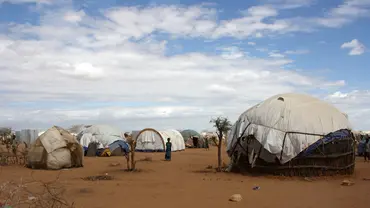
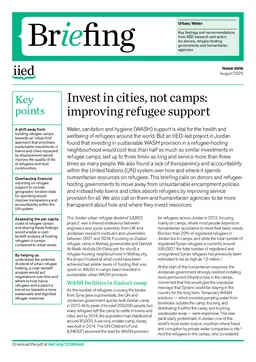
New analysis by IIED suggests that an estimated US$55m spent by the United Nations to provide a water and sanitation network in Jordan’s largest refugee camp did not achieve the value for money that same amount could have provided in the nearby city of Mafraq.
For half the cost of that system – built to serve the Zaatari camp’s 80,000 inhabitants for 10 years – the UN and Jordan could have upgraded a Mafraq suburb with a water and sewerage network capable of supporting more than 250,000 people for 30 years.
Doing this could have provided thousands of Syrian refugees with higher-quality, more dignified living standards in the city while creating a base of infrastructure that benefitted ordinary Jordanians too.
IIED’s analysis also found data on water, sanitation and hygiene (WASH) spending in Zaatari to be worryingly opaque, incomplete and vague. UNICEF has made public itemised data for trivial things such as staplers, ring binders and posters for donor visits, but not cost breakdowns for large construction contracts.
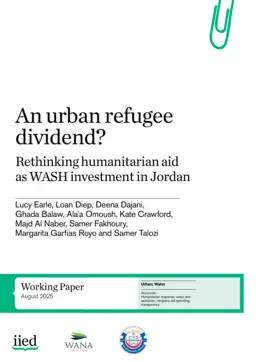
Researchers found it was impossible, using publicly available information, to determine precisely how – or how much – WASH funding was spent in Zaatari camp or to conduct a detailed cost effectiveness analysis.
This means lessons for refugee responses around the world may not be learned, or future international aid directed in the most effective way when it comes to WASH.
Key points
- Because public domain data was limited, the $55m figure for Zaatari’s WASH system was calculated through secondary analysis from a UNICEF press release and a DFID report. But exact or updated figures couldn’t be found
- IIED analysis of designs for WASH upgrades in Dahiyyat Al-Malik Abdullah (Al-Dahiyyah) neighbourhood suggests an initial cost of $27m. This system is designed to last 30 years
- UNICEF’s WASH programme Jordan-wide had a value of at least $494m between 2012 and 2019. However, line item-level expenditure could only be found for $90m
Dr Lucy Earle, the director of IIED’s Human Settlements research group, said: “Evidence shows living in towns or cities rather than camps can be better for refugees’ wellbeing. We’ve now found that housing them there might also provide better value for aid donors’ money while improving infrastructure for existing residents.
“UNICEF has provided high-quality water and sanitation services for thousands of extremely vulnerable refugees in Zaatari over the last decade despite logistical and political challenges.
“But its lack of transparency prevents a thorough analysis of whether aid money achieved the maximum possible benefits for those refugees or for Jordanians.
“This also makes it harder for people responding to refugee crises elsewhere in the world to learn from UNICEF’s experience.”
The new paper does not suggest humanitarian aid should be appropriated directly for construction in places like Mafraq. This would contravene some donor countries’ rules for how humanitarian aid can be spent.
However, it seems clear the international community has spent a lot of money on infrastructure for a small, visible and easy-to-reach population in a camp, while it could have supported many more refugees and their Jordanian hosts with sustainable, longer-term solutions.
Dr Earle added: “For years the UN has faced speculation from humanitarian workers that while less than a fifth of Syrian refugees in Jordan were in camps, those camps received the vast majority of funding. Being more transparent with data would help reassure donors their money has been spent effectively.”
Notes to editors
For more background on IIED’s work about refugee camps, see the following outputs:
- Press release: Refugee camps failing as a safety net against hunger, homelessness and ill-health (September 2023)
- Insight: Wellbeing in refugee camps: life inside a bottle, Boel McAteer (December 2022)
For more information or to request an interview, contact Jon Sharman:
+44 7407 727 886, or [email protected]