Scoring adaptation finance for locally led adaptation: a way to make it accountable
IIED and partners are developing scorecards to help stakeholders assess whether their adaptation initiatives align with the principles for locally led adaptation (LLA) and to support the ambition to channel more climate finance to the local level.

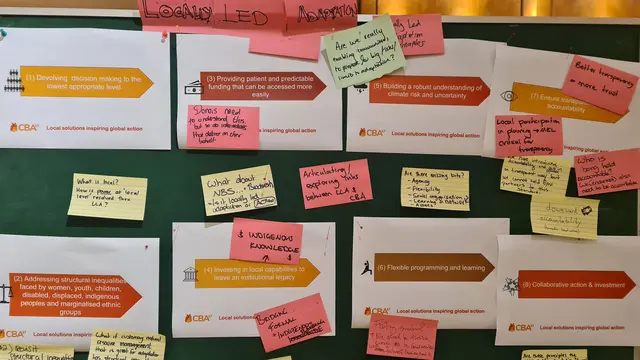
Piloting scorecards in Bangladesh (Photo: Ranon Jahan, ICCCAD)
Finance for adaptation projects is typically delivered through a finance delivery chain. This chain typically comprises providers (bilateral donors, climate funds, philanthropies), intermediaries who hold and reallocate the funds (NGOs, UN agencies) and recipients who receive the funds from intermediaries to implement adaptation actions (community groups, community-based organisations, local governments).
But this model often fails communities on the frontlines of climate change. Climate funding dwindles as it travels through the delivery chain and only a small amount reaches the community level.
Scorecards for accountability
As climate impacts escalate and the need for adaptation grows, it is vital that new adaptation funding is more accountable.
A crucial step towards greater accountability is evaluating how each actor in the delivery chain contributes to ensuring adaptation actions are locally led – including how they respond to the LLA principles, which set out the essential requirements for fair adaptation funding.
What is IIED doing?
IIED and the International Center for Climate Change and Development (ICCCAD), Fundación Avina, El Centro para la Autonomía y Desarrollo de los Pueblos Indígenas (CADPI) and Fundación Futuro Latinoamericano (FFLA) have developed a set of scorecards and indicators to help stakeholders assess adaptation programming and funding in relation to the LLA principles.
IIED and partners – the International Center for Climate Change and Development (ICCCAD), Fundación Avina, El Centro para la Autonomía y Desarrollo de los Pueblos Indígenas (CADPI) and Fundación Futuro Latinoamericano (FFLA) – have developed scorecards, which can be used to assess adaptation finance at all levels in the delivery chain, and are linked to a bank of indicators (or a library of questions). These can then be used to build context-specific scorecards to evaluate how well a project or programme aligns with the LLA principles.
Using the scorecards is a highly participatory process, with customised indicators for each level of the delivery chain.
Project partners in five countries in Asia and Latin America have piloted the initial versions of the scorecards, testing them across a range of different geographic, thematic and governance contexts. They collected responses from actors along the finance delivery chain with in-depth knowledge of the projects the funding is used for.
For example, in Bangladesh, ICCCAD developed a set of scorecards to assess how well adaptation projects delivered through large development agencies meet the needs of local community beneficiaries.
Initial results
While the pilots are at different stages, we have already learned important lessons:
- The finance delivery chain approach is useful, as it illuminates different perspectives on whether projects are aligned with the LLA principles. For instance, while an intermediary may believe their activities are being conducted in a bottom-up way, the scorecards may reveal that communities feel otherwise.
- It is vital to understand the local context before using the scorecards. Our partners carried out interviews with delivery chain actors and desk research to understand how best to design and implement the scorecards in a way that is sensitive to participants’ needs.
- Most importantly, the feedback from the scorecards must improve mutual accountability. Understanding the needs, challenges and expectations of all actors in the delivery chain means that each actor must have greater accountability to meet the expectations of others in the chain. Achieving accountability requires a commitment by providers, intermediaries and recipients to enact institutional change to deliver LLA.
Next steps
Using the results from the pilot projects, we are consulting a broader range of actors to refine the scorecards and indicators.
We will publish the bank of indicators so anyone who wants to assess whether a project aligns with the LLA principles can use them to build scorecards for their particular contexts.
We are planning a range of activities over the next two years – including scaling up the pilots and extending them to other countries and regions, plus regional focus groups and workshops – to build on the momentum and help ensure the scale-up of LLA includes strengthened accountability at all levels.
How can you get involved?
- Endorse the principles: join the LLA community of practice with others who have endorsed the principles to join conversations on ways to improve accountability towards LLA.
- Pilot the scorecards: whether you are a recipient, intermediary or provider, you can pilot the scorecards and share your feedback to strengthen the accountability of projects and programmes.
- Join regional dialogues: IIED and partners will organise regional focus groups and dialogues to validate indicators.
- Share feedback: we will launch a set of indicators and you will be able to use it to share their feedback and experiences.
News and updates


Publications
Additional resources
Comic book: Overcoming the Odds, Savio Rousseau Rozario, Afsara Binte Mirza, Rawan Jahan Khan Ranon, (2023), ICCCAD
Longread: A peek into locally led adaptation in practice in Ecuador, Fundación Futuro LatinoAmericano
Article: Implementation of IIED's scorecard approach built on the principles for locally led adaptation (LLA) in the base initiative, Fundación Avina