IIED's best of 2025: publications
Social protection, climate finance and debt relief are the hot topics in IIED’s 10 most downloaded publications of 2025 – plus some exciting pieces on wildlife, nature finance and urban climate adaptation.

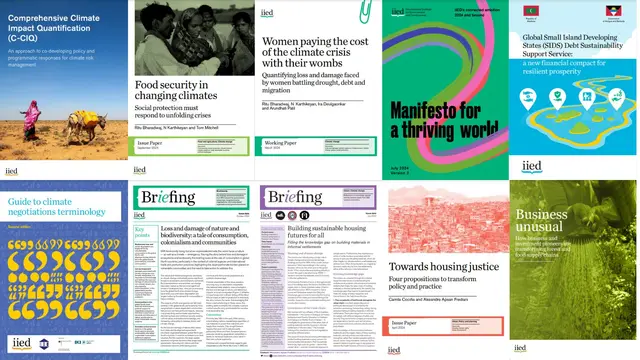
Covers of IIED's most downloaded publications of 2025 (Photo: IIED)
2025 has seen critical moments for climate and nature as the world has experienced intensifying climate disasters, geopolitical shifts and persistent barriers to participation. This year's publications highlight the need to mobilise finance, scale up adaptation and secure national climate plans.
Through it all, IIED’s research provides evidence and advocates for those communities most affected by the climate and nature crisis – from working with least developed countries (LDCs) and Small Island Developing States (SIDS) to push for and develop essential social protection policies, to demonstrating the urgent need for climate and nature finance to reach the community and local levels, to showing how informal settlements are leading the way on urban climate adaptation.
Here are our top 10 most downloaded publications of 2025.
1. Human-elephant conflict handbook: a guide to crop protection from elephant raiding
Across Africa, human-elephant conflicts are escalating as people and elephants vie for the same land. Humans are increasingly encroaching in wildlife habitats to meet subsistence needs, while elephants are moving ever closer to communities in search of water, damaging crops and endangering life.
This 30-page handbook was created by Honeyguide Foundation with input from communities living near conservation areas directly affected by wildlife conflicts. Over the past 10 years, these communities have worked to prevent human-elephant conflict, gaining valuable experience and data.
This handbook explains human-elephant conflict and helps people understand elephant behaviour. It gives practical advice, including safety guidelines for dealing with elephants, how to use the toolkit, and tools such as LED flashlights, air horns, noise balls, chili crackers, roman candles and longer-term prevention methods. It also provides information on how to set up community human-wildlife elephant conflict teams and the importance of collecting data on incidents.

More about this work: Human-elephant conflict is a major challenge for both conservation and livelihoods in Africa. IIED is supporting a South-South learning approach where Honeyguide provides training to community rangers from Namibia and develops interactive training materials.
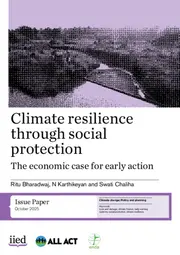
2. Climate resilience through social protection: the economic case for early action
Climate change is no longer a distant risk but a systemic development crisis. The impacts are particularly devastating for the LDCs and SIDS, where repeated shocks are eroding hard-won development gains and driving households deeper into poverty.
This 48-page issue paper demonstrates how taking early action through social protection programmes is more cost-effective than reactive, post-disaster responses and can be socially transformative.
It highlights two complementary pathways for building resilience – anticipatory direct benefit transfers and longer-term resilience-building investments – and presents the business case for these approaches, including benefit-cost ratios and return on investment, compared with existing social protection and humanitarian responses.
The findings are based on analysis from eight countries: Bangladesh, Ethiopia, Ghana, India, Malawi, Pakistan, Senegal and Uganda.
More about this work: Climate change is leading to increasingly devastating impacts on poor and vulnerable people. Compromised livelihoods, food security and stresses on long-term resilience can lead to vulnerable people undertaking distress migration, often as a last resort to sustain their families and survive.
IIED has developed tools and approaches for existing social protection programmes to help communities better absorb the effects of climate risks, adapt to climate impacts and transform their capacities to address growing climate stresses.
3. The realities of country platforms for LDCs and SIDS: ten key lessons
This briefing paper from the Climate and Development Ministerial explores the evolving use of 'country platforms' as nationally led, programmatic financing mechanisms designed to align climate and development finance with local priorities in LDCs and SIDS.
It presents 10 key lessons drawn from early mover experiences and provides actionable recommendations for governments, donors, multilateral development banks and other stakeholders to make country platforms more effective, inclusive and transformative.
Emphasising locally led adaptation and political ownership, the paper argues for a shift away from fragmented, donor-driven project models to coherent, long-term country-led strategies that prioritise adaptation, institutional capacity and systemic reform.
More about this work: Through the Climate and Development Ministerial, IIED, along with secretariat partner E3G, is working to advocate for the adaptation of the finance priorities of LDCs and SIDS. Led by 15 nations and institutions, it aims to build trust and catalyse bold, collective action for change by improving finance access and delivery.
4. Reframing transformational adaptation in the UNFCCC: lessons and pathways
This briefing examines the evolution of 'transformational adaptation' within the scientific community and United Nations Framework Convention on Climate Change (UNFCCC), highlighting its contentious reception among developing nations.
The concept of transformational adaptation has evolved from incremental and intermediary adaptation practices. By the 2010s, scholarly publications recognised that incremental changes would be insufficient to address deep-rooted vulnerabilities and high-end climate risks. Following the Intergovernmental Panel on Climate Change's explicit reference to transformational adaptation and its subsequent inclusion in the Global Goal on Adaptation, the concept became recognised within global climate policy frameworks.
While most countries do not reject transformational adaptation outright, they challenge, among other things, its definition, financing, implementation, equity and power imbalances. Without addressing these concerns, transformational adaptation risks becoming another form of adaptation conditionality rather than a tool for resilience-building.
We explore both critiques and opportunities of transformational adaptation, advocating for a reframed approach that fosters global cooperation while addressing developing countries’ concerns.
More about this work: IIED works to strengthen the position of LDCs in international climate negotiations and related global forums. We do this by providing real-time legal, technical and strategic advice and research support to the LDC Group in the UNFCCC process. We collaborate directly with the LDC chair and members of the LDC Group's core team of negotiators in delivering our work.
5. Limited GEF finance for nature reaching the local level
The Global Environment Facility (GEF) is a major multilateral funder delivering nature finance to developing countries to protect biodiversity.
The GEF is critical to ensuring that nature finance is delivered at scale and that it meets the needs of Indigenous Peoples and local communities, who are custodians of significant biodiversity across their lands and territories.
This briefing presents findings from recent research into the amount of GEF nature finance reaching Indigenous Peoples and local communities. It highlights that not enough GEF finance is reaching the local level where it is most needed and that it is not always being delivered in ways that support local priorities.
We offer recommendations to the GEF and other funders on ways to deliver better quality nature finance in line with local priorities, with the best possible outcomes for biodiversity.
More about this work: IIED and partners are working to effectively mobilise and deliver nature finance, support the needs and priorities of Indigenous Peoples and local communities, and boost community-led financial mechanisms through research and advocacy. Our nature finance strategy 2025-2030 lays out our vision for transforming the way that nature finance is delivered and redirected, in support of locally led action for people, nature and climate.
6. Shifting climate adaptation finance to local communities through effective intermediaries
Climate adaptation finance is failing to reach marginalised communities that are most vulnerable to climate impacts – including women, girls and Indigenous Peoples.
This briefing sets out how to direct climate finance – specifically financing for locally led adaptation (LLA) – effectively to local communities and organisations engaged in climate action. We focus on the role and purpose of intermediary funders to examine the important attributes they need to be effective.
Drawing on the lessons of the Global Alliance for Green and Gender Action, a pioneering alliance channelling climate finance to women-led community-based organisations, we see how intermediaries can transform locally-driven climate action and invest in long-term capacity building, by getting funds where they are needed most.
The briefing contributes to a further refinement of LLA methodologies and practices to better realise its promise of climate justice.
More about this work: IIED is working with diverse partners, including governments, donors, academia and other NGOs, to promote locally-led approaches that advance justice and resilience for people, climate and nature.
Over 130 governments and organisations have endorsed the eight LLA principles, yet less than 1% of climate finance incorporates locally-led approaches. A recent issue paper examines why LLA – which places decision-making power directly in communities’ hands – has gained widespread policy support but minimal implementation at scale.
7. Aligning debt relief for climate and nature with the Principles of Effective Development Cooperation
In recent years, mounting external public debt has placed significant constraints on low-income country government budgets, particularly for those countries on the frontlines of combating climate change and biodiversity loss.
Debt for climate and nature swaps (DfCNS) can provide sovereign debt relief to achieve climate and nature goals. However, debt swaps to date have had relatively limited impact, with parallel processes undermining development effectiveness.
These critiques bear a striking resemblance to perceptions of many aid projects. The Principles of Effective Development Cooperation, which were developed to improve aid quality and impact, could in fact be usefully applied to DfCNS.
A robust commitment to development effectiveness principles by focusing on broader, longer-term goals and impacts within national socioeconomic development could help deliver better climate, nature and development outcomes from debt swaps.
Based on an analysis of DfCNS against the development effectiveness principles, this 27-page issue paper outlines a number of action points for creditors and debtors, debtor countries, public sector actors and the G20 and other relevant international bodies to improve the effectiveness of such debt swaps.
More about this work: IIED has been working to produce analysis on how debt relief can be addressed through climate and nature programme swaps, to facilitate a coalition of creditors and debtors to take forward debt relief for climate and nature programme swaps, and to support the rollout in selected countries of debt for climate and nature programme swaps.
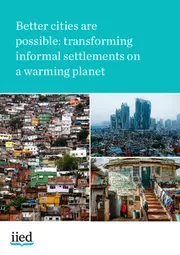
8. Better cities are possible: transforming informal settlements on a warming planet
There are currently 1.1 billion people living in informal settlements worldwide and this number is estimated to triple in the next 30 years, with most of this growth happening in countries where urbanisation is on the rise. Residents of informal settlements are often the first to suffer the consequences of global crises and the last to recover. Recognising informal settlements as a predominant form of urbanisation will help cities work with informality rather than fighting against it.
This 23-page report explores the critical shifts in governance, policy and action that are needed to address the growing challenges, exacerbated by climate change, that are faced by informal settlement residents. Through reflections on what ‘transformation’ means for settlements from the perspective of migration and displacement, housing justice, climate justice and resilience, it provides recommendations for governments, researchers, civil society and international donors.
More about this work: The second edition of IIED’s Better Cities series explores the critical shifts in governance, policy and action needed to address the growing challenges faced by 1.1 billion people living in informal settlements, exacerbated by climate change. It aims to strengthen and contribute to global commitments to accelerate real change for those who need it now.
Forced evictions of informal settlements not only violate human rights but also hinder climate mitigation and adaptation efforts. Along with partners we are developing a renewed action-research and advocacy agenda against forced evictions in the context of climate change, while supporting the efforts of local groups fighting evictions.
9. Currencies under pressure: how currency fluctuations and climate risks impact debt sustainability in SIDS and LDCs
SIDS and LDCs are facing growing debt burdens, as volatile exchange rates, amplified by climate shocks, inflate the cost of servicing external debt.
The reliance by SIDS and LDCs on US dollars for debt and trade is a critical vulnerability, with their fragile economies suffering massively from exchange rate volatility – fluctuations in currency value driven by global markets and local disruptions.
Meanwhile, climate disasters disproportionately impact SIDS and LDCs, with greater frequency and severity compared to developed countries, and this burden directly undermines their currency stability.
The resulting currency depreciation places a severe financial burden on SIDS and LDCs, with losses accumulating over decades and diverting critical resources away from development priorities and social protection, reinforcing cycles of vulnerability.
This 42-page working paper quantifies the economic impact and outlines practical solutions to mitigate debt distress and promote resilient, equitable growth. These solutions include debt restructuring, local currency financing and trade, and global financial reforms.
More about this work: Climate-related disasters are becoming more frequent and having devastating economic and development consequences for countries like SIDS that are vulnerable to climate impacts. IIED and partners are supporting these countries design a multifaceted response to address the interconnected challenges of climate change, debt and investment in resilience building.
10. Five-dimensional sustainability assessment: a tool for assessing if wild species use is sustainable, legal and safe
Billions of people across the world use wild species – for food, medicine, recreation and income, as well as a wealth of other purposes. It is estimated that between 3.5 and 5.8 billion people (between 40% and 70% of the world’s population) use thousands of wild plant, animal and fungus species and products in raw or processed forms.
It is central to the identity and culture of many Indigenous Peoples and local communities, and may also be central to the local and national economies of many countries. Unsustainable, over-exploitation of wild species is, however, one of the key drivers of biodiversity loss. It is therefore critical that use of wild species is sustainable.
Sustainability more broadly is commonly described with three dimensions: ecological, social and economic. For some, this three-dimensional view of sustainability is not enough. However, there is no straightforward way to determine if use, harvesting and trade is sustainable, safe and legal.
Nevertheless, those working in sustainability need an approach that cuts through the complexity, is accessible to conservation practitioners and policymakers, and aligns with the Kunming-Montreal Global Biodiversity Framework. To meet this need, a group of like-minded organisations collaborated to develop a novel five-dimensional framework for exploring wild species use. This 36-page toolkit provides details about the framework and how to apply it.
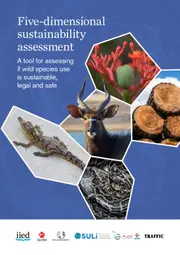
More about this work: Sustainable use of wild species is a key mechanism for supporting local peoples’ livelihoods while also conserving biodiversity. But how do we assess sustainability? This framework developed by IIED and partners explores multiple dimensions including human health and animal welfare.