Less than a third of climate finance even mentions local communities, study suggests
Consideration of Indigenous Peoples also vanishingly rare.

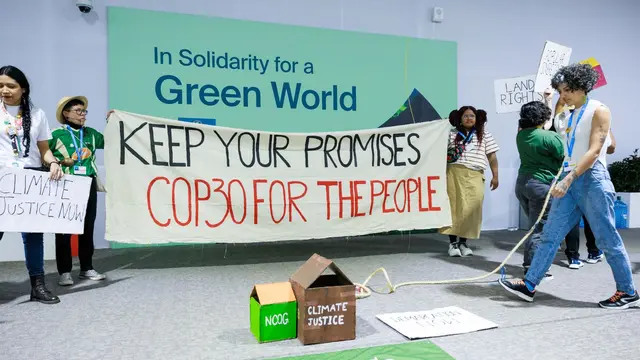
Less than a third of climate finance provided to developing countries explicitly mentions local communities, new research by IIED suggests. It comes as COP30 in Brazil prepares to hold a finance theme day on 14 November.
Experts combed the OECD’s climate finance database for projects funded by foreign aid over the eight years to 2023 – the most recent data available – using a series of keywords in English, French and Spanish.
Initially they hoped to calculate how much money was specifically earmarked for local people in places bearing the brunt of climate change. This proved impossible because climate finance is opaque and extremely difficult to monitor.
Traditional, top-down approaches to climate action may include consultation with local people, but projects often reflect the donors’ priorities. IIED advocates for communities to have real decision-making power so outcomes reflect their true needs and priorities.
In all, the project titles and descriptions linked to 140,000 individual transactions were captured. A keyword search was the only practicable way to sift this data, but it couldn’t provide insight into how a given tranche of funding was really spent.
The alternative would have been to identify every individual project, review its documentation, then develop and apply subjective criteria for determining how much of its spending could be called locally led, or locally implemented.
However, many of these documents aren’t public and donors either can’t or won’t make them available for analysis. Those that are accessible frequently lack the necessary detail.
Therefore the only available indicator of “localness” is whether the word “local” or similar terms appear in database entries. Inevitably, figures produced in this way risk significantly overestimating the extent to which climate action is genuinely including the people on the ground who know their areas best.
Even using proxy indicators that were bound to result in overcounting, and using the broadest possible search, researchers were appalled that the final figure was so low.
Overall “local”, “community” and related terms were mentioned in transactions representing only 29% of reported climate finance. A mere 24.6% of funding to cut greenhouse gas emissions appeared to consider local people, while for projects promoting adaptation to the effects of climate change the figure was 33.6%.
Only 0.7% of funding mentioned “Indigenous” or its French or Spanish equivalents. Indigenous Peoples manage a quarter of the world’s land area so this is astonishingly low.
To put this another way, the vast majority of climate finance doesn’t seem to take into account the needs of the people it should be helping.
Paul Mitchell, an IIED principal researcher, said: “We cast a very wide net to find as many locally-focused projects as possible, so these figures are shamefully low.
“In addition, a keyword search can only give so much insight into how funding is used. The actual proportion of climate finance getting into the hands of local communities will be much lower than 29%. Funders absolutely should not consider this a good performance.
“When it comes to where we live, everyone knows the frustration of having so-called ‘solutions’ imposed by central government or outside agencies that don’t understand our needs as residents, or the quirks of our local areas.
“Evidence suggests getting communities involved in development projects improves outcomes. Right now it seems aid donors aren’t getting the best value for their money, and that people bearing the brunt of climate change aren’t getting the help they need.
“Climate finance is notoriously opaque and difficult to navigate, and dubious claims about environmental benefits are not unheard of. Largely this is the fault of rich countries – the donors who created and maintain the tracking systems.
“Governments report the same information to both the UNFCCC and OECD but in completely different ways, confusing things even more.
“At COP29 rich countries pledged to provide US$300 billion annually in climate finance, but as things stand it will be impossible to monitor their contributions accurately.
“It’s easy to make commitments if you know you’re not going to be held to them, thanks to flaws in a system you designed. A full overhaul is needed to streamline climate finance tracking and make it properly transparent.”
Notes to editors
- The list of keywords used can be found in Appendix 1 of the publication 'Locally implemented or locally led? Tracking finance for community climate action'
- This analysis gives percentages rather than monetary values. Dollar figures would be misleading because methodological limitations mean that, if a transaction in the OECD’s database included one of the keywords, its full value would be counted whether or not all that money went to local people
- In this context, ‘funders’ are the UNFCCC Annex 1 countries. Funding commitments by multilateral development banks, climate funds, and UN agencies are also analysed here, but in the broadest sense, these bodies are ultimately funded by rich countries
For more information or to request an interview, contact Jon Sharman:
+44 7407 727 886, or [email protected]