Building collective power for equitable governance in conservation
‘Delivering on equity’ is one of five critical themes framing the upcoming World Conservation Congress. In Tanzania and Kenya, a new community of practice is showing what this means for governance: creating spaces where communities and practitioners work together to strengthen transparency, inclusion and accountability. Their call to high-level decision makers: put equitable governance at the heart of policies so conservation works for people and nature.


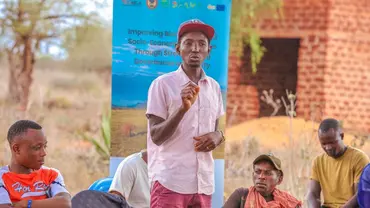
A community member in the Mbarang’andu wildlife management area, Tanzania, leads the discussion on human-elephant conflict during a baraza (community gathering) (Photo: Monica Dalmasso/Honeyguide)
“The law says we should be there,” one group of women reflected during a breakout session, “but [those in] the decision-making room still find ways to leave us out.”
That sentence, spoken quietly but with weight, captured a deeper truth. It echoed what many in the workshop already knew: that policies alone do not guarantee participation. That good intentions are not enough when voices are routinely excluded. That governance is, at its core, about who decides, who is heard, and who benefits.
This is the reality that 48 conservation practitioners, leaders and thinkers from across Tanzania and Kenya confronted at a recent community of practice (CoP) workshop in Dar es Salaam.
The workshop on equitable governance in community-led conservation areas was organised by Honeyguide as part of the Scaling up Equitable Governance in Area-based Conservation (SEGA) project.
SEGA is an IIED-led initiative that supports stakeholders and rightsholders in protected and conserved areas (PCAs) to assess governance quality, identify gaps and improve equity in biodiversity conservation.
What we mean when we talk about equitable governance
In conservation circles, ‘governance’ is a term often used, but interpreted in different ways. Some think of it as management. Others associate it with paperwork, policies or power structures.
But within SEGA, equitable governance means transparent, inclusive and accountable decision-making that upholds rights while fairly distributing the costs and benefits of conservation.
In Tanzania, even the most celebrated model of community-led conservation – Wildlife Management Areas (WMAs) – has faced serious governance challenges when it comes to transparency, inclusion and fairness.
In the past, many conservation strategies failed to meaningfully include communities or recognise their rights. As a result, local trust eroded, benefits were unevenly shared, and conservation outcomes suffered. The SEGA project addresses this head on.
Through the CoP and other activities, SEGA aims to shift the culture of governance in conservation from one shaped by exclusion and top-down directives to one built on mutual respect and co-creation.
Ground truths and hard conversations
Over two days, participants engaged in conversations that were practical, often uncomfortable, and deeply informed by lived experience. The challenges shared were not abstract but rooted in daily realities.
In one group, someone spoke about village game scouts who patrol vast landscapes with dedication, yet find themselves left out of meetings that decide how conservation revenue is used.
The room nodded when someone mentioned that communities rarely see how much money comes in from tourism or hunting concessions, let alone how or why it gets spent.
Planning, they said, happens elsewhere. Accountability, if it exists, is a one-way street: WMA leaders demand it from members, but members cannot demand the same in return.
These stories weren’t shared for sympathy, but for clarity. What emerged over the two days was a quiet but powerful understanding: these were not isolated issues but repeated patterns of exclusion, opacity and disempowerment. Naming them collectively was the first step toward addressing them.
Five governance challenges, many root causes
Through participatory discussions, the group identified five core governance challenges that cut across communities and landscapes:
- Benefit sharing remains a major concern: there is limited transparency about revenue generated from WMAs, and communities often do not know how funds are allocated or used. In many cases, financial information is either inaccessible or deliberately withheld by leaders
- Participation and accountability are consistently weak: although laws provide for community representation, women and youth often have little to no influence in practice. Village leaders often dominate processes, and the systems for holding them accountable are fragile or absent
- Overlapping or conflicting laws and policies create confusion and hinder effective governance: community members and even officials often do not know which law applies in a given situation
- Boundary disputes have become persistent, especially where demarcation was rushed or poorly managed. Some WMAs still lack formal land use plans, and this fuels both internal and external disputes, and
- Human-wildlife conflict remains a widespread issue: delayed responses to incidents, inadequate compensation and limited preparedness leave communities vulnerable and frustrated.
Participants understood these issues as interlinked. Problems feed into one another, creating a cycle of mistrust and disengagement.
Priorities from the ground up
Recommendations coming out of the workshop were practical and grounded in everyday governance struggles.
Participants called for systems that allow communities to access and understand revenue and expenditure reports. They also emphasised the need for stronger inclusion of women, youth and underrepresented groups, not just as a legal requirement, but as a strategic approach to long-term leadership.
There was broad agreement on the need for legal harmonisation. Participants urged policymakers and civil society to work together to align laws and policies across sectors, and to simplify and disseminate these in ways that communities can understand and apply.
Community-led land and resource planning was another priority. Participants highlighted how rushed or external planning undermines trust and leads to conflict. Giving communities a meaningful role in setting and enforcing boundaries would reduce disputes and strengthen local ownership.
Regarding human-wildlife conflict, the group recommended improving early warning systems, better integration of community knowledge into response mechanisms, and a review of compensation schemes to ensure they are timely and equitable.
What participants asked for, above all, was consistency. A process that continues, a network that endures, and relationships that do not end when the workshop finishes.
What happens next
This CoP started with a workshop, and the work will continue. The community has been designed as a long-term space for reflection, learning, and collective action.
The CoP will now move into a new phase: field testing some of the strategies, deepening relationships and building a shared learning agenda guided by a one-year roadmap, continued dialogues and working groups.
As conservation practitioners, leaders and decision-makers around the globe prepare to gather at the World Conservation Congress, this first meeting of this SEGA CoP proves that people on the ground have the knowledge, experience and motivation to lead.
They can act together to help reshape governance and laws, and address power imbalances in natural resource management. Only by putting equity at the heart of conservation can we safeguard biodiversity and ensure that communities thrive.
This blog was originally published on Honeyguide’s website.
This material has been funded by UK International Development from the UK government through the Darwin Initiative; however the views expressed do not necessarily reflect the UK government’s official policies.