From Seville to Belém: reimagining country platforms for adaptation finance
Country platforms hold real potential to channel climate finance to the local level and are fast becoming a centrepiece of the programmatic finance push in the lead-up to COP30. Guest authors Christopher Bartlett and Sam Mugume set out five fundamentals to make country platforms credible vehicles for adaptation and development finance.




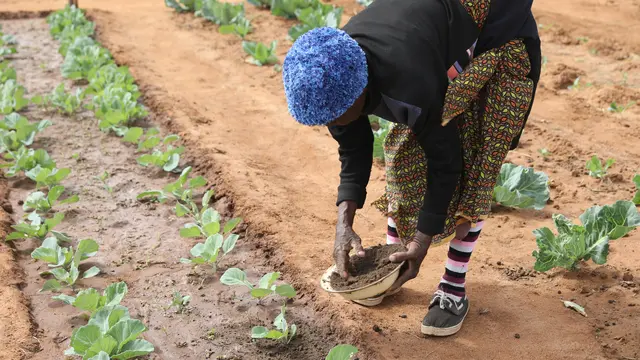
In Uganda, local farmer communities are forced to rapidly adapt to climate changes as 80% of them depend on agriculture for their livelihoods (Photo: UNDP Climate, via Flickr, CC BY-NC 2.0)
At the 4th International Conference on Financing for Development (FfD4), temperatures soared − both outdoors and in the room − as over 70 heads of state, finance ministers and climate leaders pressed for real-world solutions.
The result? The Sevilla Platform for Action emerged alongside the ‘Compromiso de Sevilla’ − a commitment to translate talk into tangible, country-led financing strategies.
Integral to these strategies are country platforms − country-led mechanisms designed to streamline sources of climate finance in line with climate and development priorities.
Country platforms are not a new idea − but the political momentum around them is new. The G20, the Vulnerable Twenty Group’s (V20) climate prosperity plans, and the COP30 Circle of Finance Ministers have all positioned country platforms as critical infrastructure to deliver nationally owned adaptation and development finance.
For years, least developed countries (LDCs) and Small Island Developing State (SIDS) have called for climate finance that aligns with their systems, priorities and plans. But delivery has remained fragmented and externally driven, with funding shaped by donor priorities, channelled through parallel systems and often bypassing national planning processes.
At the June 2025 Sevilla Technical Workshop convened by the Climate and Development Ministerial (C&DM), stakeholders from governments, multilateral development banks, climate funds, civil society and philanthropy put the long-standing ambition of LDCs and SIDS – for climate finance aligned with their systems, priorities, and plans – to the test against real-world delivery challenges.
Grounded in the C&DM’s country platforms realities paper and insights from Sevilla, we set out five practical priorities that define what it will take for country platforms to deliver on their potential.
Five priorities for a next-generation country platform
1. Centre country ownership − politically, institutionally and socially
At their core, country platforms must be country-led, not donor-scripted. Platforms in Ghana and Bangladesh demonstrate the value of political anchoring − they are led by ministries of finance or planning, and not outsourced to intermediaries.
But ownership must go beyond government. In Vanuatu, the national advisory board on climate change integrates ministries, civil society and the private sector into platform governance. Climate funds flow through treasury systems, and community committees shape national priorities – including for loss and damage.
Country platforms only succeed when they are embedded in political realities, shaped by national actors, and built through inclusive and participatory processes that reflect the full diversity of local institutions and voices.
2. Embed adaptation and locally led action from the start
The Seville workshop echoed what many have said: country platforms have leaned too heavily toward mitigation. In LDCs and SIDS, adaptation is not a co-benefit – it’s the starting point.
Nepal’s national adaptation plan, the Least Developed Countries (LDC) Initiative for Effective Adaptation and Resilience (LIFE-AR) programme in Uganda and Senegal, and Bangladesh’s LoGIC initiative all demonstrate that locally led adaptation can be integrated into country platforms through decentralised planning, fiscal transfers and participatory monitoring, evaluation and learning (MEL).
In Nepal, 80% of adaptation finance is channelled to the local level and integrated into planning processes. In Uganda, LIFE-AR enables climate finance to flow to parish-level communities via the Parish Development Model.
This model comprises seven pillars aimed at enhancing self-reliance and reducing poverty at the household level, particularly among the lowest-income households. It adopts a whole-of-government approach, led by the finance ministry, with other ministries responsible for engaging across the seven pillars.
The finance ministry manages the resources, with funds channelled directly to beneficiaries through community-owned initiatives at both district and community levels. The governance structure − although well-conceived − still has gaps, particularly in ensuring that funds are disbursed at scale, reach all intended communities in a timely way, and are accessible to the most marginalised groups.
3. Align finance around national systems and let go of control
One clear theme dominated discussions in Seville: countries are spending more time navigating donor requirements than delivering results. Multiple safeguards, duplicated reporting and parallel pipelines have turned adaptation funding into a bureaucratic maze.
The solution is straightforward: donors and multilateral development banks must align with country systems, not impose parallel ones. That means pooled funding, harmonised safeguards, and monitoring, evaluation and learning frameworks that are jointly designed and governed by countries and their development partners − rather than imposed by external actors.
For example, instead of forcing diverse reporting formats, LIFE-AR introduced both global and country-level MEL systems with quarterly financial and semi-annual narrative reporting. These systems were co-designed by LDCs and donors and designed to foster transparency, reduce burden and generate adaptive learning.
These systems build trust − by being co-designed, transparent and less burdensome − and trust is the basis of effective, long-term adaptation finance.
4. Build as you go − invest in capacity, not just capital
Country platforms require infrastructure − not just financial, but institutional. In Seville, countries highlighted that capacity constraints aren’t a reason to delay; instead, building capacity should be integral to the platform itself – learning and strengthening institutions as you go.
Addressing this means investing in coordination units, MEL systems, staffing, local government training and digital tools. It’s also essential to address gender and inclusivity challenges. The example of the Rwanda Green Fund shows that project preparation and pipeline development require sustained support – not one-off consultants, but long-term partnerships for upstream work.
5. Track progress, learn, and adapt
Workshop participants stressed the importance of learning-oriented MEL. Country platforms are not fixed blueprints. They must evolve, respond to feedback and adjust in real time. That means embedding monitoring, participatory tracking and MEL functions from the start.
Zambia’s Nature and People Investment Platform uses a programmatic entry point to track how investments contribute to national goals, with built-in tools for monitoring progress and gathering local feedback.
What COP30 must now deliver
Country platforms are gaining traction but still risk being reduced to the next climate buzzword. COP30 must act decisively to shift country platforms from concept to credibility.
This means:
- A global country platform commitment on adaptation finance: a joint statement or declaration – endorsed by LDCs, SIDS and development partners – affirming country platforms as vehicles for programmatic, inclusive and long-term adaptation finance.
- Pilot packages — with political and financial backing: support at least 5-10 countries to move from country platforms scoping to delivery. Packages should include co-designed grants, institutional capacity support and project preparation funding – not just technical advice.
- Alignment platform for donors and funds: create a standing mechanism to coordinate donor behaviour around country platforms: harmonised safeguards, pooled financing strategies and delegated fiduciary systems.
It’s make-or-break
Country platforms must be co-created. They must be flexible, nationally led, and embedded in the systems and realities of LDCs and SIDS.
COP30 is the moment when we decide whether we will support those pathways – or default, yet again, to business as usual.
We would like to thank IIED senior researcher Mohsen Gul for contributing to this insight.